

Ready & Packaged Foods
All →Vegetables & Legumes
All →Desserts & Confectionery
All →Meat & Protein
All →Grains & Bakery
All →Beverages
All →Milk & Dairy
All →

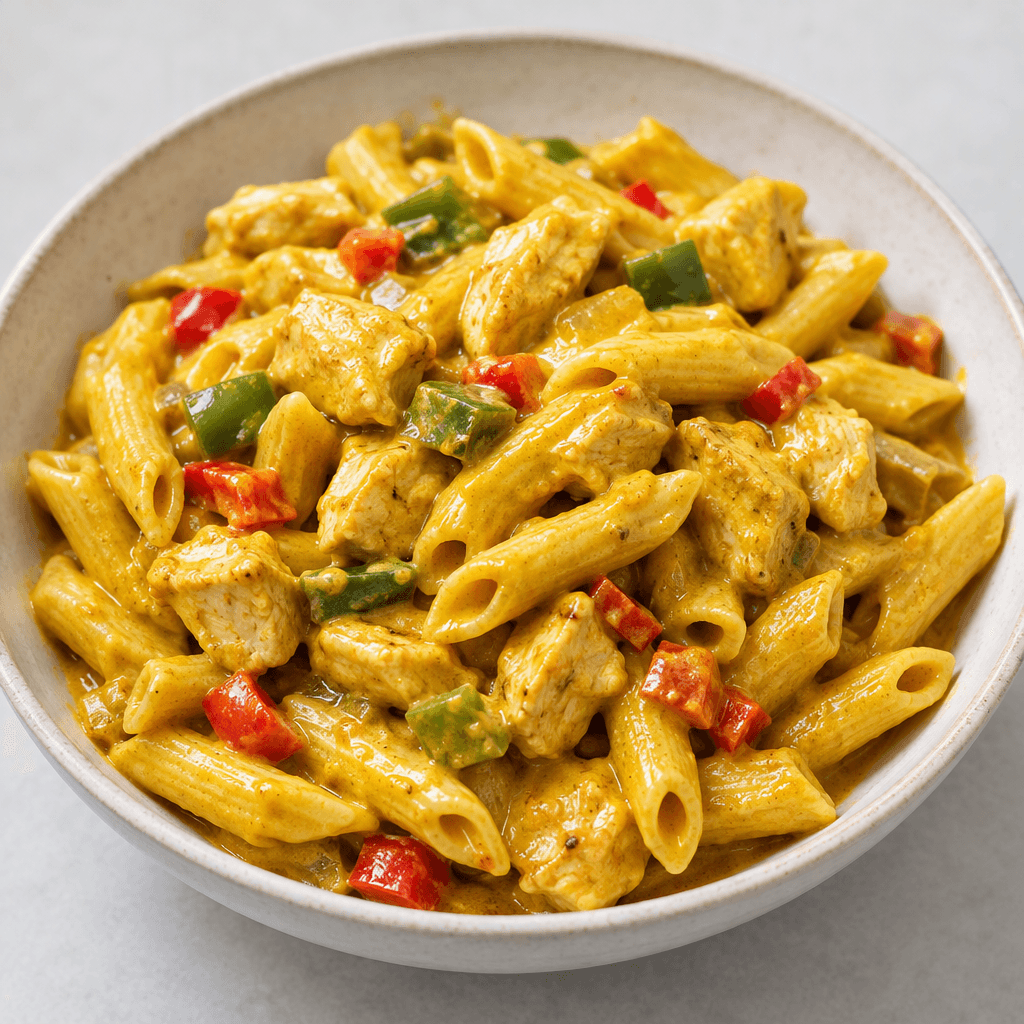
Chicken curry pasta Calories
Chicken curry pasta
In season: Spring · Summer · Autumn · Winter
CALORIES
GI
POTASSIUM
FIBER
Quick answer
1 serving (medium) of Chicken curry pasta (250 g) has 425 calories. That works out to 170 calories per 100 g. It contains 52.5 g of carbs, 25 g of protein, 13 g of fat and 4 g of fiber. Its 275 mg of Phosphorus covers 39% of the Daily Value. Its glycemic index is 55 (medium), so it raises blood sugar at a moderate pace.
Chicken curry pasta Nutrition Facts
Selected: 100 g
170
KCAL / 100G
Carbs
21g
· 8% DV
Protein
10g
· 20% DV
Fat
5.2g
· 7% DV
Fiber
1.6g
· 6% DV
DV is the share of the daily value covered, on a 2,000 kcal reference diet.
Calories come from: Carbs 49% · Protein 23% · Fat 28%
Chicken curry pasta Vitamins & Minerals
Vitamins
B3
2.1mg · 13% DV
B6
0.18mg · 11% DV
B5
0.45mg · 9% DV
B1
0.09mg · 8% DV
Minerals
Phosphorus
110mg · 16% DV
Selenium
7µg · 13% DV
Sodium
260mg · 11% DV
Zinc
1mg · 9% DV
How Nutritious Is Chicken curry pasta?
Nutrient density
Medium
How many vitamins, minerals and how much fiber this food carries per calorie. A high score means a lot of nutrition for few calories.
Satiety score
Medium
An EatBetter score computed from fiber, protein and calorie density. A high score means staying full longer on the same calories.
Both scores are calculated per 100 g and do not change with the selected portion. The satiety score is EatBetter's own calculation, not a clinical measure.
Chicken curry pasta Glycemic Index
GLYCEMIC INDEX
GLYCEMIC LOAD
Accounts for portion size — a more realistic measure than GI alone.
How to Burn Off Chicken curry pasta
To burn the 170 calories in 100 g:
🚶
Walking (5 km/h)
🏃
Running (8 km/h)
🚴
Cycling
🏊
Swimming
Times are calculated with the MET equation for a 70 kg adult. Actual burn varies with your weight, age and pace.
Is Chicken curry pasta Processed?
NOVA 3
Processed
1. Unprocessed
2. Minimally Processed
3. Processed
4. Ultra-Processed
NOVA classifies foods into 4 groups by industrial processing. NOVA 1 (unprocessed) is the healthiest.
Does Chicken curry pasta Contain Allergens?
Contains these allergens:
Which Diets Is Chicken curry pasta Good For?
Vegan
— Not suitable
Vegetarian
— Not suitable
Gluten-Free
— Not suitable
Dairy-Free
— Not suitable
Mediterranean
— Not suitable
Paleo
— Not suitable
Whole30
— Not suitable
DASH
— Not suitable
Keto
— Not suitable
Low FODMAP
— Not suitable
Chicken curry pasta Fat Profile
SATURATED
1.1g
MONOUNSATURATED
1.8g
POLYUNSATURATED
0.4g
Omega 6:3 ratio 8:1
Above the ideal 4:1 (8:1).
Compare Chicken curry pasta
Foods Similar to Chicken curry pasta
Frequently Asked Questions About Chicken curry pasta
Is chicken curry pasta better before or after a workout?
Its mix of carbs and protein can work either 2-3 hours before training as a meal or after training as part of recovery. If eaten too close to exercise, the sauce may feel heavy for some people.
How should chicken curry pasta be stored for the next day?
Refrigerate it promptly after cooking rather than leaving it at room temperature for long. Because it contains chicken and sauce, reheat it thoroughly all the way through before eating.
Can chicken curry pasta be frozen?
Yes, but the pasta may soften after thawing and the sauce texture can change slightly. Freeze in single portions if possible and avoid refreezing once thawed.
What goes well with chicken curry pasta?
A leafy salad or some yogurt pairs well and can make the meal feel more balanced. Adding vegetables on the side is also an easy way to increase fibre intake.
Why can chicken curry pasta feel heavy?
The combination of pasta, chicken and sauce can digest more slowly, especially in large portions. Eating it quickly, late at night, or in a richer recipe can make that feeling more noticeable.
Is chicken curry pasta okay to eat at night?
Yes, but a large portion close to bedtime may cause bloating or indigestion in some people. A moderate serving with a lighter side tends to be more comfortable.
Is chicken curry pasta considered a healthy meal?
It is not automatically unhealthy or healthy on its own. Since it is a processed food, portion size and overall ingredient quality matter, and adding vegetables can make it a better-balanced meal.
What is the difference between homemade and ready-made chicken curry pasta?
Homemade versions usually give you more control over salt, fat and sauce ingredients. Ready-made or more processed versions may be higher in sodium and designed for a more uniform texture and flavour.
Is chicken curry pasta suitable for children?
Usually yes, but the curry flavour may be too strong or spicy for some children. It also contains gluten, so it is not suitable for people with coeliac disease or a medical need to avoid gluten.
Can you eat chicken curry pasta every day?
It can be a practical option sometimes, but eating it daily may crowd out more varied whole foods. It is better used in rotation with meals based on vegetables, legumes, eggs, fish and other minimally processed foods.
Have another question about Chicken curry pasta?
Ask the AI nutrition coach — calories, portions, alternatives and more, answered in seconds in the app.

Scan calories with your camera
Instant AI nutrition analysis

Nutrition data compiled from USDA FoodData Central and scientific sources.