

Ready & Packaged Foods
All →Vegetables & Legumes
All →Desserts & Confectionery
All →Meat & Protein
All →Grains & Bakery
All →Beverages
All →Milk & Dairy
All →

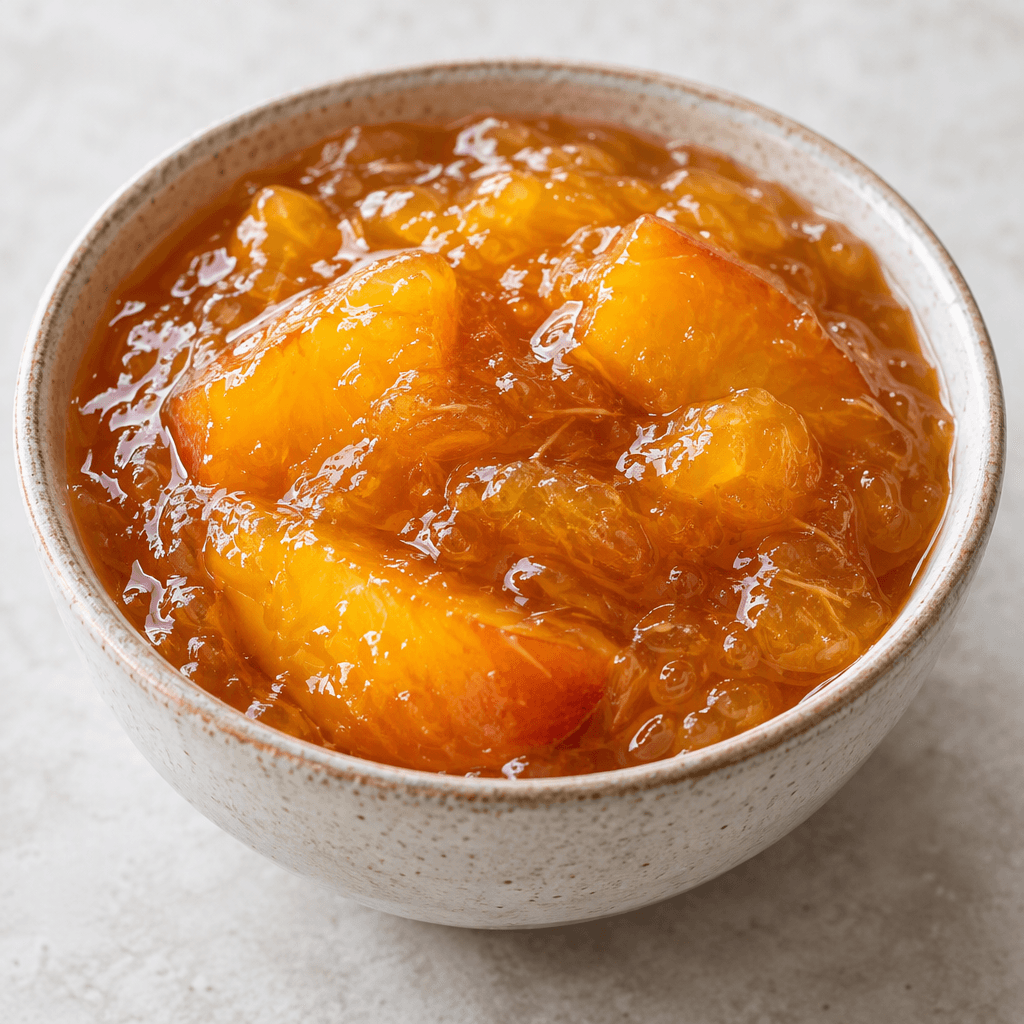
Unsweetened peach jam Calories
No added sugar, fruit-rich, contains fiber
In season: Summer · Autumn
CALORIES
GI
POTASSIUM
FIBER
Quick answer
1 tablespoon (medium) of Unsweetened peach jam (20 g) has 14 calories. That works out to 70 calories per 100 g. It contains 3.4 g of carbs, 0.1 g of protein, 0 g of fat and 0.3 g of fiber. Its glycemic index is 45 (medium), so it raises blood sugar at a moderate pace.
What is Unsweetened peach jam?
Unsweetened peach jam is made by cooking peaches without adding sugar, so its sweetness comes from the fruit. Depending on the recipe and how ripe the peaches are, it can be smooth or retain small pieces, with a soft, spreadable texture.
It is commonly spread on toast or bread at breakfast, and also goes well with porridge, yoghurt or pancakes. In places where jam is a familiar breakfast staple, it offers a fruit-forward alternative to sweeter spreads; the peaches contribute some fibre. It contains 70 calories per 100 g, so a modest spoonful is an easy way to add peach flavour without using a thick layer.
Unsweetened peach jam Nutrition Facts
Selected: 100 g
70
KCAL / 100G
Carbs
17g
· 6% DV
Protein
0.7g
· 1% DV
Fat
0.1g
· 0% DV
Fiber
1.5g
· 5% DV
DV is the share of the daily value covered, on a 2,000 kcal reference diet.
Calories come from: Carbs 95% · Protein 4% · Fat 1%
Unsweetened peach jam Vitamins & Minerals
Vitamins
Vitamin E
0.7mg · 5% DV
B3
0.7mg · 4% DV
Vitamin C
4mg · 4% DV
Vitamin A
30µg · 3% DV
Minerals
Potassium ⭐
110mg · 3% DV
Magnesium
7mg · 2% DV
Phosphorus
15mg · 2% DV
Calcium
8mg · 1% DV
How Nutritious Is Unsweetened peach jam?
Nutrient density
Medium
How many vitamins, minerals and how much fiber this food carries per calorie. A high score means a lot of nutrition for few calories.
Satiety score
Medium
An EatBetter score computed from fiber, protein and calorie density. A high score means staying full longer on the same calories.
Both scores are calculated per 100 g and do not change with the selected portion. The satiety score is EatBetter's own calculation, not a clinical measure.
Unsweetened peach jam Glycemic Index
GLYCEMIC INDEX
GLYCEMIC LOAD
Accounts for portion size — a more realistic measure than GI alone.
How to Burn Off Unsweetened peach jam
To burn the 70 calories in 100 g:
🚶
Walking (5 km/h)
🏃
Running (8 km/h)
🚴
Cycling
🏊
Swimming
Times are calculated with the MET equation for a 70 kg adult. Actual burn varies with your weight, age and pace.
Is Unsweetened peach jam Processed?
NOVA 3
Processed
1. Unprocessed
2. Minimally Processed
3. Processed
4. Ultra-Processed
NOVA classifies foods into 4 groups by industrial processing. NOVA 1 (unprocessed) is the healthiest.
Does Unsweetened peach jam Contain Allergens?
No known major allergens
Which Diets Is Unsweetened peach jam Good For?
Vegan
✓ Suitable
Vegetarian
✓ Suitable
Gluten-Free
✓ Suitable
Dairy-Free
— Not suitable
Mediterranean
✓ Suitable
Paleo
— Not suitable
Whole30
— Not suitable
DASH
— Not suitable
Keto
— Not suitable
Low FODMAP
— Not suitable
Unsweetened peach jam Fat Profile
SATURATED
0.01g
MONOUNSATURATED
0.02g
POLYUNSATURATED
0.04g
Omega 6:3 ratio 3:1
Below the ideal 4:1 — a good omega balance.
Compare Unsweetened peach jam
Foods Similar to Unsweetened peach jam
Frequently Asked Questions About Unsweetened peach jam
Is unsweetened peach jam actually sugar-free?
No. Unsweetened peach jam has no sugar added, but peaches contain naturally occurring sugars. “Unsweetened” describes how the jam is made, not a complete absence of sugar, so it may still affect blood glucose.
How do you make unsweetened peach jam without pectin?
Cook peeled or unpeeled chopped peaches with a little lemon juice until soft, then mash them and simmer until some moisture evaporates. Without added pectin or sugar, the result may be softer than conventional jam; chill it to help it set.
Does unsweetened peach jam need to be refrigerated?
Yes, refrigerate unsweetened peach jam after opening. With no added sugar to help preserve it, it is not a shelf-stable pantry preserve once opened; use a clean utensil each time and keep the jar tightly closed.
Can you safely can unsweetened peach jam?
Only use a tested canning recipe designed for unsweetened peach preserves. Removing sugar from a standard jam recipe can change its texture and storage properties, and simply filling jars while hot does not make the jam safe for pantry storage.
Why is unsweetened peach jam runny?
Unsweetened peach jam can be runny because it lacks the sugar that helps conventional jam set, and peaches may not provide enough natural pectin. Simmer it longer to evaporate water or use a suitable pectin product according to its instructions.
Can unsweetened peach jam replace sugar in baking?
Not as a direct one-for-one substitute. Unsweetened peach jam adds fruit, moisture, and natural sugars, while granulated sugar also affects browning and structure. It works better as a filling or topping than as a complete replacement in most baking recipes.
Can people with diabetes eat unsweetened peach jam?
Some people with diabetes can include a measured serving, but the peaches still contribute natural sugars and carbohydrates. Count it as part of the meal rather than treating it as sugar-free; ask your clinician or dietitian for advice tailored to your glucose plan.
What foods pair well with unsweetened peach jam besides toast?
Unsweetened peach jam pairs well with plain yogurt, oatmeal, pancakes, and soft cheeses. For a savory contrast, try a small spoonful with roasted pork or a cheese board; its fruitiness works especially well with salty or tangy flavors.
Can you freeze unsweetened peach jam?
Yes. Freeze unsweetened peach jam in a freezer-safe container, leaving room for expansion, and thaw it in the refrigerator. Its texture may be looser after thawing, so stir it before serving and keep thawed jam refrigerated.
How can you tell if unsweetened peach jam has spoiled?
Discard unsweetened peach jam if you see mold, notice bubbling or fermentation, or detect an unusual sour or alcoholic smell. Do not scrape off mold and eat the rest; with soft, moist foods, contamination can extend beyond what is visible.
Have another question about Unsweetened peach jam?
Ask the AI nutrition coach — calories, portions, alternatives and more, answered in seconds in the app.

Scan calories with your camera
Instant AI nutrition analysis

Nutrition data compiled from USDA FoodData Central and scientific sources.