

Ready & Packaged Foods
All →Vegetables & Legumes
All →Desserts & Confectionery
All →Meat & Protein
All →Grains & Bakery
All →Beverages
All →Milk & Dairy
All →

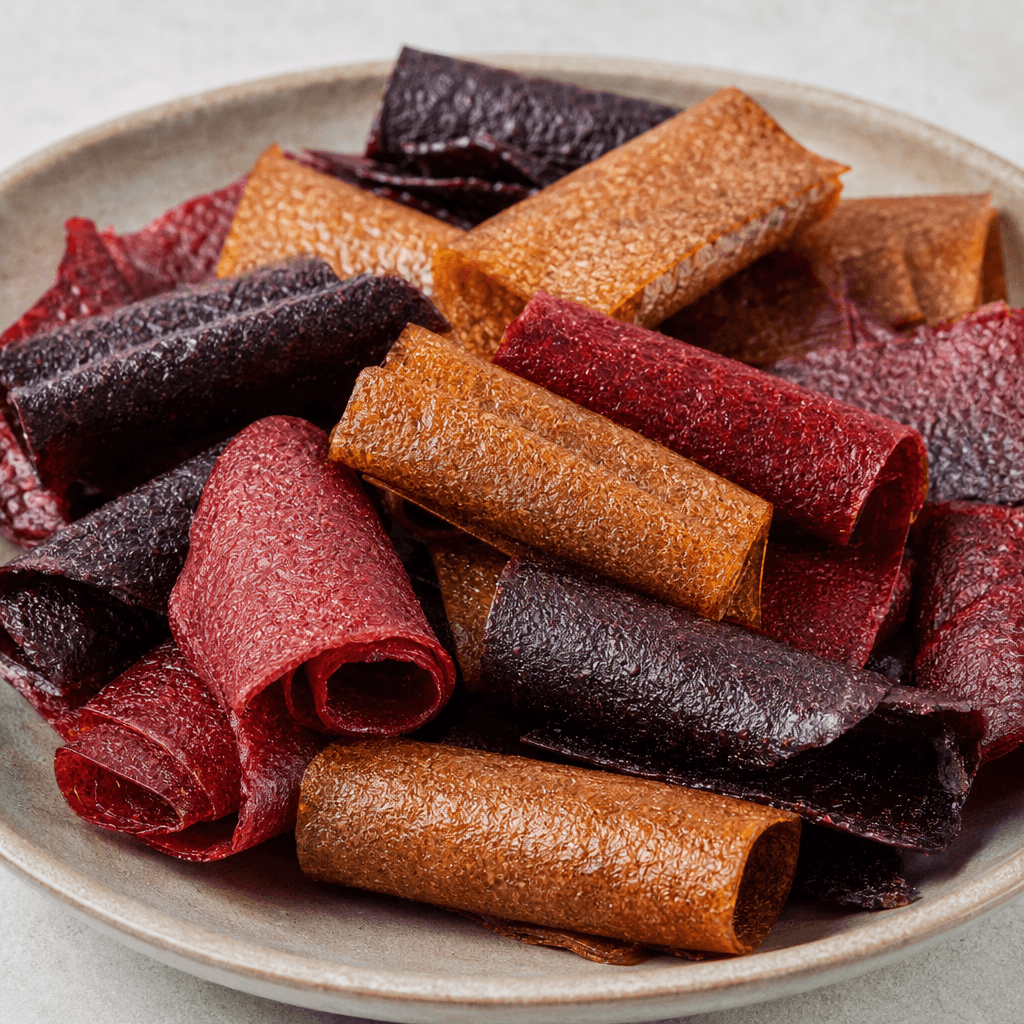
Fruit Leather Calories
Traditional fruit snack, natural source of sugars
In season: Autumn · Winter
CALORIES
GI
POTASSIUM
FIBER
Quick answer
1 piece (medium) of Fruit Leather (25 g) has 80 calories. That works out to 320 calories per 100 g. It contains 19.5 g of carbs, 0.6 g of protein, 0.2 g of fat and 1.6 g of fiber. Its glycemic index is 45 (medium), so it raises blood sugar at a moderate pace.
What is Fruit Leather?
Pestil is the Turkish style of fruit leather: fruit purée, often made from grapes, mulberries or apricots, is spread thinly and dried into flexible sheets. It is a traditional way of preserving fruit, with recipes and texture varying by region and household.
Chewy and concentrated in sweet-tart fruit flavour, fruit leather is eaten as a snack in Turkey, often alongside tea or rolled around walnuts or hazelnuts. It is mostly carbohydrate, with naturally occurring fruit sugars, so a modest piece can be satisfying; pairing it with nuts adds crunch and makes a more substantial snack. You can eat it plain, or cut it into strips for sharing.
Fruit Leather Nutrition Facts
Selected: 100 g
320
KCAL / 100G
Carbs
78g
· 28% DV
Protein
2.2g
· 4% DV
Fat
0.6g
· 1% DV
Fiber
6.5g
· 23% DV
DV is the share of the daily value covered, on a 2,000 kcal reference diet.
Calories come from: Carbs 96% · Protein 3% · Fat 1%
Fruit Leather Vitamins & Minerals
Vitamins
Vitamin C
6mg · 7% DV
B6
0.08mg · 5% DV
B2
0.05mg · 4% DV
B3
0.7mg · 4% DV
Minerals
Potassium ⭐
480mg · 14% DV
Iron
1mg · 6% DV
Magnesium
22mg · 5% DV
Phosphorus
35mg · 5% DV
How Nutritious Is Fruit Leather?
Nutrient density
Medium
How many vitamins, minerals and how much fiber this food carries per calorie. A high score means a lot of nutrition for few calories.
Satiety score
Medium
An EatBetter score computed from fiber, protein and calorie density. A high score means staying full longer on the same calories.
Both scores are calculated per 100 g and do not change with the selected portion. The satiety score is EatBetter's own calculation, not a clinical measure.
Fruit Leather Glycemic Index
GLYCEMIC INDEX
GLYCEMIC LOAD
Accounts for portion size — a more realistic measure than GI alone.
How to Burn Off Fruit Leather
To burn the 320 calories in 100 g:
🚶
Walking (5 km/h)
🏃
Running (8 km/h)
🚴
Cycling
🏊
Swimming
Times are calculated with the MET equation for a 70 kg adult. Actual burn varies with your weight, age and pace.
Is Fruit Leather Processed?
NOVA 2
Minimally Processed
1. Unprocessed
2. Minimally Processed
3. Processed
4. Ultra-Processed
NOVA classifies foods into 4 groups by industrial processing. NOVA 1 (unprocessed) is the healthiest.
Does Fruit Leather Contain Allergens?
No known major allergens
Which Diets Is Fruit Leather Good For?
Vegan
✓ Suitable
Vegetarian
✓ Suitable
Gluten-Free
✓ Suitable
Dairy-Free
— Not suitable
Mediterranean
✓ Suitable
Paleo
— Not suitable
Whole30
— Not suitable
DASH
— Not suitable
Keto
— Not suitable
Low FODMAP
— Not suitable
Fruit Leather Fat Profile
SATURATED
0.1g
MONOUNSATURATED
0.2g
POLYUNSATURATED
0.2g
Omega 6:3 ratio 4:1
Below the ideal 4:1 — a good omega balance.
Compare Fruit Leather
Foods Similar to Fruit Leather
Frequently Asked Questions About Fruit Leather
What is fruit leather made of?
Fruit leather is made by spreading fruit purée into a thin layer and drying it until it becomes flexible. Homemade versions may contain only fruit, while some packaged products also include added sugar, concentrates, or other ingredients.
Is fruit leather the same as dried fruit?
No. Fruit leather is puréed fruit dried as a continuous sheet, while dried fruit is usually left in pieces or slices. Puréeing changes the texture and makes fruit leather easy to roll or cut into strips.
How do you make fruit leather at home?
Blend or cook fruit into a smooth purée, spread it thinly on a lined tray, then dry it on low heat until the surface is no longer wet and the sheet peels away. Let it cool before cutting and rolling.
Why is homemade fruit leather sticky?
Homemade fruit leather is usually sticky because it has not dried long enough or the fruit purée was spread too thickly. Dry it longer at low heat; it should feel pliable but not wet before you remove it.
How do you stop fruit leather from sticking together?
Place parchment or wax paper between fruit leather pieces before stacking or rolling them. Keep the separated pieces in an airtight container in a cool, dry place; warm or humid storage can make them tacky again.
How long does homemade fruit leather last?
Homemade fruit leather can keep for weeks when fully dried and stored airtight in a cool, dry place. If it feels damp or develops mold, an unusual smell, or a marked change in appearance, discard it.
Can you freeze fruit leather?
Yes, fruit leather can be frozen. Wrap it tightly or separate pieces with parchment, then place them in a freezer-safe container; thaw the wrapped portion before opening to reduce condensation on the fruit leather.
Does fruit leather have added sugar?
Some fruit leather has added sugar, but recipes and brands differ. Homemade fruit leather can be made from fruit alone; for packaged versions, check the ingredient list for sugar, syrups, or fruit juice concentrates.
Is fruit leather a healthy snack?
Fruit leather can be a convenient fruit-based snack, but drying concentrates its sugars and it is easy to eat several pieces quickly. Choose a portion that satisfies you and pair it with a more filling food if needed.
Can babies eat fruit leather?
Fruit leather is not a good choice for babies who are still learning to chew: its chewy, sticky texture can be difficult to manage. Offer age-appropriate soft fruit instead, and follow your child’s usual guidance for introducing foods.
Have another question about Fruit Leather?
Ask the AI nutrition coach — calories, portions, alternatives and more, answered in seconds in the app.

Scan calories with your camera
Instant AI nutrition analysis

Nutrition data compiled from USDA FoodData Central and scientific sources.