

Ready & Packaged Foods
All →Vegetables & Legumes
All →Desserts & Confectionery
All →Meat & Protein
All →Grains & Bakery
All →Beverages
All →Milk & Dairy
All →

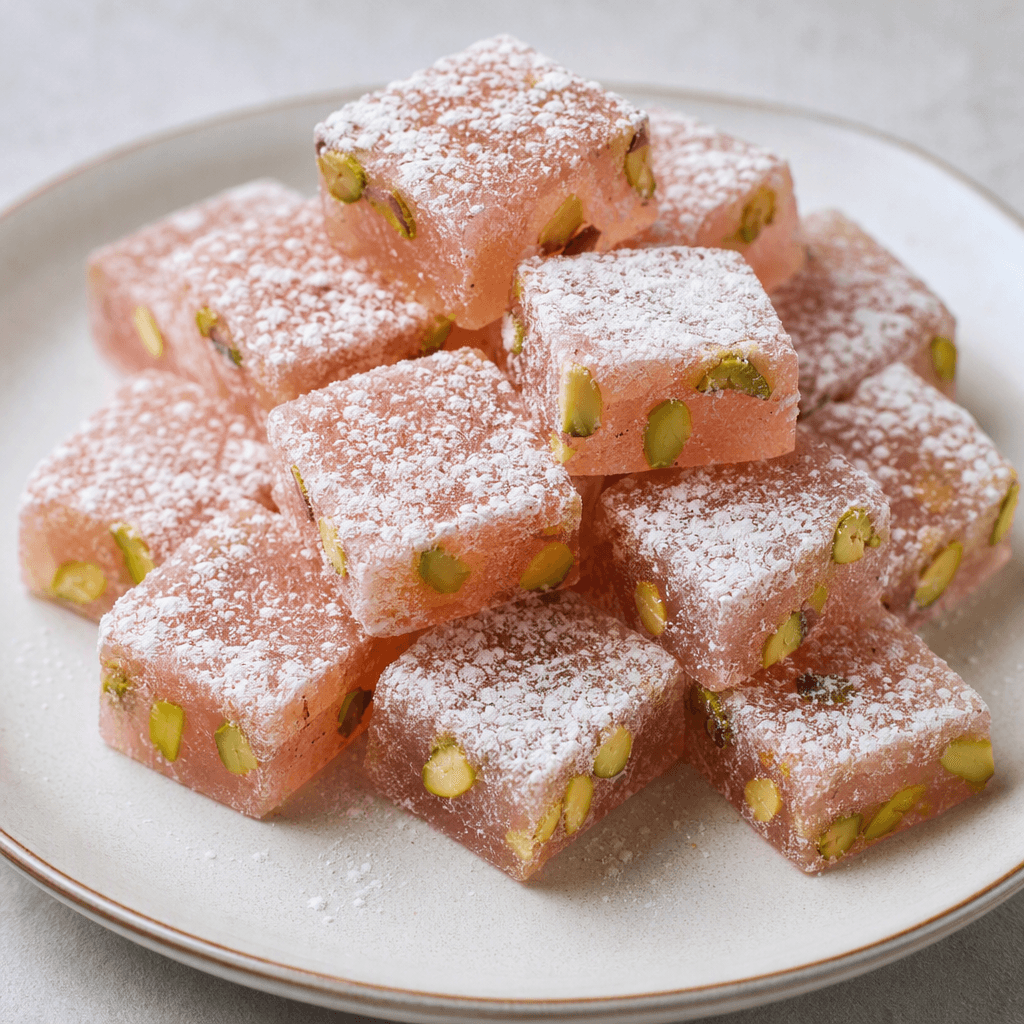
Pistachio Turkish Delight Calories
Classic Turkish sweet, enriched with pistachios
In season: Spring · Summer · Autumn · Winter
CALORIES
GI
POTASSIUM
FIBER
Quick answer
3 piece (medium) of Pistachio Turkish Delight (45 g) has 167 calories. That works out to 370 calories per 100 g. It contains 36 g of carbs, 1.9 g of protein, 2.9 g of fat and 0.9 g of fiber. Its 0.1 mg of Copper covers 7% of the Daily Value. Its glycemic index is 80 (high), so it raises blood sugar quickly.
What is Pistachio Turkish Delight?
Pistachio Turkish Delight is a soft confection made by cooking sugar and starch into a gently chewy gel, then mixing in pieces of pistachio. Lokum has a long history in Turkey, where it is often sold in neat cubes, sometimes dusted with icing sugar or flavoured with rose.
In Turkey, it is a familiar offering with coffee or tea and is especially associated with hospitality and holiday visits. Elsewhere, it is often enjoyed as a small sweet after a meal or shared alongside coffee. It is mainly a sugary, carbohydrate-rich treat; pistachios add a little protein, fat and crunch. Its sweetness is concentrated, so serve a few pieces with unsweetened tea or coffee for a more balanced pairing.
Pistachio Turkish Delight Nutrition Facts
Selected: 100 g
370
KCAL / 100G
Carbs
80g
· 29% DV
Protein
4.2g
· 8% DV
Fat
6.5g
· 8% DV
Fiber
2.1g
· 8% DV
DV is the share of the daily value covered, on a 2,000 kcal reference diet.
Calories come from: Carbs 81% · Protein 4% · Fat 15%
Pistachio Turkish Delight Vitamins & Minerals
Vitamins
B6
0.08mg · 5% DV
Vitamin E
0.7mg · 5% DV
Biotin
1.2µg · 4% DV
B1
0.04mg · 3% DV
Minerals
Zinc
1mg · 9% DV
Iron
1mg · 6% DV
Phosphorus
45mg · 6% DV
Magnesium
18mg · 4% DV
How Nutritious Is Pistachio Turkish Delight?
Nutrient density
Low
How many vitamins, minerals and how much fiber this food carries per calorie. A high score means a lot of nutrition for few calories.
Satiety score
Low
An EatBetter score computed from fiber, protein and calorie density. A high score means staying full longer on the same calories.
Both scores are calculated per 100 g and do not change with the selected portion. The satiety score is EatBetter's own calculation, not a clinical measure.
Pistachio Turkish Delight Glycemic Index
GLYCEMIC INDEX
GLYCEMIC LOAD
Accounts for portion size — a more realistic measure than GI alone.
How to Burn Off Pistachio Turkish Delight
To burn the 370 calories in 100 g:
🚶
Walking (5 km/h)
🏃
Running (8 km/h)
🚴
Cycling
🏊
Swimming
Times are calculated with the MET equation for a 70 kg adult. Actual burn varies with your weight, age and pace.
Is Pistachio Turkish Delight Processed?
NOVA 3
Processed
1. Unprocessed
2. Minimally Processed
3. Processed
4. Ultra-Processed
NOVA classifies foods into 4 groups by industrial processing. NOVA 1 (unprocessed) is the healthiest.
Does Pistachio Turkish Delight Contain Allergens?
Contains these allergens:
Which Diets Is Pistachio Turkish Delight Good For?
Vegan
— Not suitable
Vegetarian
✓ Suitable
Gluten-Free
— Not suitable
Dairy-Free
— Not suitable
Mediterranean
✓ Suitable
Paleo
— Not suitable
Whole30
— Not suitable
DASH
— Not suitable
Keto
— Not suitable
Low FODMAP
— Not suitable
Pistachio Turkish Delight Fat Profile
SATURATED
0.8g
MONOUNSATURATED
3.2g
POLYUNSATURATED
2.1g
Omega 6:3 ratio 63.3:1
Above the ideal 4:1 (63.3:1).
Compare Pistachio Turkish Delight
Foods Similar to Pistachio Turkish Delight
Frequently Asked Questions About Pistachio Turkish Delight
What is Pistachio Turkish Delight made of?
Pistachio Turkish Delight is typically made from sugar, water, and starch, with pistachios folded into the chewy mixture. Recipes may also use lemon juice or flavorings, and the finished pieces are often coated with powdered sugar or starch to keep them from sticking.
How is Pistachio Turkish Delight traditionally made?
Pistachio Turkish Delight is made by cooking a sweetened starch mixture until it becomes thick and elastic, then adding pistachios. The mixture is left to set, cut into cubes, and usually dusted with powdered sugar or starch before serving.
Is Pistachio Turkish Delight the same as lokum?
Yes. Pistachio Turkish Delight is a pistachio-filled variety of lokum, the chewy confection also known in English as Turkish delight. The pistachios distinguish this version from plain lokum, while the soft, starch-set texture is characteristic of both.
Does Pistachio Turkish Delight contain gelatin?
Traditional Pistachio Turkish Delight is usually thickened with starch rather than gelatin. Commercial recipes can differ, so check the ingredient list if you need to avoid gelatin; homemade versions also depend on the thickener used in the recipe.
Why is Pistachio Turkish Delight so chewy?
Pistachio Turkish Delight gets its chewy, springy texture from the cooked sugar-and-starch mixture. Cooking it until the starch thickens, then letting it set, creates the soft gel; the pistachios add crunch but do not create the chewiness.
How should you serve Pistachio Turkish Delight?
Serve Pistachio Turkish Delight in small cubes, often alongside Turkish coffee or tea. Its sweetness makes it a natural after-dinner treat, and a light dusting of powdered sugar can be shaken off before arranging the pieces on a plate.
Can Pistachio Turkish Delight be frozen?
Freezing Pistachio Turkish Delight is generally not recommended because thawing can change its soft texture and make the pieces damp or sticky. Keep it in a tightly closed container in a cool, dry place instead.
Does Pistachio Turkish Delight go bad?
Yes, Pistachio Turkish Delight can spoil or lose quality, especially if exposed to moisture or left open. Follow the date on the package, and discard it if you notice mold, an unusual smell, or a marked change in texture.
Why is Pistachio Turkish Delight coated in powdered sugar?
Pistachio Turkish Delight is often dusted with powdered sugar or starch to stop the cubes from sticking together. The coating also helps keep the surface dry, though some varieties use only starch or a different finish.
Can people with diabetes eat Pistachio Turkish Delight?
Pistachio Turkish Delight is a sugary sweet and can raise blood glucose, so people with diabetes should be mindful of portion size. The right amount depends on an individual’s meal plan and medication, so a clinician or dietitian can offer tailored guidance.
Have another question about Pistachio Turkish Delight?
Ask the AI nutrition coach — calories, portions, alternatives and more, answered in seconds in the app.

Scan calories with your camera
Instant AI nutrition analysis

Nutrition data compiled from USDA FoodData Central and scientific sources.