

Ready & Packaged Foods
All →Vegetables & Legumes
All →Desserts & Confectionery
All →Meat & Protein
All →Grains & Bakery
All →Beverages
All →Milk & Dairy
All →

Trabzon bread Calories
Traditional Turkish bread
In season: Spring · Summer · Autumn · Winter
CALORIES
GI
POTASSIUM
FIBER
Quick answer
1 slice (thick) of Trabzon bread (40 g) has 106 calories. That works out to 266 calories per 100 g. It contains 22 g of carbs, 3.4 g of protein, 0.7 g of fat and 1.1 g of fiber. Its 11.2 µg of Selenium covers 20% of the Daily Value. Its glycemic index is 74 (high), so it raises blood sugar quickly.
What is Trabzon bread?
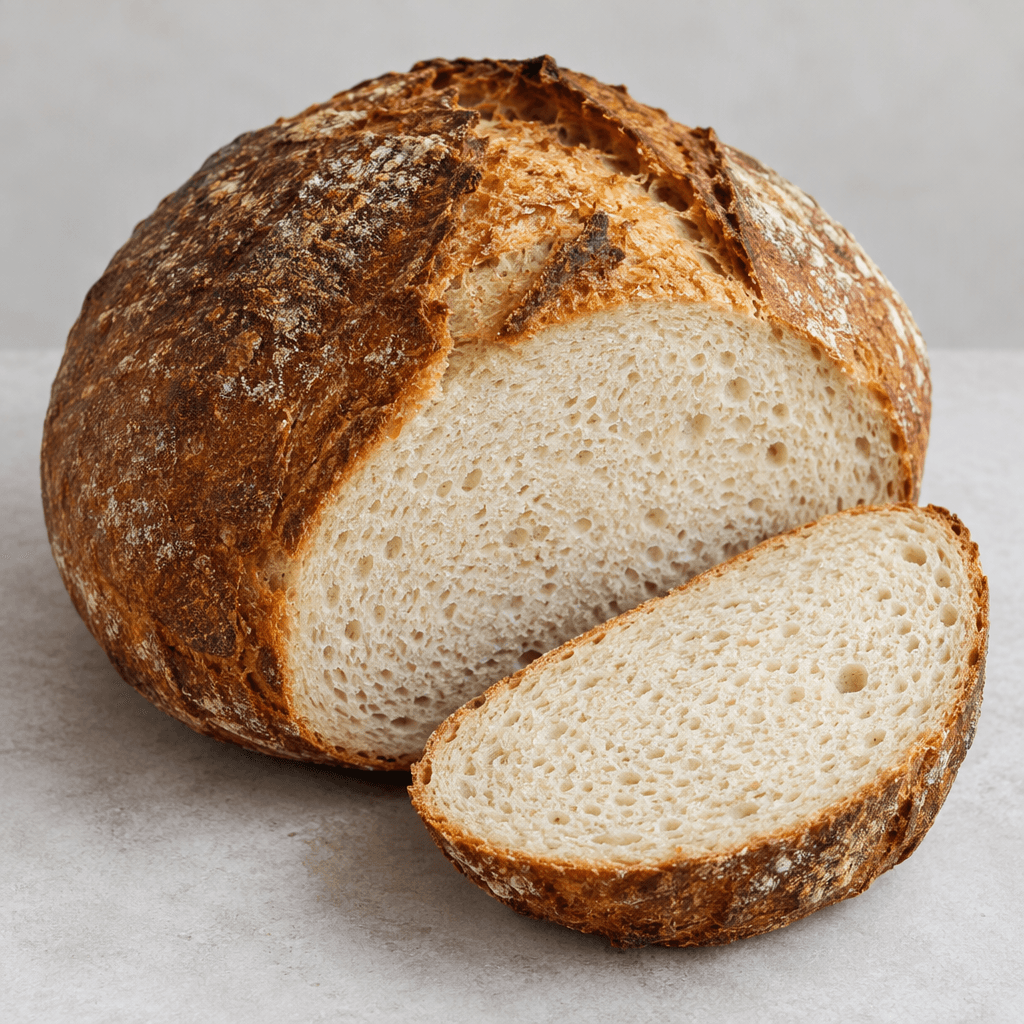
Trabzon bread is a large, round wheat loaf associated with the Black Sea city of Trabzon in northeastern Turkey. Made from wheat flour, water, yeast and salt, it is known for a thick, deeply browned crust and a pale, close-textured crumb. It is usually sold whole and sliced at the table.
In Turkey, it appears at breakfast with cheese, olives and tea, and alongside soups and home-cooked meals. Elsewhere, it works well as toast or for a substantial sandwich. Like most breads, it is chiefly a source of carbohydrate, with some protein and little fat. For a lighter plate, serve a smaller slice with vegetables and a protein-rich topping.
Trabzon bread Nutrition Facts
Selected: 100 g
266
KCAL / 100G
Carbs
55g
· 20% DV
Protein
8.5g
· 17% DV
Fat
1.8g
· 2% DV
Fiber
2.7g
· 10% DV
DV is the share of the daily value covered, on a 2,000 kcal reference diet.
Calories come from: Carbs 81% · Protein 13% · Fat 6%
Trabzon bread Vitamins & Minerals
Vitamins
B1
0.32mg · 27% DV
B3
3.4mg · 21% DV
Folate
85µg · 21% DV
B2
0.18mg · 14% DV
Minerals
Selenium
28µg · 51% DV
Manganese
1mg · 43% DV
Iron
4mg · 22% DV
Sodium
490mg · 21% DV
How Nutritious Is Trabzon bread?
Nutrient density
Low
How many vitamins, minerals and how much fiber this food carries per calorie. A high score means a lot of nutrition for few calories.
Satiety score
Medium
An EatBetter score computed from fiber, protein and calorie density. A high score means staying full longer on the same calories.
Both scores are calculated per 100 g and do not change with the selected portion. The satiety score is EatBetter's own calculation, not a clinical measure.
Trabzon bread Glycemic Index
GLYCEMIC INDEX
GLYCEMIC LOAD
Accounts for portion size — a more realistic measure than GI alone.
How to Burn Off Trabzon bread
To burn the 266 calories in 100 g:
🚶
Walking (5 km/h)
🏃
Running (8 km/h)
🚴
Cycling
🏊
Swimming
Times are calculated with the MET equation for a 70 kg adult. Actual burn varies with your weight, age and pace.
Is Trabzon bread Processed?
NOVA 3
Processed
1. Unprocessed
2. Minimally Processed
3. Processed
4. Ultra-Processed
NOVA classifies foods into 4 groups by industrial processing. NOVA 1 (unprocessed) is the healthiest.
Does Trabzon bread Contain Allergens?
Contains these allergens:
Which Diets Is Trabzon bread Good For?
Vegan
✓ Suitable
Vegetarian
✓ Suitable
Gluten-Free
— Not suitable
Dairy-Free
— Not suitable
Mediterranean
✓ Suitable
Paleo
— Not suitable
Whole30
— Not suitable
DASH
— Not suitable
Keto
— Not suitable
Low FODMAP
— Not suitable
Trabzon bread Fat Profile
SATURATED
0.32g
MONOUNSATURATED
0.22g
POLYUNSATURATED
0.65g
Omega 6:3 ratio 20.7:1
Above the ideal 4:1 (20.7:1).
Compare Trabzon bread
Foods Similar to Trabzon bread
Frequently Asked Questions About Trabzon bread
What is Trabzon bread?
Trabzon bread is a traditional Turkish loaf, typically large and round, with a thick, dark crust and a pale, close-textured crumb. It is associated with the Black Sea region and is often sold as a whole loaf rather than in small rolls.
Why is Trabzon bread so large?
Trabzon bread is traditionally baked as a large loaf, a style linked to regional baking practices and long-lasting household bread. Its size also means a whole loaf can be cut into thick slices for meals rather than served as individual portions.
Is Trabzon bread the same as Vakfıkebir bread?
The names are often used for closely related bread from Trabzon province, since Vakfıkebir is especially associated with this style. Usage is not completely uniform, though, and recipes or loaf characteristics can vary between bakeries.
Does Trabzon bread use sourdough?
Traditional versions of Trabzon bread are often made with sourdough and a long fermentation. Recipes vary, and some bakeries use commercial yeast instead, so the name alone does not guarantee a sourdough loaf.
Why does Trabzon bread have such a thick crust?
Trabzon bread’s thick crust develops as the large loaf bakes for a relatively long time. The outside loses more moisture and browns more deeply than the interior, giving the bread its characteristic contrast between crust and crumb.
How should you store Trabzon bread?
Store Trabzon bread at room temperature in a bread box or a clean cloth bag, with the cut side covered. Avoid refrigerating it, as refrigeration can make bread go stale and firm more quickly.
Can you freeze Trabzon bread?
Yes, Trabzon bread freezes well. Slice it first, seal the slices in a freezer-safe bag, and take out only what you need; individual slices can be thawed or toasted without defrosting the whole loaf.
How do you refresh stale Trabzon bread?
Lightly dampen the crust of stale Trabzon bread and warm it in the oven for a short time. This can soften the loaf temporarily, so serve it soon after reheating rather than letting it cool and dry again.
What do you eat with Trabzon bread?
Trabzon bread goes well with Turkish soups, bean dishes, and breakfast foods such as cheese and eggs. Its sturdy slices are also useful for dipping into sauces or the broth of a meal.
Can people with diabetes eat Trabzon bread?
Yes, people with diabetes can eat Trabzon bread, but its carbohydrates can raise blood glucose, so the portion matters. Pairing a slice with protein and vegetables can make a more balanced meal; ask your diabetes care team about a portion that suits you.
Have another question about Trabzon bread?
Ask the AI nutrition coach — calories, portions, alternatives and more, answered in seconds in the app.

Scan calories with your camera
Instant AI nutrition analysis

Nutrition data compiled from USDA FoodData Central and scientific sources.