

Ready & Packaged Foods
All →Vegetables & Legumes
All →Desserts & Confectionery
All →Meat & Protein
All →Grains & Bakery
All →Beverages
All →Milk & Dairy
All →

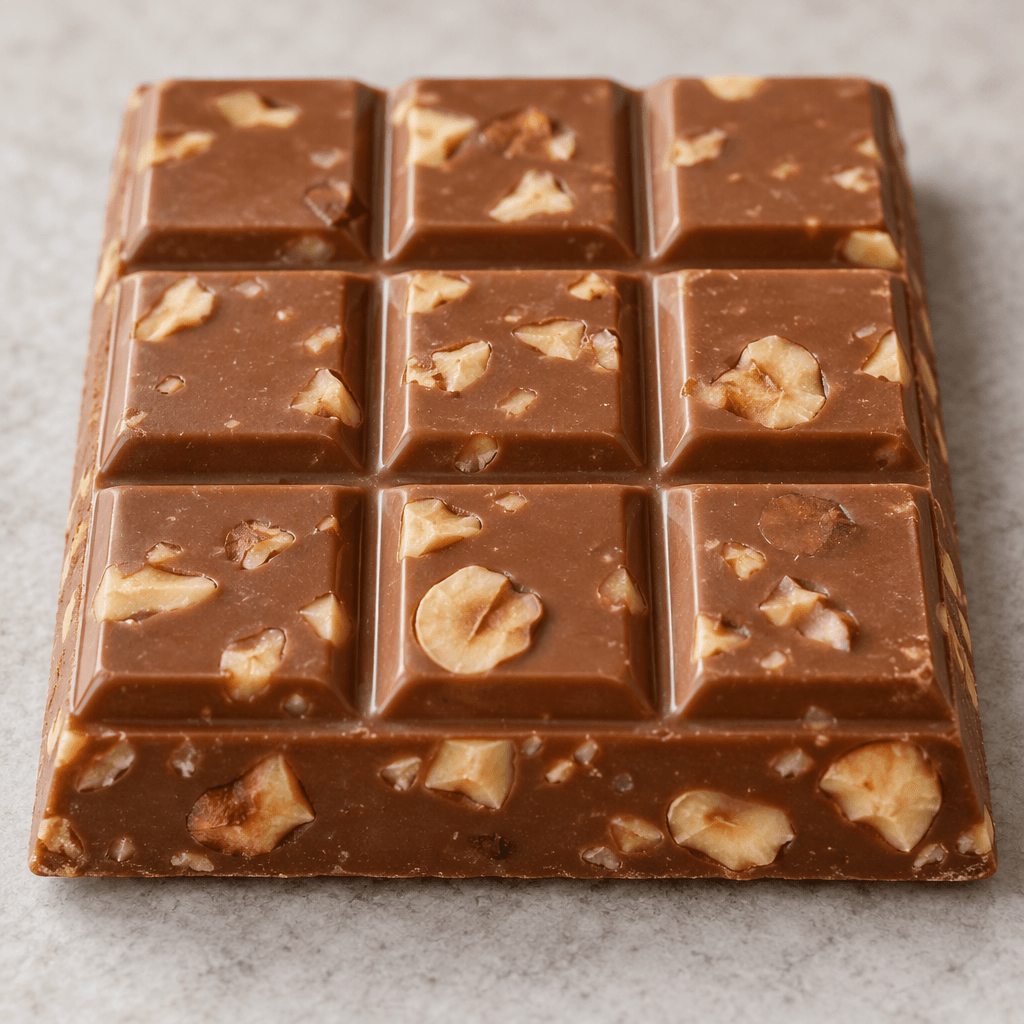
Tadelle No Added Sugar Chocolate Calories
No added sugar, high cocoa, fiber-rich chocolate
CALORIES
GI
POTASSIUM
FIBER
Quick answer
1 piece (medium) of Tadelle No Added Sugar Chocolate (30 g) has 141 calories. That works out to 470 calories per 100 g. It contains 11.4 g of carbs, 2.2 g of protein, 10.2 g of fat and 4.2 g of fiber. Its 0.3 mg of Copper covers 37% of the Daily Value. Its glycemic index is 25 (low), so it raises blood sugar slowly.
What is Tadelle No Added Sugar Chocolate?
Tadelle No Added Sugar Chocolate is a chocolate bar from the Turkish Tadelle range, made without added sugar. The milk-chocolate-style bar has a smooth surface with hazelnut pieces throughout, and raised sections that make it easy to break into smaller portions.
Its creamy texture and crunchy nuts make it an easy treat with tea or coffee, or a small dessert after a meal. It is rich in fat and carbohydrates, while also providing fibre; “no added sugar” does not mean sugar-free. If you want a modest sweet bite, break off a section and enjoy it with unsweetened tea or coffee.
Tadelle No Added Sugar Chocolate Nutrition Facts
Selected: 100 g
470
KCAL / 100G
Carbs
38g
· 14% DV
Protein
7.2g
· 14% DV
Fat
34g
· 44% DV
Fiber
14g
· 50% DV
DV is the share of the daily value covered, on a 2,000 kcal reference diet.
Calories come from: Carbs 31% · Protein 6% · Fat 63%
Tadelle No Added Sugar Chocolate Vitamins & Minerals
Vitamins
B2
0.12mg · 9% DV
B3
1.2mg · 8% DV
B1
0.08mg · 7% DV
Biotin
2µg · 7% DV
Minerals
Copper
1mg · 111% DV
Manganese
2mg · 87% DV
Magnesium
120mg · 29% DV
Phosphorus
180mg · 26% DV
How Nutritious Is Tadelle No Added Sugar Chocolate?
Nutrient density
Low
How many vitamins, minerals and how much fiber this food carries per calorie. A high score means a lot of nutrition for few calories.
Satiety score
Medium
An EatBetter score computed from fiber, protein and calorie density. A high score means staying full longer on the same calories.
Both scores are calculated per 100 g and do not change with the selected portion. The satiety score is EatBetter's own calculation, not a clinical measure.
Tadelle No Added Sugar Chocolate Glycemic Index
GLYCEMIC INDEX
GLYCEMIC LOAD
Accounts for portion size — a more realistic measure than GI alone.
How to Burn Off Tadelle No Added Sugar Chocolate
To burn the 470 calories in 100 g:
🚶
Walking (5 km/h)
🏃
Running (8 km/h)
🚴
Cycling
🏊
Swimming
Times are calculated with the MET equation for a 70 kg adult. Actual burn varies with your weight, age and pace.
Is Tadelle No Added Sugar Chocolate Processed?
NOVA 3
Processed
1. Unprocessed
2. Minimally Processed
3. Processed
4. Ultra-Processed
NOVA classifies foods into 4 groups by industrial processing. NOVA 1 (unprocessed) is the healthiest.
Does Tadelle No Added Sugar Chocolate Contain Allergens?
Contains these allergens:
Which Diets Is Tadelle No Added Sugar Chocolate Good For?
Vegan
— Not suitable
Vegetarian
✓ Suitable
Gluten-Free
— Not suitable
Dairy-Free
— Not suitable
Mediterranean
— Not suitable
Paleo
— Not suitable
Whole30
— Not suitable
DASH
— Not suitable
Keto
— Not suitable
Low FODMAP
— Not suitable
Tadelle No Added Sugar Chocolate Fat Profile
SATURATED
20g
MONOUNSATURATED
10g
POLYUNSATURATED
1.2g
Omega 6:3 ratio 8.3:1
Above the ideal 4:1 (8.3:1).
Compare Tadelle No Added Sugar Chocolate
Foods Similar to Tadelle No Added Sugar Chocolate
Frequently Asked Questions About Tadelle No Added Sugar Chocolate
Is Tadelle No Added Sugar Chocolate sugar-free?
No. “No added sugar” means sugar was not added as an ingredient; it does not guarantee that the chocolate contains no sugars from its other ingredients. Check the current package for its total sugars and sweetener information.
What sweetener is used in Tadelle No Added Sugar Chocolate?
The exact sweetener is best confirmed on the current ingredient list, since product formulations can change. Read the package ingredients for the specific version you have rather than assuming that every no-added-sugar chocolate uses the same sweetener.
Can people with diabetes eat Tadelle No Added Sugar Chocolate?
It is not automatically suitable for everyone with diabetes. The chocolate still contains carbohydrates, and a no-added-sugar claim does not mean it cannot affect blood glucose. Ask your doctor or dietitian how to fit it into your individual plan.
How does Tadelle No Added Sugar Chocolate compare with regular Tadelle?
The no-added-sugar version is made without added sugar, so its sweetening ingredients and nutrition profile differ from regular Tadelle. That can also change the sweetness and aftertaste, so it may not taste exactly like the original.
Does Tadelle No Added Sugar Chocolate taste bitter?
Not necessarily. It is still a sweetened chocolate, but its sweetness and aftertaste may differ from a conventional milk-chocolate bar. If you are sensitive to the taste of sweeteners, try a small piece before choosing it as your regular chocolate.
Can you bake with Tadelle No Added Sugar Chocolate?
Yes, you can chop or melt it for recipes. It may not behave exactly like sugar-sweetened chocolate when melted or baked, so test it in a small batch and adjust any additional sweetener in the recipe to taste.
How should Tadelle No Added Sugar Chocolate be stored after opening?
Keep it tightly wrapped in a cool, dry place away from sunlight, heat, and strong odors. If you refrigerate it, keep it sealed and let the package warm to room temperature before opening to reduce condensation on the chocolate.
Is Tadelle No Added Sugar Chocolate keto-friendly?
Not necessarily. No added sugar does not mean low in carbohydrates, so it may use up a significant share of a strict keto allowance. Check the carbohydrate amount for the portion you plan to eat and count it toward your daily limit.
How much Tadelle No Added Sugar Chocolate is a serving?
The typical serving provided for this chocolate is about 30 grams, or a few divided sections depending on the bar. Use the package’s portion information to judge your serving rather than treating the no-added-sugar claim as a reason to eat more.
Does Tadelle No Added Sugar Chocolate help with weight loss?
No, the chocolate itself does not cause weight loss. Its lack of added sugar does not make it calorie-free or unlimited; having a measured portion can help you enjoy it without turning a snack into a much larger serving.
Have another question about Tadelle No Added Sugar Chocolate?
Ask the AI nutrition coach — calories, portions, alternatives and more, answered in seconds in the app.

Scan calories with your camera
Instant AI nutrition analysis

Nutrition data compiled from USDA FoodData Central and scientific sources.