

Ready & Packaged Foods
All →Vegetables & Legumes
All →Desserts & Confectionery
All →Meat & Protein
All →Grains & Bakery
All →Beverages
All →Milk & Dairy
All →

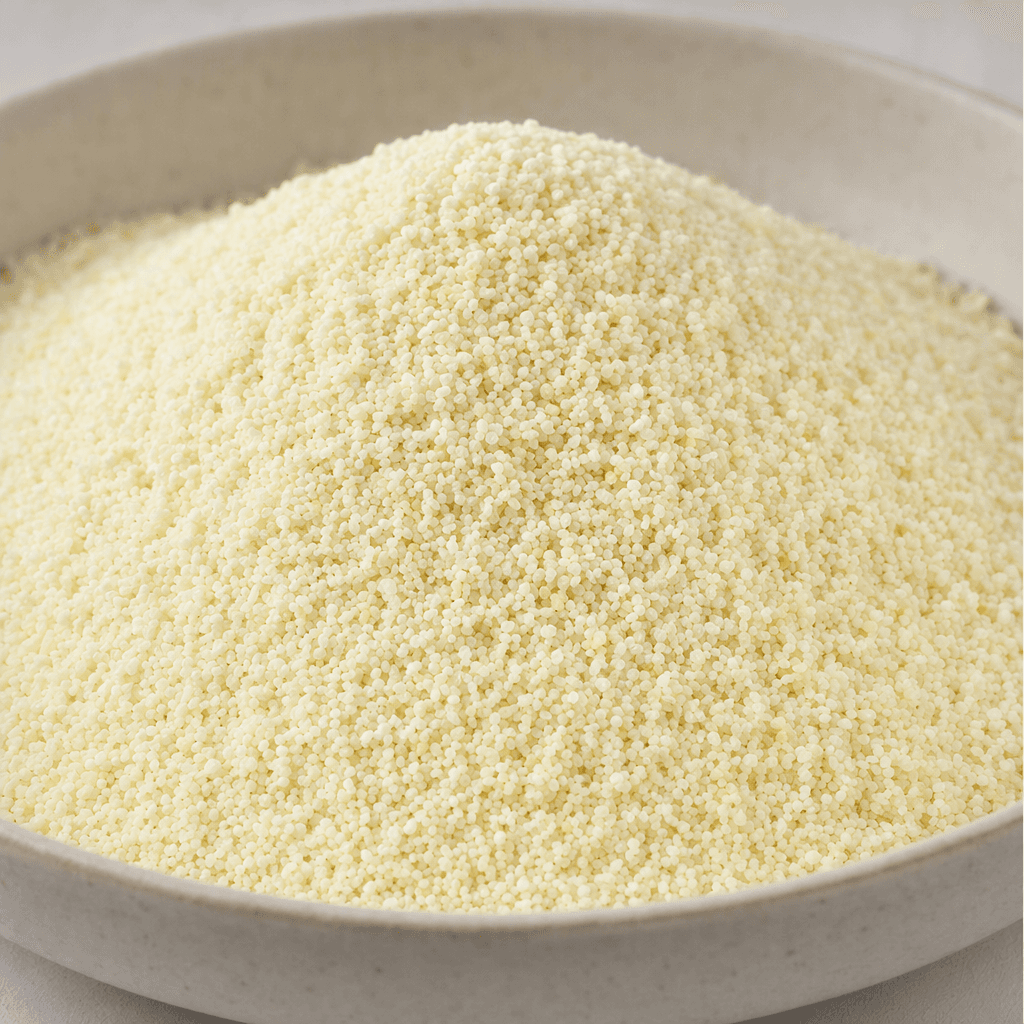
Raw rice semolina Calories
Gluten-free coarse rice granules for porridge and desserts
CALORIES
GI
POTASSIUM
FIBER
Quick answer
1 cup (medium) of Raw rice semolina (170 g) has 612 calories. That works out to 360 calories per 100 g. It contains 135.7 g of carbs, 11.4 g of protein, 1.4 g of fat and 2.2 g of fiber. Its 1.2 mg of Manganese covers 52% of the Daily Value. Its glycemic index is 69 (medium), so it raises blood sugar at a moderate pace.
What is Raw rice semolina?
Raw rice semolina is made by milling rice into coarse, pale grains. Despite the word “semolina,” it is rice-based rather than wheat-based, and the dry granules need to be cooked before eating. They soften as they absorb liquid, giving porridges and desserts a creamy, gently grainy texture.
Across many cuisines, it is cooked with milk or water for breakfast porridge, or used in puddings and other sweets; fruit, cinnamon or nuts make simple toppings. It is naturally gluten-free and made up mostly of carbohydrate, with little fat and relatively little fibre. For a lighter bowl, cook it with water or a milk-and-water mix and sweeten it with fruit rather than adding much sugar.
Raw rice semolina Nutrition Facts
Selected: 100 g
360
KCAL / 100G
Carbs
79.8g
· 29% DV
Protein
6.7g
· 13% DV
Fat
0.8g
· 1% DV
Fiber
1.3g
· 5% DV
DV is the share of the daily value covered, on a 2,000 kcal reference diet.
Calories come from: Carbs 90% · Protein 8% · Fat 2%
Raw rice semolina Vitamins & Minerals
Vitamins
B3
1.6mg · 10% DV
B5
0.4mg · 8% DV
B6
0.12mg · 7% DV
Biotin
2µg · 7% DV
Minerals
Manganese
1mg · 43% DV
Phosphorus
95mg · 14% DV
Selenium
7µg · 13% DV
Zinc
1mg · 9% DV
How Nutritious Is Raw rice semolina?
Nutrient density
Low
How many vitamins, minerals and how much fiber this food carries per calorie. A high score means a lot of nutrition for few calories.
Satiety score
Low
An EatBetter score computed from fiber, protein and calorie density. A high score means staying full longer on the same calories.
Both scores are calculated per 100 g and do not change with the selected portion. The satiety score is EatBetter's own calculation, not a clinical measure.
Raw rice semolina Glycemic Index
GLYCEMIC INDEX
GLYCEMIC LOAD
Accounts for portion size — a more realistic measure than GI alone.
How to Burn Off Raw rice semolina
To burn the 360 calories in 100 g:
🚶
Walking (5 km/h)
🏃
Running (8 km/h)
🚴
Cycling
🏊
Swimming
Times are calculated with the MET equation for a 70 kg adult. Actual burn varies with your weight, age and pace.
Is Raw rice semolina Processed?
NOVA 2
Minimally Processed
1. Unprocessed
2. Minimally Processed
3. Processed
4. Ultra-Processed
NOVA classifies foods into 4 groups by industrial processing. NOVA 1 (unprocessed) is the healthiest.
Does Raw rice semolina Contain Allergens?
No known major allergens
Which Diets Is Raw rice semolina Good For?
Vegan
✓ Suitable
Vegetarian
✓ Suitable
Gluten-Free
✓ Suitable
Dairy-Free
— Not suitable
Mediterranean
✓ Suitable
Paleo
— Not suitable
Whole30
— Not suitable
DASH
— Not suitable
Keto
— Not suitable
Low FODMAP
— Not suitable
Raw rice semolina Fat Profile
SATURATED
0.22g
MONOUNSATURATED
0.25g
POLYUNSATURATED
0.25g
Omega 6:3 ratio 24:1
Above the ideal 4:1 (24:1).
Compare Raw rice semolina
Foods Similar to Raw rice semolina
Frequently Asked Questions About Raw rice semolina
What is raw rice semolina?
Raw rice semolina is rice ground into coarse, small granules. Unlike wheat semolina, it is made from rice, and its grainier texture makes it useful for porridge, puddings, and some baking.
How do you cook raw rice semolina?
Cook raw rice semolina in water or milk over low to medium heat, stirring often until the grains soften and the mixture thickens. Add the liquid gradually if you want more control over the final consistency.
Can you make rice pudding with raw rice semolina?
Yes, raw rice semolina works in rice pudding, though it makes the dessert smoother and more uniform than whole rice does. Stir it into the milk gradually and keep stirring as it cooks to prevent lumps.
What is the difference between raw rice semolina and rice flour?
Raw rice semolina has a coarse, grainy texture, while rice flour is finely ground. Semolina gives porridge and desserts more texture; rice flour is better when a smooth, even mixture is needed.
Can raw rice semolina replace rice flour in baking?
Sometimes, but the result will be coarser and may have a different texture. Rice semolina does not disperse like fine rice flour, so it is a better swap in recipes that can accommodate noticeable grains than in delicate, smooth batters.
Do you need to wash raw rice semolina before cooking?
No, raw rice semolina is generally cooked without washing. The small granules can wash away through a sieve, so add them directly to the cooking liquid and stir to distribute them.
How should you store raw rice semolina?
Keep raw rice semolina in a tightly sealed, dry container in a cool place away from sunlight and moisture. Check it for unusual odors, clumping, or insects before use, especially if it has been stored for a long time.
Can you freeze raw rice semolina?
Yes, you can freeze raw rice semolina in an airtight, moisture-proof container. Freezing is usually unnecessary if it is stored dry and sealed, but let the closed container return to room temperature before opening to limit condensation.
Can you eat raw rice semolina without cooking it?
It is best to cook raw rice semolina before eating it. The dry grains are hard and unpleasantly gritty; cooking softens them and makes them suitable for porridge, pudding, or other dishes.
Why does raw rice semolina clump when you cook it?
Raw rice semolina clumps when dry granules meet hot liquid unevenly, forming sticky lumps on the outside. Whisk it into cool or warm liquid before heating, or add it gradually while stirring continuously.
Have another question about Raw rice semolina?
Ask the AI nutrition coach — calories, portions, alternatives and more, answered in seconds in the app.

Scan calories with your camera
Instant AI nutrition analysis

Nutrition data compiled from USDA FoodData Central and scientific sources.