

Ready & Packaged Foods
All →Vegetables & Legumes
All →Desserts & Confectionery
All →Meat & Protein
All →Grains & Bakery
All →Beverages
All →Milk & Dairy
All →

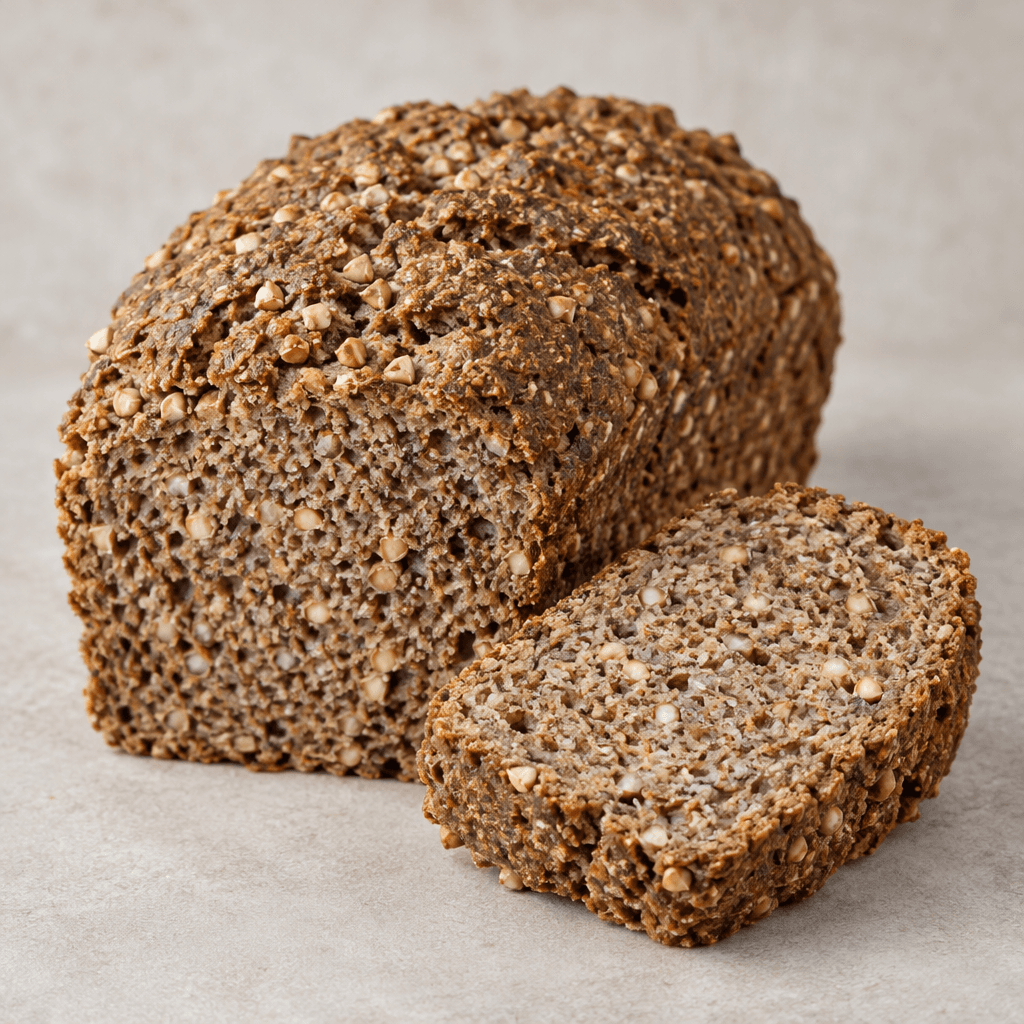
Raw buckwheat bread Calories
Gluten-free, fiber-rich, raw-prepared
CALORIES
GI
POTASSIUM
FIBER
Quick answer
1 slice (medium) of Raw buckwheat bread (35 g) has 86 calories. That works out to 245 calories per 100 g. It contains 14.8 g of carbs, 3 g of protein, 1.5 g of fat and 2.7 g of fiber. Its 0.4 mg of Manganese covers 17% of the Daily Value. Its glycemic index is 48 (low), so it raises blood sugar slowly.
What is Raw buckwheat bread?
Raw buckwheat bread is a dense loaf made from buckwheat groats, usually soaked, ground or mashed, then shaped and dried at low heat rather than baked like conventional bread. It belongs to modern raw-food cooking rather than to one particular traditional bread-making region. Buckwheat gives it an earthy, mildly nutty flavour and a coarse, sometimes crumbly texture.
Serve a slice with avocado, hummus or vegetables, or alongside soup; it also works as a hearty base for open sandwiches. It has a notably fibre-rich profile, with 7.8 g of fibre per 100 g. Because the loaf can be quite dense, pair a modest slice with fresh produce for a lighter meal.
Raw buckwheat bread Nutrition Facts
Selected: 100 g
245
KCAL / 100G
Carbs
42.3g
· 15% DV
Protein
8.5g
· 17% DV
Fat
4.2g
· 5% DV
Fiber
7.8g
· 28% DV
DV is the share of the daily value covered, on a 2,000 kcal reference diet.
Calories come from: Carbs 70% · Protein 14% · Fat 16%
Raw buckwheat bread Vitamins & Minerals
Vitamins
B3
1.9mg · 12% DV
B6
0.18mg · 11% DV
B1
0.12mg · 10% DV
Biotin
3µg · 10% DV
Minerals
Manganese
1mg · 43% DV
Phosphorus
220mg · 31% DV
Magnesium
118mg · 28% DV
Zinc
2mg · 18% DV
How Nutritious Is Raw buckwheat bread?
Nutrient density
High
How many vitamins, minerals and how much fiber this food carries per calorie. A high score means a lot of nutrition for few calories.
Satiety score
Medium
An EatBetter score computed from fiber, protein and calorie density. A high score means staying full longer on the same calories.
Both scores are calculated per 100 g and do not change with the selected portion. The satiety score is EatBetter's own calculation, not a clinical measure.
Raw buckwheat bread Glycemic Index
GLYCEMIC INDEX
GLYCEMIC LOAD
Accounts for portion size — a more realistic measure than GI alone.
How to Burn Off Raw buckwheat bread
To burn the 245 calories in 100 g:
🚶
Walking (5 km/h)
🏃
Running (8 km/h)
🚴
Cycling
🏊
Swimming
Times are calculated with the MET equation for a 70 kg adult. Actual burn varies with your weight, age and pace.
Is Raw buckwheat bread Processed?
NOVA 3
Processed
1. Unprocessed
2. Minimally Processed
3. Processed
4. Ultra-Processed
NOVA classifies foods into 4 groups by industrial processing. NOVA 1 (unprocessed) is the healthiest.
Does Raw buckwheat bread Contain Allergens?
No known major allergens
Which Diets Is Raw buckwheat bread Good For?
Vegan
✓ Suitable
Vegetarian
✓ Suitable
Gluten-Free
✓ Suitable
Dairy-Free
— Not suitable
Mediterranean
✓ Suitable
Paleo
— Not suitable
Whole30
— Not suitable
DASH
— Not suitable
Keto
— Not suitable
Low FODMAP
— Not suitable
Raw buckwheat bread Fat Profile
SATURATED
0.82g
MONOUNSATURATED
1.1g
POLYUNSATURATED
1.28g
Omega 6:3 ratio 14.4:1
Above the ideal 4:1 (14.4:1).
Compare Raw buckwheat bread
Foods Similar to Raw buckwheat bread
Frequently Asked Questions About Raw buckwheat bread
What is raw buckwheat bread?
Raw buckwheat bread is a dense loaf usually made from soaked buckwheat groats, blended into a dough and dried at low heat rather than baked like conventional bread. Recipes may also include seeds, vegetables or seasonings.
How do you make raw buckwheat bread?
To make raw buckwheat bread, soak and rinse the groats, blend them with water and any chosen binders, then shape the dough and dry it at low heat. A dehydrator can help dry the loaf evenly throughout.
Is raw buckwheat bread actually raw?
Not always. Some recipes dry the loaf at a low temperature to fit a raw-food approach, while others use a hotter oven. The preparation method matters: a loaf exposed to higher heat is not technically raw.
Do you need to soak buckwheat for raw buckwheat bread?
Yes, most raw buckwheat bread recipes soak the groats before blending. Soaking softens them for a smoother dough; rinsing afterward removes the thick, sometimes slippery coating that develops in the soaking water.
Does raw buckwheat bread need yeast?
No, raw buckwheat bread does not necessarily need yeast. Some recipes rely on fermentation of the soaked buckwheat, while others mix the dough and dry it without fermenting. The recipe determines its rise, tang and texture.
Why does raw buckwheat bread crumble?
Raw buckwheat bread can crumble if the dough lacks enough binding or becomes too dry during preparation. Let the loaf cool fully before slicing, use a sharp knife, and adjust the binder or moisture in your next batch.
How should you store raw buckwheat bread?
Store raw buckwheat bread in an airtight container in the refrigerator because its moist texture can spoil more quickly at room temperature. Freeze slices for longer storage, and discard the loaf if you notice mold or an unusual sour smell.
Can you freeze raw buckwheat bread?
Yes, raw buckwheat bread freezes well. Slice it first and separate the slices with parchment so you can take out only what you need. Thaw a slice in the refrigerator or warm it gently before serving.
Can you toast raw buckwheat bread?
Yes, you can toast raw buckwheat bread, but handle the slices gently because the dense loaf may crumble. Toasting heats it, so the finished slice is no longer raw, even though it is still fine to eat.
What goes well with raw buckwheat bread?
Raw buckwheat bread pairs well with hummus, avocado, nut butter or savory spreads. Its earthy flavor also works with soup or a salad; choose a topping that adds moisture if the loaf seems dry or crumbly.
Have another question about Raw buckwheat bread?
Ask the AI nutrition coach — calories, portions, alternatives and more, answered in seconds in the app.

Scan calories with your camera
Instant AI nutrition analysis

Nutrition data compiled from USDA FoodData Central and scientific sources.