

Ready & Packaged Foods
All →Vegetables & Legumes
All →Desserts & Confectionery
All →Meat & Protein
All →Grains & Bakery
All →Beverages
All →Milk & Dairy
All →

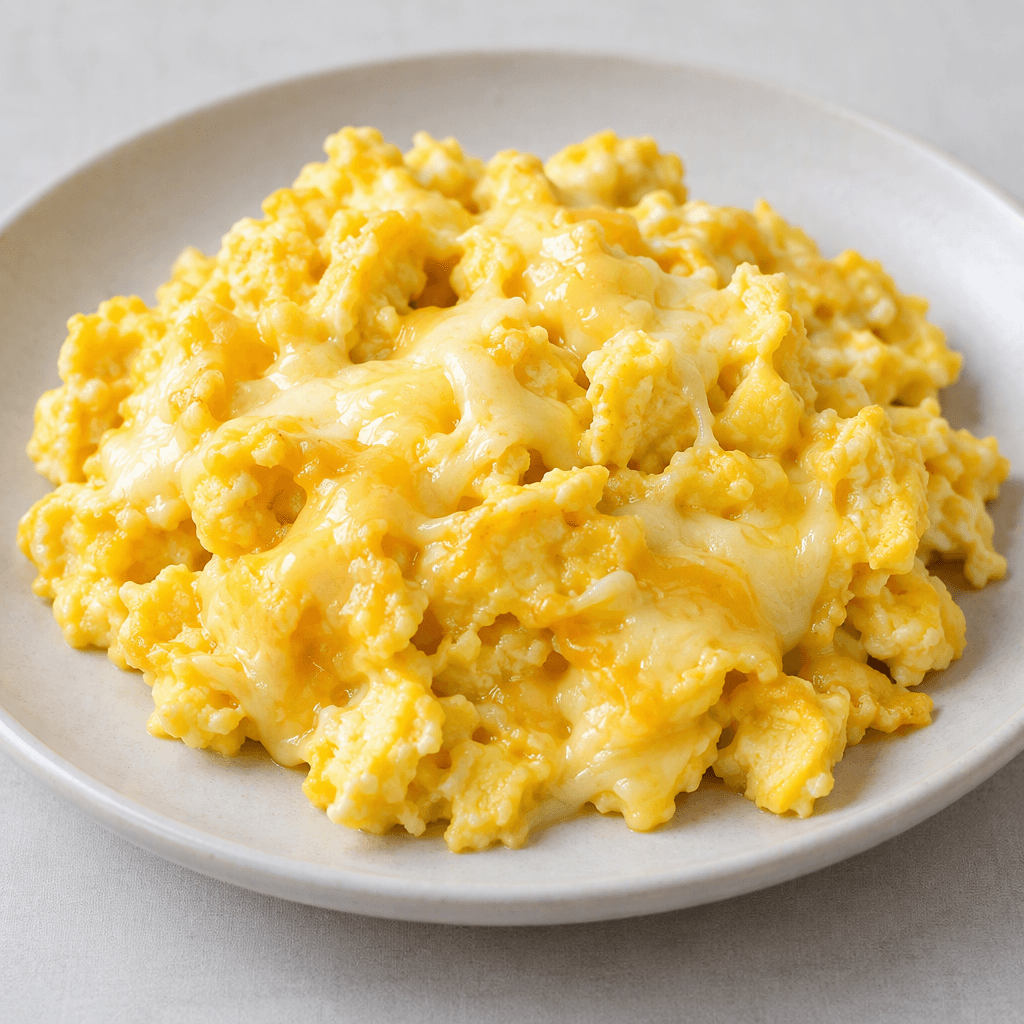
Scrambled Eggs with Cheese Calories
High in protein, calcium, and B vitamins; popular breakfast dish.
In season: Spring · Summer · Autumn · Winter
CALORIES
GI
POTASSIUM
FIBER
Quick answer
1 serving (medium) of Scrambled Eggs with Cheese (120 g) has 204 calories. That works out to 170 calories per 100 g. It contains 2.6 g of carbs, 13.8 g of protein, 15 g of fat and 0 g of fiber. Its 24 µg of Biotin covers 80% of the Daily Value. Its glycemic index is 20 (low), so it raises blood sugar slowly.
What is Scrambled Eggs with Cheese?
Peynirli çılbır is a cheese-topped variation of çılbır, the Turkish dish of poached eggs served over yogurt. It is often finished with melted butter and red pepper, and makes a hearty breakfast or light meal in Turkey.
The runny yolk contrasts with cool, tangy yogurt, while the cheese adds a savoury, creamy note. Tear off bread to scoop up the sauce, or serve it with fresh tomato and cucumber. Eggs and cheese make this a protein-rich, calcium-containing dish. For a lighter plate, use less butter and keep the yogurt plain; its richness means a modest portion can still feel satisfying.
Scrambled Eggs with Cheese Nutrition Facts
Selected: 100 g
170
KCAL / 100G
Carbs
2.2g
· 1% DV
Protein
11.5g
· 23% DV
Fat
12.5g
· 16% DV
Fiber
0g
· 0% DV
DV is the share of the daily value covered, on a 2,000 kcal reference diet.
Calories come from: Carbs 5% · Protein 27% · Fat 68%
Scrambled Eggs with Cheese Vitamins & Minerals
Vitamins
Biotin
20µg · 67% DV
B12
1.3µg · 54% DV
B2
0.36mg · 28% DV
B5
1.2mg · 24% DV
Minerals
Selenium
18µg · 33% DV
Phosphorus
180mg · 26% DV
Calcium
180mg · 18% DV
Sodium
320mg · 14% DV
How Nutritious Is Scrambled Eggs with Cheese?
Nutrient density
High
How many vitamins, minerals and how much fiber this food carries per calorie. A high score means a lot of nutrition for few calories.
Satiety score
Medium
An EatBetter score computed from fiber, protein and calorie density. A high score means staying full longer on the same calories.
Both scores are calculated per 100 g and do not change with the selected portion. The satiety score is EatBetter's own calculation, not a clinical measure.
Scrambled Eggs with Cheese Glycemic Index
GLYCEMIC INDEX
GLYCEMIC LOAD
Accounts for portion size — a more realistic measure than GI alone.
How to Burn Off Scrambled Eggs with Cheese
To burn the 170 calories in 100 g:
🚶
Walking (5 km/h)
🏃
Running (8 km/h)
🚴
Cycling
🏊
Swimming
Times are calculated with the MET equation for a 70 kg adult. Actual burn varies with your weight, age and pace.
Is Scrambled Eggs with Cheese Processed?
NOVA 2
Minimally Processed
1. Unprocessed
2. Minimally Processed
3. Processed
4. Ultra-Processed
NOVA classifies foods into 4 groups by industrial processing. NOVA 1 (unprocessed) is the healthiest.
Does Scrambled Eggs with Cheese Contain Allergens?
Contains these allergens:
Which Diets Is Scrambled Eggs with Cheese Good For?
Vegan
— Not suitable
Vegetarian
✓ Suitable
Gluten-Free
— Not suitable
Dairy-Free
— Not suitable
Mediterranean
✓ Suitable
Paleo
— Not suitable
Whole30
— Not suitable
DASH
— Not suitable
Keto
— Not suitable
Low FODMAP
— Not suitable
Scrambled Eggs with Cheese Fat Profile
SATURATED
5.2g
MONOUNSATURATED
4.8g
POLYUNSATURATED
1.4g
Omega 6:3 ratio 9.2:1
Above the ideal 4:1 (9.2:1).
Compare Scrambled Eggs with Cheese
Foods Similar to Scrambled Eggs with Cheese
Frequently Asked Questions About Scrambled Eggs with Cheese
What is Peynirli çılbır?
Peynirli çılbır is a Turkish cheese-added variation of çılbır, traditionally poached eggs served over garlicky yogurt, often finished with spiced butter. Despite this page’s English label, it is not simply the usual scrambled eggs mixed with cheese.
Is Peynirli çılbır made with poached or scrambled eggs?
Traditional çılbır uses poached eggs, not scrambled eggs. The defining combination is soft eggs on a bed of yogurt; cheese is an added variation, and recipes may differ in how and when they include it.
Why does Peynirli çılbır have yogurt underneath the eggs?
Yogurt is the cool, tangy base that distinguishes çılbır from ordinary egg dishes. Spoon garlicky yogurt onto the plate first, then add the hot poached eggs so the creamy and warm elements come together at serving.
What cheese works best in Peynirli çılbır?
A mildly salty cheese that complements yogurt works well in Peynirli çılbır. Crumbled feta gives a tangy, crumbly finish, while a mild melting cheese makes the topping softer; taste before adding extra salt.
How do you stop eggs breaking when making Peynirli çılbır?
For Peynirli çılbır, crack each egg into a small cup before sliding it gently into barely simmering water. Avoid a rolling boil, which can scatter the white, and cook eggs in batches if the pan is crowded.
Does the water need vinegar for Peynirli çılbır?
No, vinegar is optional when poaching eggs for Peynirli çılbır. A small splash can help the whites set sooner, but careful handling and gently simmering water are more important; drain the eggs before placing them on the yogurt.
Can you make Peynirli çılbır without garlic?
Yes, you can leave garlic out of Peynirli çılbır’s yogurt. Garlic is a common savory addition rather than a requirement, and plain or lightly salted yogurt still provides the creamy base that pairs with poached eggs.
What goes on top of Peynirli çılbır besides cheese?
Peynirli çılbır is commonly finished with butter warmed with paprika or red pepper flakes. The spiced butter adds aroma and warmth; mint is another possible garnish, but use restraint so it does not overpower the yogurt and cheese.
Can you prepare Peynirli çılbır ahead of time?
It is better to assemble Peynirli çılbır just before serving. You can mix the yogurt and garlic in advance, but poached eggs are best fresh; once assembled, the yogurt can loosen and the eggs can become overcooked when reheated.
What do you serve with Peynirli çılbır?
Serve Peynirli çılbır with crusty bread or warm flatbread for scooping up the yogurt and egg yolk. A simple tomato-and-cucumber salad makes a fresh accompaniment, while additional salty sides may be unnecessary if the cheese is brined.
Have another question about Scrambled Eggs with Cheese?
Ask the AI nutrition coach — calories, portions, alternatives and more, answered in seconds in the app.

Scan calories with your camera
Instant AI nutrition analysis

Nutrition data compiled from USDA FoodData Central and scientific sources.