

Ready & Packaged Foods
All →Vegetables & Legumes
All →Desserts & Confectionery
All →Meat & Protein
All →Grains & Bakery
All →Beverages
All →Milk & Dairy
All →

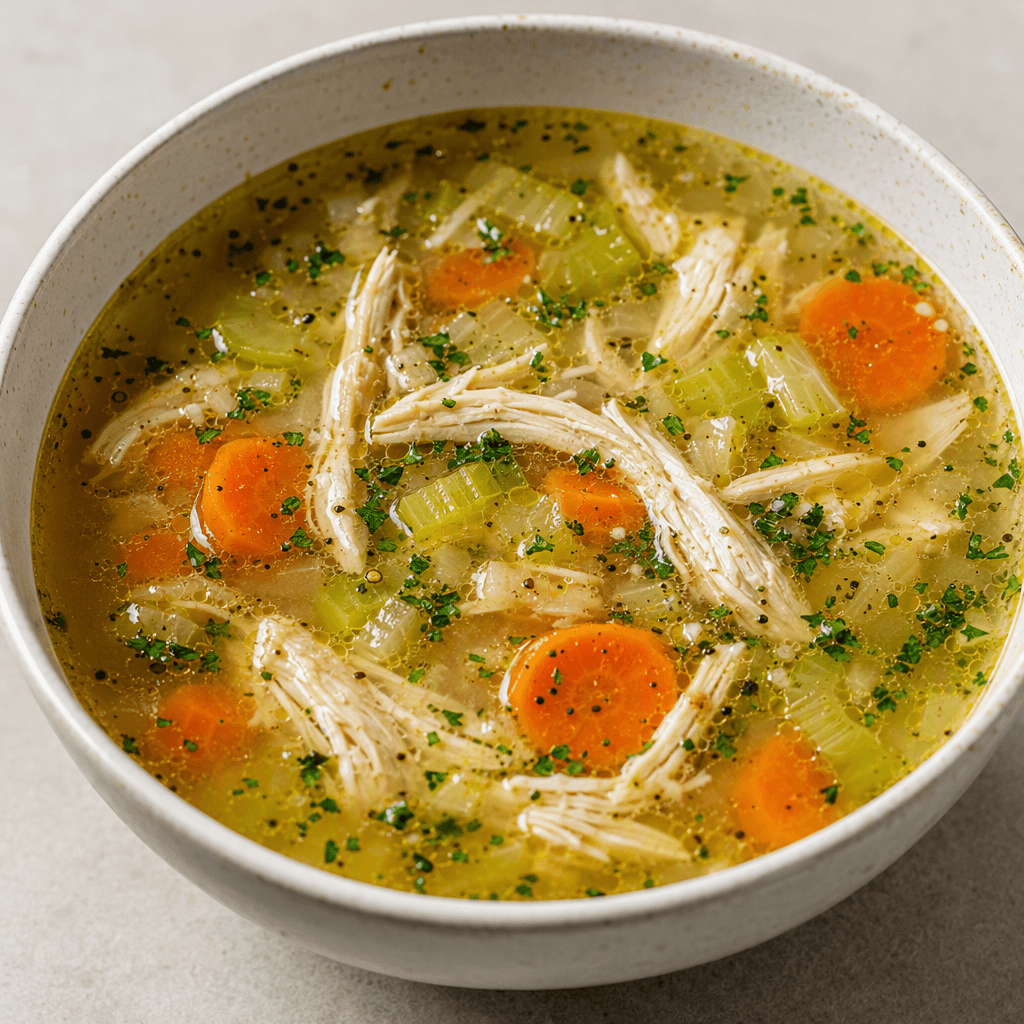
Chicken Soup Calories
Protein source, low fat, warm and nourishing
In season: Winter · Autumn
CALORIES
GI
POTASSIUM
FIBER
Quick answer
1 cup (medium) of Chicken Soup (240 g) has 108 calories. That works out to 45 calories per 100 g. It contains 10.1 g of carbs, 8.4 g of protein, 2.9 g of fat and 1 g of fiber. Its 768 mg of Sodium covers 33% of the Daily Value. Its glycemic index is 45 (low), so it raises blood sugar slowly.
Chicken Soup Nutrition Facts
Selected: 100 g
45
KCAL / 100G
Carbs
4.2g
· 2% DV
Protein
3.5g
· 7% DV
Fat
1.2g
· 2% DV
Fiber
0.4g
· 1% DV
DV is the share of the daily value covered, on a 2,000 kcal reference diet.
Calories come from: Carbs 40% · Protein 34% · Fat 26%
Chicken Soup Vitamins & Minerals
Vitamins
B3
0.6mg · 4% DV
B5
0.18mg · 4% DV
B6
0.07mg · 4% DV
Biotin
1.2µg · 4% DV
Minerals
Sodium
320mg · 14% DV
Selenium
2.5µg · 5% DV
Phosphorus
32mg · 5% DV
Potassium ⭐
110mg · 3% DV
How Nutritious Is Chicken Soup?
Nutrient density
Medium
How many vitamins, minerals and how much fiber this food carries per calorie. A high score means a lot of nutrition for few calories.
Satiety score
Medium
An EatBetter score computed from fiber, protein and calorie density. A high score means staying full longer on the same calories.
Both scores are calculated per 100 g and do not change with the selected portion. The satiety score is EatBetter's own calculation, not a clinical measure.
Chicken Soup Glycemic Index
GLYCEMIC INDEX
GLYCEMIC LOAD
Accounts for portion size — a more realistic measure than GI alone.
How to Burn Off Chicken Soup
To burn the 45 calories in 100 g:
🚶
Walking (5 km/h)
🏃
Running (8 km/h)
🚴
Cycling
🏊
Swimming
Times are calculated with the MET equation for a 70 kg adult. Actual burn varies with your weight, age and pace.
Is Chicken Soup Processed?
NOVA 2
Minimally Processed
1. Unprocessed
2. Minimally Processed
3. Processed
4. Ultra-Processed
NOVA classifies foods into 4 groups by industrial processing. NOVA 1 (unprocessed) is the healthiest.
Does Chicken Soup Contain Allergens?
No known major allergens
Which Diets Is Chicken Soup Good For?
Vegan
— Not suitable
Vegetarian
— Not suitable
Gluten-Free
— Not suitable
Dairy-Free
— Not suitable
Mediterranean
✓ Suitable
Paleo
— Not suitable
Whole30
— Not suitable
DASH
— Not suitable
Keto
— Not suitable
Low FODMAP
— Not suitable
Chicken Soup Fat Profile
SATURATED
0.3g
MONOUNSATURATED
0.4g
POLYUNSATURATED
0.1g
Omega 6:3 ratio 3.5:1
Below the ideal 4:1 — a good omega balance.
Compare Chicken Soup
Foods Similar to Chicken Soup
Frequently Asked Questions About Chicken Soup
Does chicken soup actually cure a cold?
Chicken soup does not cure a cold or flu. Its warm liquid can soothe a sore throat, support hydration, and be easier to eat when appetite is low.
How long does homemade chicken soup keep in the fridge?
If cooled and refrigerated in a covered container within two hours of cooking, it generally keeps for 3 to 4 days. Reheat it until steaming hot throughout before serving.
Can chicken soup be frozen?
Yes, chicken soup freezes well in airtight containers. Noodles, rice, and potatoes can become soft after thawing, so adding them when reheating often gives a better texture.
Is it safe to reheat chicken soup more than once?
It is best to divide the soup into portions so only the amount you plan to eat is reheated. Reheat each portion thoroughly once rather than repeatedly cooling and reheating the whole pot.
How can I keep chicken soup clear instead of cloudy?
Keep the broth at a gentle simmer rather than a hard boil, and skim off foam that rises to the surface. Avoid vigorous stirring while the chicken cooks.
When should lemon be added to chicken soup?
Add lemon near the end of cooking or at the table to preserve its fresh flavor. If the soup contains milk, cream, or yogurt, add lemon carefully because the acidity can cause curdling.
Is chicken soup better before or after a workout?
A large bowl immediately before intense exercise may feel heavy. After training, it can be part of a recovery meal, especially when paired with a carbohydrate food such as bread, rice, or potatoes.
Is chicken soup a good choice at night?
It can be a comforting light meal in the evening. People prone to reflux may do better with a smaller portion and fewer spicy ingredients close to bedtime.
Are bouillon cubes the same as homemade chicken soup?
No. Bouillon cubes mainly add flavor and are often high in salt, while homemade chicken soup can provide chicken, vegetables, and a more complete meal base.
Who should be especially careful about the salt in chicken soup?
People with high blood pressure, heart failure, or kidney disease should be mindful of salty canned soups, stock concentrates, and bouillon. Flavoring soup with herbs, garlic, lemon, and spices can reduce the need for added salt.
Have another question about Chicken Soup?
Ask the AI nutrition coach — calories, portions, alternatives and more, answered in seconds in the app.

Scan calories with your camera
Instant AI nutrition analysis

Nutrition data compiled from USDA FoodData Central and scientific sources.