

Ready & Packaged Foods
All →Vegetables & Legumes
All →Desserts & Confectionery
All →Meat & Protein
All →Grains & Bakery
All →Beverages
All →Milk & Dairy
All →

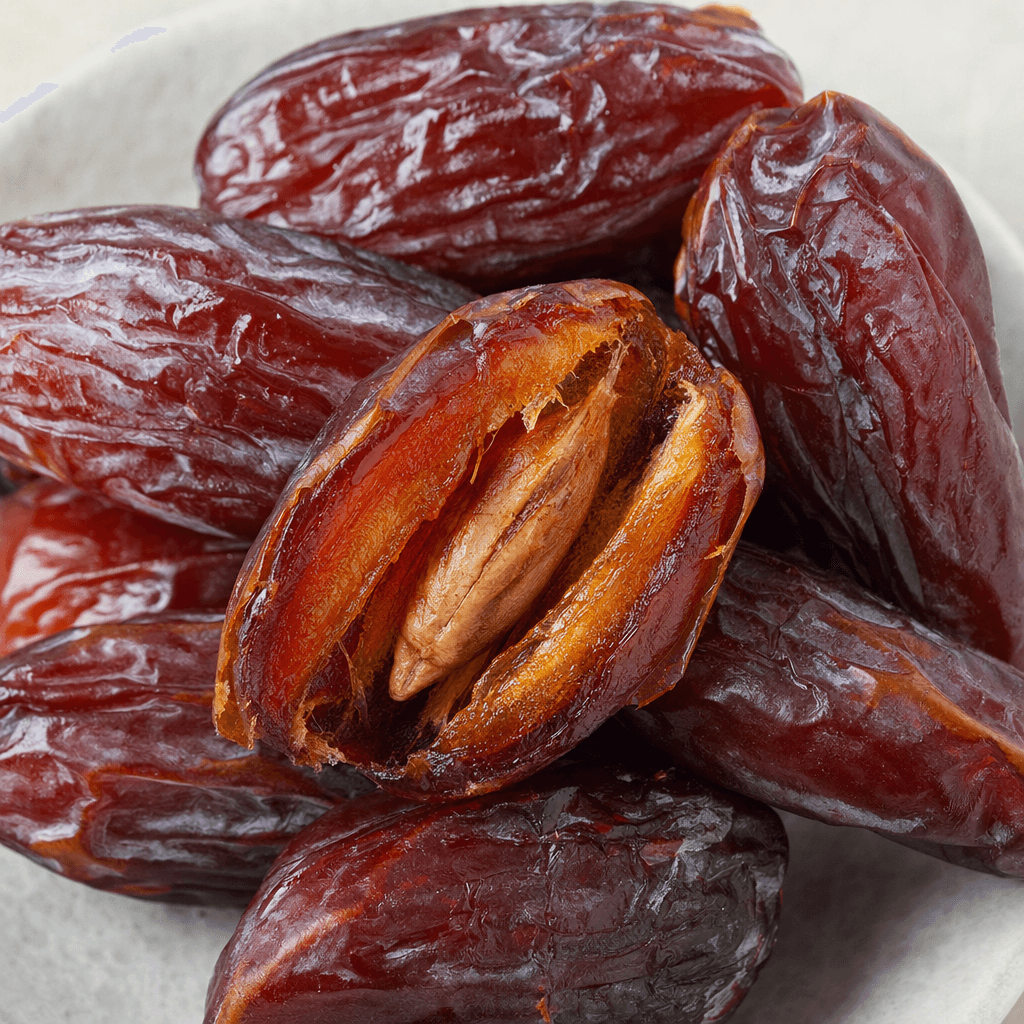
Medjoul Date Calories
Very large, soft and sweet date variety. Natural energy source, rich in fiber and potassium.
In season: Autumn · Winter
CALORIES
GI
POTASSIUM
FIBER
Quick answer
1 piece (large) of Medjoul Date (24 g) has 66 calories. That works out to 277 calories per 100 g. It contains 18 g of carbs, 0.4 g of protein, 0 g of fat and 1.6 g of fiber. Its 0.1 mg of Copper covers 10% of the Daily Value. Its glycemic index is 43 (medium), so it raises blood sugar at a moderate pace.
What is Medjoul Date?
Medjoul dates are a particularly large, soft variety of date, originally from Morocco. Their wrinkled skins range from reddish to deep brown, and the sticky flesh is richly sweet, with a long pit at the centre. Eat one as it is, or remove the pit and fill the date with nuts; chopped dates also work well in porridge, baking and smoothies.
Across date-growing regions and in kitchens worldwide, they’re enjoyed as a snack or used to sweeten dishes. They’re mostly carbohydrate, with some fibre; 100 g provides 6.7 g of fibre. One large date is about 24 g, so it’s an easy portion to pair with plain yoghurt, nuts or cheese when you want a more substantial snack.
Medjoul Date Nutrition Facts
Selected: 100 g
277
KCAL / 100G
Carbs
75g
· 27% DV
Protein
1.8g
· 4% DV
Fat
0.2g
· 0% DV
Fiber
6.7g
· 24% DV
DV is the share of the daily value covered, on a 2,000 kcal reference diet.
Calories come from: Carbs 97% · Protein 2% · Fat 1%
Medjoul Date Vitamins & Minerals
Vitamins
B5
0.8mg · 16% DV
B6
0.24mg · 14% DV
B3
1.6mg · 10% DV
Biotin
1.7µg · 6% DV
Minerals
Potassium ⭐
696mg · 20% DV
Magnesium
54mg · 13% DV
Phosphorus
62mg · 9% DV
Calcium
64mg · 6% DV
How Nutritious Is Medjoul Date?
Nutrient density
High
How many vitamins, minerals and how much fiber this food carries per calorie. A high score means a lot of nutrition for few calories.
Satiety score
Medium
An EatBetter score computed from fiber, protein and calorie density. A high score means staying full longer on the same calories.
Both scores are calculated per 100 g and do not change with the selected portion. The satiety score is EatBetter's own calculation, not a clinical measure.
Medjoul Date Glycemic Index
GLYCEMIC INDEX
GLYCEMIC LOAD
Accounts for portion size — a more realistic measure than GI alone.
How to Burn Off Medjoul Date
To burn the 277 calories in 100 g:
🚶
Walking (5 km/h)
🏃
Running (8 km/h)
🚴
Cycling
🏊
Swimming
Times are calculated with the MET equation for a 70 kg adult. Actual burn varies with your weight, age and pace.
Is Medjoul Date Processed?
NOVA 1
Unprocessed
1. Unprocessed
2. Minimally Processed
3. Processed
4. Ultra-Processed
NOVA classifies foods into 4 groups by industrial processing. NOVA 1 (unprocessed) is the healthiest.
Does Medjoul Date Contain Allergens?
No known major allergens
Which Diets Is Medjoul Date Good For?
Vegan
✓ Suitable
Vegetarian
✓ Suitable
Gluten-Free
✓ Suitable
Dairy-Free
— Not suitable
Mediterranean
✓ Suitable
Paleo
✓ Suitable
Whole30
— Not suitable
DASH
— Not suitable
Keto
— Not suitable
Low FODMAP
— Not suitable
Medjoul Date Fat Profile
SATURATED
0.03g
MONOUNSATURATED
0.04g
POLYUNSATURATED
0.05g
Omega 6:3 ratio 3:1
Below the ideal 4:1 — a good omega balance.
Compare Medjoul Date
Foods Similar to Medjoul Date
Frequently Asked Questions About Medjoul Date
What makes a Medjoul date different from other dates?
A Medjoul date is usually larger, softer, and plumper than many smaller, drier date varieties. Its sticky, caramel-like flesh makes it easy to eat as a snack or use as a sweet ingredient in recipes.
How do you eat a Medjoul date?
Split the Medjoul date open, remove its long, hard pit, and eat the flesh. You can also stuff it with nuts or spread it with nut butter; the pit should not be eaten.
How should Medjoul dates be stored?
Keep Medjoul dates in a sealed container in a cool, dry place if you will eat them soon. For longer storage, refrigerate them in an airtight container to help prevent them from drying out or absorbing other food odors.
Can you freeze Medjoul dates?
Yes, Medjoul dates freeze well. Remove the pits if you prefer, then seal the dates in a freezer-safe container or bag. Thaw only the amount you need in the refrigerator or at room temperature.
How can you tell if Medjoul dates have gone bad?
Discard Medjoul dates if you see mold or notice a sour, fermented smell or an unusually slimy surface. Wrinkled skin and sticky flesh are normal for this variety and do not, on their own, mean the dates have spoiled.
Can you use Medjoul dates instead of sugar in baking?
Yes, Medjoul dates can replace some sugar in recipes when blended into a paste, but they also add moisture, fiber, and a distinctive date flavor. Adjust the liquid and texture of the recipe rather than swapping them in spoon for spoon.
Do you need to wash Medjoul dates before eating them?
Yes, rinse Medjoul dates under cool running water before eating, especially if dust or residue is visible. Dry them with a clean towel so excess water does not make the stored dates damp.
Do Medjoul dates raise blood sugar?
Yes, Medjoul dates contain natural sugars and can raise blood glucose. Their fiber does not cancel out that effect, so people managing diabetes should account for the portion in their meal plan and ask their clinician for individual guidance.
Are Medjoul dates a good snack before a workout?
Yes, a Medjoul date can be a convenient source of carbohydrate before exercise. Its soft texture makes it easy to eat on the go; pair it with water, and choose the timing and amount that feel comfortable during your workout.
Can you eat the skin of a Medjoul date?
Yes, the skin of a Medjoul date is edible and does not need to be peeled. Rinse the date under running water before eating, then split it open to remove the hard pit.
Have another question about Medjoul Date?
Ask the AI nutrition coach — calories, portions, alternatives and more, answered in seconds in the app.

Scan calories with your camera
Instant AI nutrition analysis

Nutrition data compiled from USDA FoodData Central and scientific sources.