

Ready & Packaged Foods
All →Vegetables & Legumes
All →Desserts & Confectionery
All →Meat & Protein
All →Grains & Bakery
All →Beverages
All →Milk & Dairy
All →

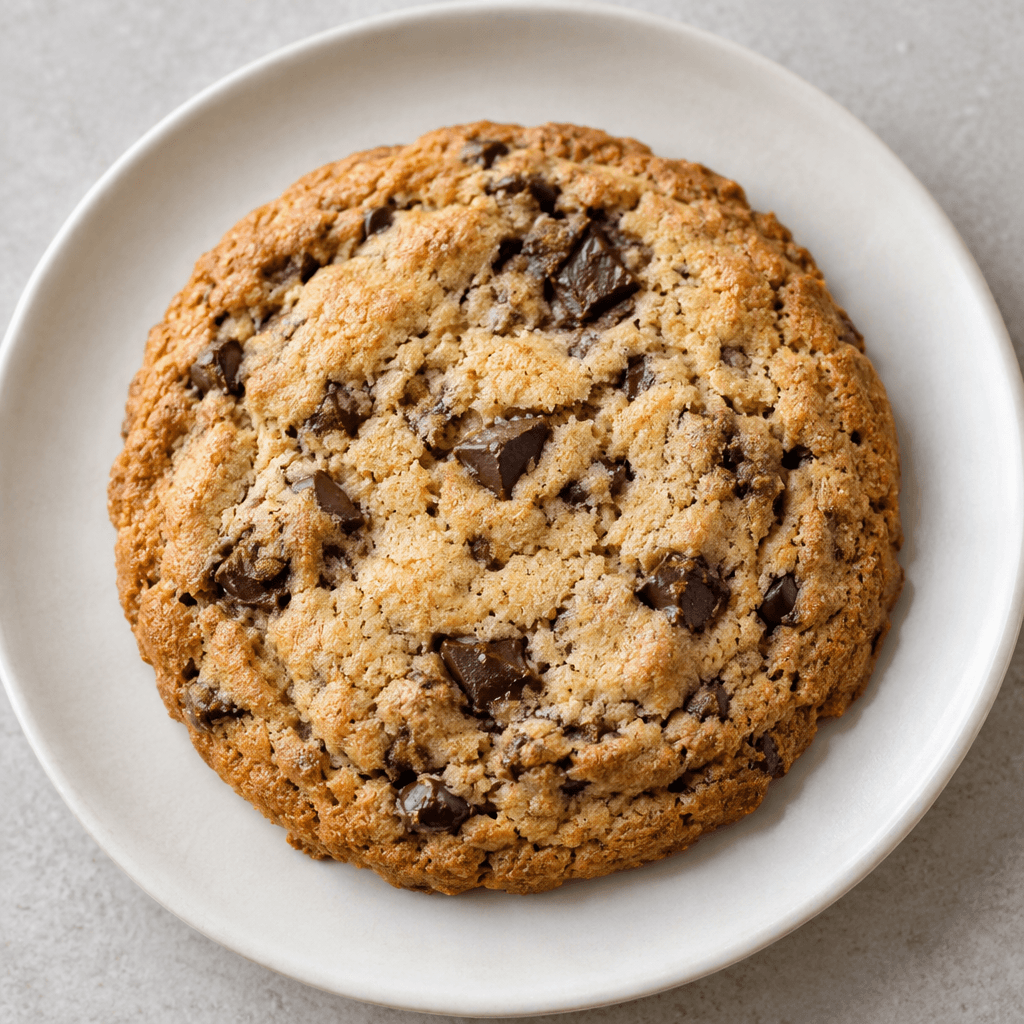
Large cookie Calories
Large, sweet cookie; typically made with flour, sugar, butter.
In season: Spring · Summer · Autumn · Winter
CALORIES
GI
POTASSIUM
FIBER
Quick answer
1 piece (large) of Large cookie (60 g) has 288 calories. That works out to 480 calories per 100 g. It contains 40.8 g of carbs, 3.3 g of protein, 12.6 g of fat and 1.5 g of fiber. Its 192 mg of Sodium covers 8% of the Daily Value. Its glycemic index is 65 (high), so it raises blood sugar quickly.
What is Large cookie?
A large cookie is an oversized baked sweet, commonly made with flour, sugar and butter. Recipes vary, and bakeries may offer plain versions as well as ones with chocolate or other additions; it is usually eaten as a snack or dessert rather than as part of a meal.
Its edges may be crisp while the centre stays soft and chewy. In many English-speaking places, it is served with tea or coffee, packed as a treat to take along, or shared after a meal. It is energy-dense, with 480 calories per 100 g. If you want a lighter snack, split one between people or serve a smaller portion with fruit.
Large cookie Nutrition Facts
Selected: 100 g
480
KCAL / 100G
Carbs
68g
· 25% DV
Protein
5.5g
· 11% DV
Fat
21g
· 27% DV
Fiber
2.5g
· 9% DV
DV is the share of the daily value covered, on a 2,000 kcal reference diet.
Calories come from: Carbs 56% · Protein 5% · Fat 39%
Large cookie Vitamins & Minerals
Vitamins
B2
0.12mg · 9% DV
B3
1.2mg · 8% DV
Biotin
2.5µg · 8% DV
B1
0.08mg · 7% DV
Minerals
Sodium
320mg · 14% DV
Selenium
6µg · 11% DV
Phosphorus
65mg · 9% DV
Iron
1mg · 6% DV
How Nutritious Is Large cookie?
Nutrient density
Low
How many vitamins, minerals and how much fiber this food carries per calorie. A high score means a lot of nutrition for few calories.
Satiety score
Low
An EatBetter score computed from fiber, protein and calorie density. A high score means staying full longer on the same calories.
Both scores are calculated per 100 g and do not change with the selected portion. The satiety score is EatBetter's own calculation, not a clinical measure.
Large cookie Glycemic Index
GLYCEMIC INDEX
GLYCEMIC LOAD
Accounts for portion size — a more realistic measure than GI alone.
How to Burn Off Large cookie
To burn the 480 calories in 100 g:
🚶
Walking (5 km/h)
🏃
Running (8 km/h)
🚴
Cycling
🏊
Swimming
Times are calculated with the MET equation for a 70 kg adult. Actual burn varies with your weight, age and pace.
Is Large cookie Processed?
NOVA 3
Processed
1. Unprocessed
2. Minimally Processed
3. Processed
4. Ultra-Processed
NOVA classifies foods into 4 groups by industrial processing. NOVA 1 (unprocessed) is the healthiest.
Does Large cookie Contain Allergens?
Contains these allergens:
Which Diets Is Large cookie Good For?
Vegan
— Not suitable
Vegetarian
✓ Suitable
Gluten-Free
— Not suitable
Dairy-Free
— Not suitable
Mediterranean
— Not suitable
Paleo
— Not suitable
Whole30
— Not suitable
DASH
— Not suitable
Keto
— Not suitable
Low FODMAP
— Not suitable
Large cookie Fat Profile
SATURATED
8.5g
MONOUNSATURATED
7.2g
POLYUNSATURATED
3.3g
Omega 6:3 ratio 105:1
Above the ideal 4:1 (105:1).
Compare Large cookie
Foods Similar to Large cookie
Frequently Asked Questions About Large cookie
How do you make a large cookie at home?
Make a large cookie by shaping cookie dough into one thick round and baking it on a lined tray. Leave room around the dough for spreading, and take it out when the edges are set while the centre is still slightly soft.
Why does a large cookie spread too much?
A large cookie can spread too much if the butter is warm or the dough is very soft. Chill the shaped dough before baking and use a cool, lined baking tray so the cookie holds its shape better.
How long should you bake a large cookie?
A large cookie’s baking time varies with its thickness and your oven, so a single time does not suit every recipe. Look for set, lightly browned edges and a centre that is still a little soft; it will firm up as it cools.
How can you tell when a large cookie is done?
A large cookie is ready when its edges look set and lightly golden, even if the centre still seems soft. It continues to cook on the hot tray after baking, so waiting for a firm centre in the oven can make it dry.
How do you keep a large cookie soft?
Keep a large cookie soft by storing it only after it has cooled, in an airtight container at room temperature. Avoid baking it until the centre is completely firm, since it will continue to set after leaving the oven.
Can you freeze large cookie dough?
Yes, large cookie dough can be frozen. Shape it into a round first, wrap it well, and thaw it in the refrigerator before baking; check for the recipe’s usual doneness cues, as the dough may need extra time.
Can you bake a large cookie in a skillet?
Yes, you can bake a large cookie in an oven-safe skillet. Press the dough into the pan in an even layer, leaving room for it to spread, and make sure the handle is oven-safe before putting the skillet in.
Why is my large cookie raw in the middle?
A large cookie can stay raw in the middle because its thick centre heats more slowly than its edges. If the edges brown too quickly, lower the oven temperature and continue baking until the centre is just set.
Can you cut a large cookie while it is warm?
Yes, but a large cookie is easier to cut after it has rested briefly on the tray. Cutting it straight from the oven can make the soft centre collapse; for neat slices, let it cool further before serving.
What can you add to a large cookie?
Chocolate chips, chopped nuts, or candy pieces are common additions to a large cookie. Press them gently into the top of the shaped dough so they stay in place and are visible after baking.
Have another question about Large cookie?
Ask the AI nutrition coach — calories, portions, alternatives and more, answered in seconds in the app.

Scan calories with your camera
Instant AI nutrition analysis

Nutrition data compiled from USDA FoodData Central and scientific sources.