

Ready & Packaged Foods
All →Vegetables & Legumes
All →Desserts & Confectionery
All →Meat & Protein
All →Grains & Bakery
All →Beverages
All →Milk & Dairy
All →

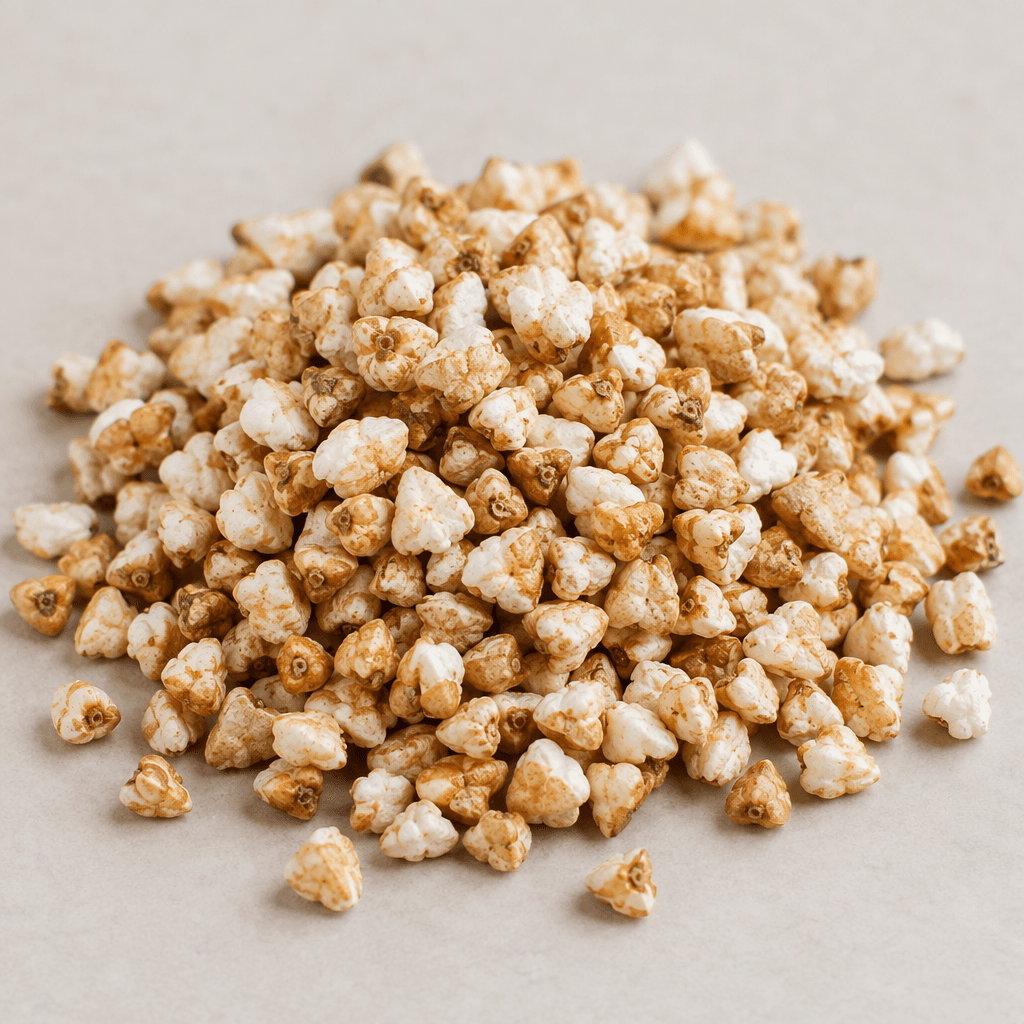
Buckwheat puff Calories
Gluten-free, light, crisp grain product
CALORIES
GI
POTASSIUM
FIBER
Quick answer
1 cup (medium) of Buckwheat puff (14 g) has 51 calories. That works out to 364 calories per 100 g. It contains 10 g of carbs, 1.9 g of protein, 0.5 g of fat and 1.4 g of fiber. Its 32.3 mg of Magnesium covers 8% of the Daily Value. Its glycemic index is 65 (medium), so it raises blood sugar at a moderate pace.
What is Buckwheat puff?
Buckwheat puff is made by heating buckwheat kernels until they expand into small, airy, crisp pieces. It has a mild, toasted, earthy flavour and an irregular shape, making it a crunchy alternative to more familiar puffed grains.
It is commonly eaten at breakfast with milk or yogurt, stirred into cereal and granola, or sprinkled over a yogurt bowl; it also works as a simple snack. Its nutrition is mainly carbohydrate, with 9.8 g of fibre per 100 g. Pair it with fresh fruit, nuts and a protein-rich yogurt for a more substantial breakfast, and add it just before eating if you want to keep its crunch.
Buckwheat puff Nutrition Facts
Selected: 100 g
364
KCAL / 100G
Carbs
71.5g
· 26% DV
Protein
13.3g
· 27% DV
Fat
3.4g
· 4% DV
Fiber
9.8g
· 35% DV
DV is the share of the daily value covered, on a 2,000 kcal reference diet.
Calories come from: Carbs 77% · Protein 14% · Fat 9%
Buckwheat puff Vitamins & Minerals
Vitamins
B3
7mg · 44% DV
B2
0.43mg · 33% DV
B5
1.2mg · 24% DV
Biotin
6µg · 20% DV
Minerals
Magnesium
231mg · 55% DV
Phosphorus
347mg · 50% DV
Manganese
1mg · 43% DV
Zinc
2mg · 18% DV
How Nutritious Is Buckwheat puff?
Nutrient density
Medium
How many vitamins, minerals and how much fiber this food carries per calorie. A high score means a lot of nutrition for few calories.
Satiety score
Medium
An EatBetter score computed from fiber, protein and calorie density. A high score means staying full longer on the same calories.
Both scores are calculated per 100 g and do not change with the selected portion. The satiety score is EatBetter's own calculation, not a clinical measure.
Buckwheat puff Glycemic Index
GLYCEMIC INDEX
GLYCEMIC LOAD
Accounts for portion size — a more realistic measure than GI alone.
How to Burn Off Buckwheat puff
To burn the 364 calories in 100 g:
🚶
Walking (5 km/h)
🏃
Running (8 km/h)
🚴
Cycling
🏊
Swimming
Times are calculated with the MET equation for a 70 kg adult. Actual burn varies with your weight, age and pace.
Is Buckwheat puff Processed?
NOVA 2
Minimally Processed
1. Unprocessed
2. Minimally Processed
3. Processed
4. Ultra-Processed
NOVA classifies foods into 4 groups by industrial processing. NOVA 1 (unprocessed) is the healthiest.
Does Buckwheat puff Contain Allergens?
No known major allergens
Which Diets Is Buckwheat puff Good For?
Vegan
✓ Suitable
Vegetarian
✓ Suitable
Gluten-Free
✓ Suitable
Dairy-Free
— Not suitable
Mediterranean
✓ Suitable
Paleo
— Not suitable
Whole30
— Not suitable
DASH
— Not suitable
Keto
— Not suitable
Low FODMAP
— Not suitable
Buckwheat puff Fat Profile
SATURATED
0.74g
MONOUNSATURATED
1.02g
POLYUNSATURATED
1.03g
Omega 6:3 ratio 11.9:1
Above the ideal 4:1 (11.9:1).
Compare Buckwheat puff
Foods Similar to Buckwheat puff
Frequently Asked Questions About Buckwheat puff
What is a buckwheat puff?
A buckwheat puff is a buckwheat kernel expanded with heat, producing a light, crisp grain. It is usually ready to eat without cooking and is commonly added to breakfast bowls, snacks, or recipes.
How do you eat buckwheat puffs for breakfast?
Add buckwheat puffs to yogurt, milk, or kefir for breakfast, or combine them with fruit and nuts. Stir them in just before eating if you want to keep their crunch.
Do buckwheat puffs need to be cooked?
No, buckwheat puffs are generally ready to eat and do not need cooking. You can eat them plain or sprinkle them over yogurt, soup, or salad; follow the package directions if they specify otherwise.
How are buckwheat puffs made?
Buckwheat puffs are made by rapidly heating buckwheat kernels so they expand and become airy. A home pan-roast usually makes toasted kernels, not the same crisp, puffed texture as commercial buckwheat puffs.
What is the difference between buckwheat puffs and buckwheat groats?
Buckwheat puffs are expanded and crisp, while buckwheat groats are whole kernels that are usually cooked until tender. They behave differently in recipes, so puffs are not a like-for-like substitute for groats.
Why do buckwheat puffs go soggy in yogurt?
Buckwheat puffs absorb moisture from yogurt and gradually lose their crunch. Add them immediately before serving for a crisp topping, or mix them in earlier if you prefer a softer texture.
How should you store buckwheat puffs after opening?
Store buckwheat puffs in a tightly sealed container in a cool, dry place. Exposure to humidity makes them lose their crispness, so reseal the package promptly and keep it away from steam.
Can you add buckwheat puffs to granola?
Yes, buckwheat puffs work well in granola, but add them after baking and cooling. Baking them for a long time can make them overly toasted or diminish the light, crisp texture.
What do buckwheat puffs taste like?
Buckwheat puffs have a mild, earthy, slightly nutty flavor and a crisp texture. Their taste is subtle enough to pair with sweet toppings such as fruit or honey, as well as savory soups and salads.
Can buckwheat puffs help with weight loss?
Buckwheat puffs do not cause weight loss on their own. Their airy texture can make portions easy to underestimate, so pair a measured serving with protein-rich yogurt or another filling food.
Have another question about Buckwheat puff?
Ask the AI nutrition coach — calories, portions, alternatives and more, answered in seconds in the app.

Scan calories with your camera
Instant AI nutrition analysis

Nutrition data compiled from USDA FoodData Central and scientific sources.