

Ready & Packaged Foods
All →Vegetables & Legumes
All →Desserts & Confectionery
All →Meat & Protein
All →Grains & Bakery
All →Beverages
All →Milk & Dairy
All →

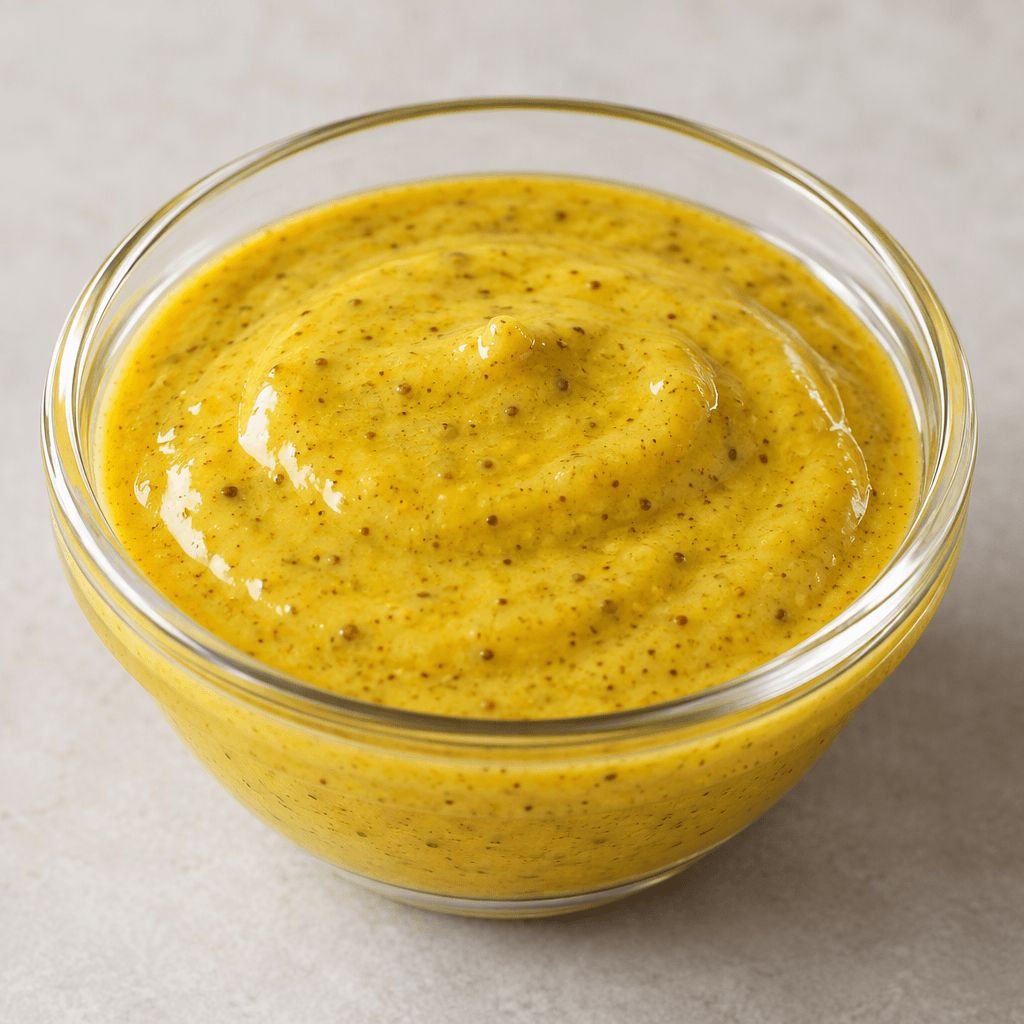
Mustard salad dressing Calories
Tangy mustard-based salad dressing
CALORIES
GI
POTASSIUM
FIBER
Quick answer
2 tablespoon (medium) of Mustard salad dressing (30 g) has 96 calories. That works out to 320 calories per 100 g. It contains 2.6 g of carbs, 0.4 g of protein, 9.3 g of fat and 0.2 g of fiber. Its 270 mg of Sodium covers 12% of the Daily Value. Its glycemic index is 35 (low), so it raises blood sugar slowly.
Mustard salad dressing Nutrition Facts
Selected: 100 g
320
KCAL / 100G
Carbs
8.5g
· 3% DV
Protein
1.2g
· 2% DV
Fat
31g
· 40% DV
Fiber
0.7g
· 3% DV
DV is the share of the daily value covered, on a 2,000 kcal reference diet.
Calories come from: Carbs 11% · Protein 2% · Fat 87%
Mustard salad dressing Vitamins & Minerals
Vitamins
Vitamin K
38µg · 32% DV
Vitamin E
2.1mg · 14% DV
Biotin
1.2µg · 4% DV
B1
0.02mg · 2% DV
Minerals
Sodium
900mg · 39% DV
Phosphorus
18mg · 3% DV
Calcium
22mg · 2% DV
Magnesium
7mg · 2% DV
How Nutritious Is Mustard salad dressing?
Nutrient density
Low
How many vitamins, minerals and how much fiber this food carries per calorie. A high score means a lot of nutrition for few calories.
Satiety score
Low
An EatBetter score computed from fiber, protein and calorie density. A high score means staying full longer on the same calories.
Both scores are calculated per 100 g and do not change with the selected portion. The satiety score is EatBetter's own calculation, not a clinical measure.
Mustard salad dressing Glycemic Index
GLYCEMIC INDEX
GLYCEMIC LOAD
Accounts for portion size — a more realistic measure than GI alone.
How to Burn Off Mustard salad dressing
To burn the 320 calories in 100 g:
🚶
Walking (5 km/h)
🏃
Running (8 km/h)
🚴
Cycling
🏊
Swimming
Times are calculated with the MET equation for a 70 kg adult. Actual burn varies with your weight, age and pace.
Is Mustard salad dressing Processed?
NOVA 3
Processed
1. Unprocessed
2. Minimally Processed
3. Processed
4. Ultra-Processed
NOVA classifies foods into 4 groups by industrial processing. NOVA 1 (unprocessed) is the healthiest.
Does Mustard salad dressing Contain Allergens?
No known major allergens
Which Diets Is Mustard salad dressing Good For?
Vegan
— Not suitable
Vegetarian
✓ Suitable
Gluten-Free
— Not suitable
Dairy-Free
— Not suitable
Mediterranean
✓ Suitable
Paleo
— Not suitable
Whole30
— Not suitable
DASH
— Not suitable
Keto
— Not suitable
Low FODMAP
— Not suitable
Mustard salad dressing Fat Profile
SATURATED
2.8g
MONOUNSATURATED
19g
POLYUNSATURATED
7.5g
Omega 6:3 ratio 11.2:1
Above the ideal 4:1 (11.2:1).
Compare Mustard salad dressing
Foods Similar to Mustard salad dressing
Frequently Asked Questions About Mustard salad dressing
How long does mustard salad dressing keep after opening?
Once opened, it should be kept refrigerated with the lid tightly closed. Follow the storage guidance on the label, and discard it if the smell, color, or texture changes noticeably.
Can mustard salad dressing be frozen?
Usually not recommended. Freezing and thawing can break the emulsion, causing separation and a poorer texture.
Why does mustard salad dressing sometimes taste sharp or slightly bitter?
That usually comes from mustard’s natural pungency and the acidic ingredients such as vinegar. You can soften the flavor by pairing it with yogurt, olive oil, or a small amount of honey.
What foods go best with mustard salad dressing?
It works well with leafy salads, potato salad, chicken, tuna, and sandwiches. Its sharp flavor adds contrast to milder ingredients.
Can mustard salad dressing make a salad soggy?
Yes, especially if it is added too early to watery vegetables or delicate greens. For better texture, dress the salad just before serving.
Is mustard salad dressing better before or after a workout?
It is better thought of as a condiment than a workout food on its own. Before training, a small amount is usually more comfortable, while after training it fits best alongside a protein-containing meal.
Is mustard salad dressing lighter than mayonnaise?
Not always. Some mustard dressings are mayonnaise-based and can feel similarly rich, while others are more vinegar-forward and lighter in texture.
Should mustard salad dressing be used cold or can it be heated?
It is mostly used cold. Heating can change the texture and may cause the dressing to split, so it is usually best added after cooking rather than during high heat.
Who should be careful with mustard salad dressing?
Anyone with a mustard allergy should avoid it completely. Its sharp, acidic profile may also bother some people with reflux or a sensitive stomach.
Is mustard salad dressing automatically healthy because it goes on salad?
No. It can make salads more enjoyable, but it is still a processed product and easy to overuse, so portion awareness matters.
Have another question about Mustard salad dressing?
Ask the AI nutrition coach — calories, portions, alternatives and more, answered in seconds in the app.

Scan calories with your camera
Instant AI nutrition analysis

Nutrition data compiled from USDA FoodData Central and scientific sources.