

Ready & Packaged Foods
All →Vegetables & Legumes
All →Desserts & Confectionery
All →Meat & Protein
All →Grains & Bakery
All →Beverages
All →Milk & Dairy
All →

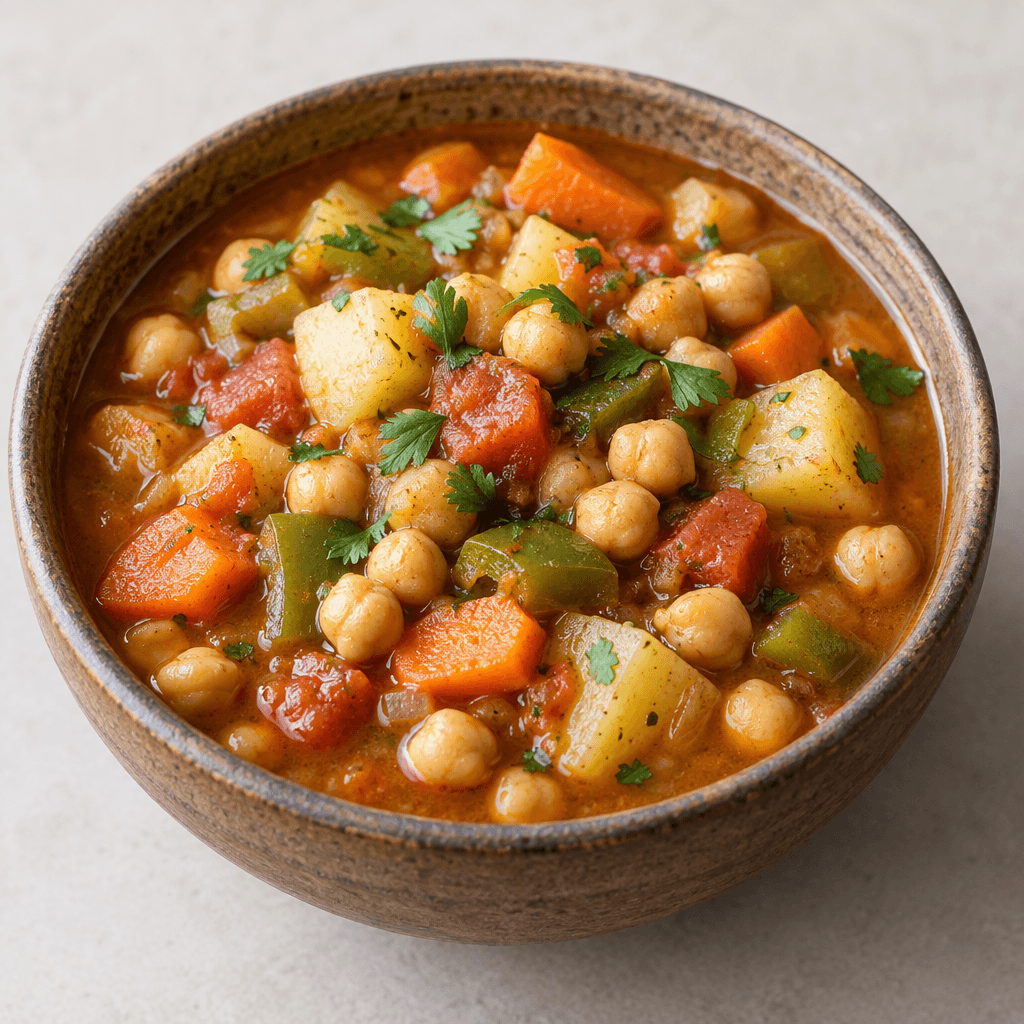
Chickpea Stew with Vegetables Calories
Plant-based protein, fiber, vitamins and minerals. Vegan and gluten-free.
In season: Spring · Summer · Autumn · Winter
CALORIES
GI
POTASSIUM
FIBER
Quick answer
1 cup (medium) of Chickpea Stew with Vegetables (200 g) has 220 calories. That works out to 110 calories per 100 g. It contains 35 g of carbs, 8.4 g of protein, 4.2 g of fat and 9.2 g of fiber. Its 0.4 mg of Copper covers 42% of the Daily Value. Its glycemic index is 35 (low), so it raises blood sugar slowly.
Chickpea Stew with Vegetables Nutrition Facts
Selected: 100 g
110
KCAL / 100G
Carbs
17.5g
· 6% DV
Protein
4.2g
· 8% DV
Fat
2.1g
· 3% DV
Fiber
4.6g
· 16% DV
DV is the share of the daily value covered, on a 2,000 kcal reference diet.
Calories come from: Carbs 66% · Protein 16% · Fat 18%
Chickpea Stew with Vegetables Vitamins & Minerals
Vitamins
Folate
55µg · 14% DV
Biotin
3.5µg · 12% DV
B1
0.12mg · 10% DV
Vitamin C
8mg · 9% DV
Minerals
Iron
2mg · 11% DV
Phosphorus
78mg · 11% DV
Sodium
220mg · 10% DV
Zinc
1mg · 9% DV
How Nutritious Is Chickpea Stew with Vegetables?
Nutrient density
High
How many vitamins, minerals and how much fiber this food carries per calorie. A high score means a lot of nutrition for few calories.
Satiety score
Medium
An EatBetter score computed from fiber, protein and calorie density. A high score means staying full longer on the same calories.
Both scores are calculated per 100 g and do not change with the selected portion. The satiety score is EatBetter's own calculation, not a clinical measure.
Chickpea Stew with Vegetables Glycemic Index
GLYCEMIC INDEX
GLYCEMIC LOAD
Accounts for portion size — a more realistic measure than GI alone.
How to Burn Off Chickpea Stew with Vegetables
To burn the 110 calories in 100 g:
🚶
Walking (5 km/h)
🏃
Running (8 km/h)
🚴
Cycling
🏊
Swimming
Times are calculated with the MET equation for a 70 kg adult. Actual burn varies with your weight, age and pace.
Is Chickpea Stew with Vegetables Processed?
NOVA 2
Minimally Processed
1. Unprocessed
2. Minimally Processed
3. Processed
4. Ultra-Processed
NOVA classifies foods into 4 groups by industrial processing. NOVA 1 (unprocessed) is the healthiest.
Does Chickpea Stew with Vegetables Contain Allergens?
No known major allergens
Which Diets Is Chickpea Stew with Vegetables Good For?
Vegan
✓ Suitable
Vegetarian
✓ Suitable
Gluten-Free
✓ Suitable
Dairy-Free
— Not suitable
Mediterranean
✓ Suitable
Paleo
— Not suitable
Whole30
— Not suitable
DASH
— Not suitable
Keto
— Not suitable
Low FODMAP
— Not suitable
Chickpea Stew with Vegetables Fat Profile
SATURATED
0.22g
MONOUNSATURATED
0.48g
POLYUNSATURATED
0.35g
Omega 6:3 ratio 10.7:1
Above the ideal 4:1 (10.7:1).
Compare Chickpea Stew with Vegetables
Foods Similar to Chickpea Stew with Vegetables
Frequently Asked Questions About Chickpea Stew with Vegetables
Does chickpea stew with vegetables taste better the next day?
Yes, it often does. Like many legume dishes, the flavors meld and deepen after resting overnight in the fridge.
Can chickpea stew with vegetables be frozen?
Yes, it freezes well in individual portions. Reheat gently after thawing; some vegetables may soften a bit more, but the dish is usually still very good.
How can I make chickpea stew easier to digest?
Soaking dried chickpeas well, changing the soaking water, and cooking them thoroughly can help. Some people also find spices like cumin, fennel, or ginger useful for reducing bloating.
Is chickpea stew with vegetables better before or after a workout?
It can work for either, depending on portion size and timing. Before training, a smaller serving may feel lighter; after training, pairing it with grains or yogurt can make the meal more substantial.
What goes well with chickpea stew with vegetables?
It pairs well with rice, bulgur, whole-grain bread, or a simple salad. These sides can make the meal more filling and round out the texture and flavor.
Is canned chickpea stew less healthy than homemade?
Not necessarily. Homemade gives you more control over salt and oil, but a canned or shortcut version can still be a reasonable choice, especially if you rinse canned chickpeas first.
Is chickpea stew with vegetables okay to eat at night?
Yes, for most people it is. Its fiber can help with fullness, but very large portions late at night may feel heavy if you are sensitive to legumes.
Is chickpea stew with vegetables suitable for children?
Usually yes, especially when the chickpeas and vegetables are cooked until soft. For younger children, softer texture and smaller chickpea pieces can make it easier and safer to eat.
Can chickpea stew with vegetables help with weight management?
It can fit well into a weight-management plan because the fiber and protein may support fullness. Portion size and how much oil or bread you add still matter.
Why does chickpea stew sometimes taste bitter or overly sour?
Bitterness can come from over-browned tomato paste, garlic, or onions. Excess sourness usually comes from acidic tomatoes or added lemon, and it can often be balanced by gentler cooking and seasoning.
Have another question about Chickpea Stew with Vegetables?
Ask the AI nutrition coach — calories, portions, alternatives and more, answered in seconds in the app.

Scan calories with your camera
Instant AI nutrition analysis

Nutrition data compiled from USDA FoodData Central and scientific sources.