

Ready & Packaged Foods
All →Vegetables & Legumes
All →Desserts & Confectionery
All →Meat & Protein
All →Grains & Bakery
All →Beverages
All →Milk & Dairy
All →

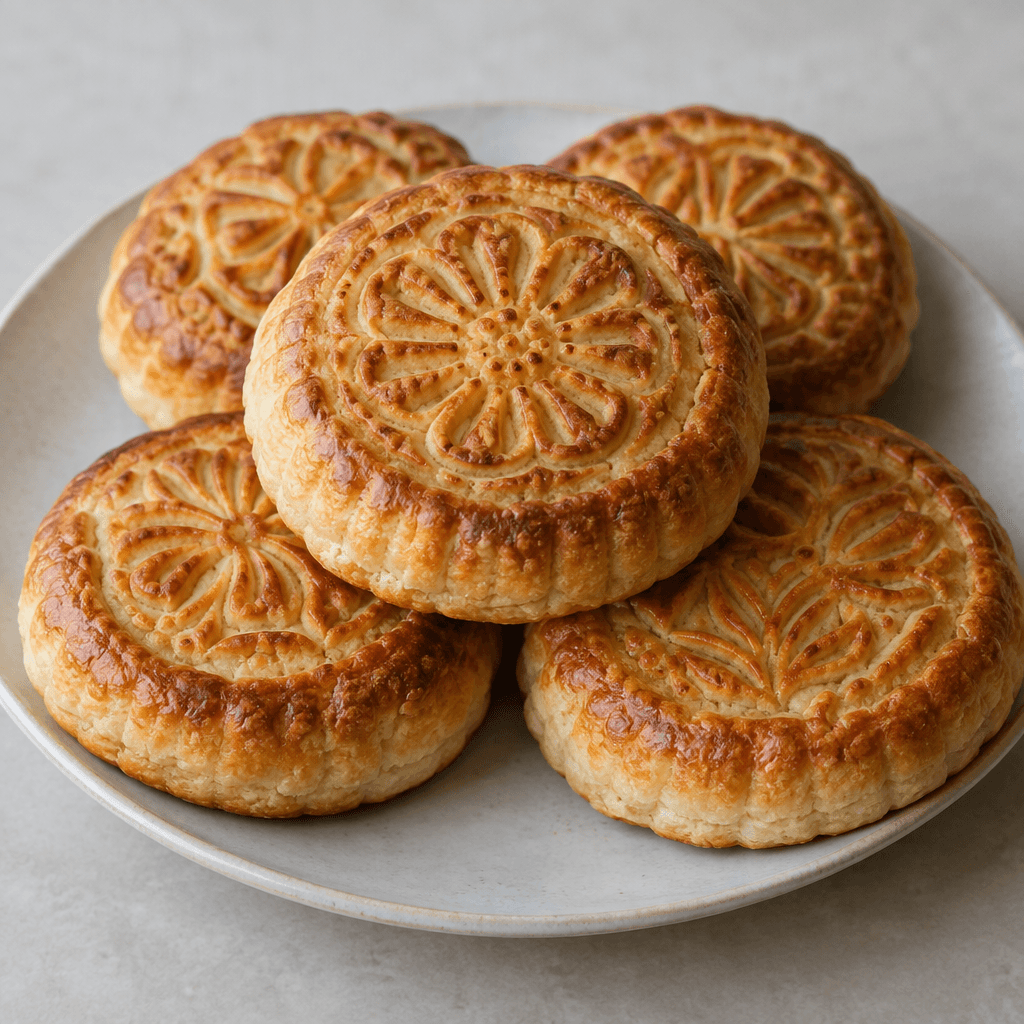
Bayram kömbesi Calories
Traditional festive pastry, spiced and filled cookie
In season: Spring · Summer · Autumn · Winter
CALORIES
GI
POTASSIUM
FIBER
Quick answer
1 piece (medium) of Bayram kömbesi (60 g) has 252 calories. That works out to 420 calories per 100 g. It contains 37.2 g of carbs, 4.2 g of protein, 9.6 g of fat and 1.5 g of fiber. Its 4.2 µg of Selenium covers 8% of the Daily Value. Its glycemic index is 65 (high), so it raises blood sugar quickly.
What is Bayram kömbesi?
Bayram kömbesi is a traditional Turkish festive cookie, especially associated with Hatay and nearby parts of southern Turkey. Its aromatic, spiced dough is shaped in a patterned mould and typically encloses a filling; recipes vary, with dates or walnuts among the common choices. Families often make it for Bayram, the holiday marking the end of Ramadan, as well as other festive occasions.
The outside is usually firm or lightly crisp, while the centre is softer and fragrant with spices. It is served to guests with tea and enjoyed as a sweet between meals. Made largely from flour and sugar, with a noticeable amount of fat, it is an energy-dense treat. A small piece alongside tea makes a satisfying festive offering.
Bayram kömbesi Nutrition Facts
Selected: 100 g
420
KCAL / 100G
Carbs
62g
· 23% DV
Protein
7g
· 14% DV
Fat
16g
· 21% DV
Fiber
2.5g
· 9% DV
DV is the share of the daily value covered, on a 2,000 kcal reference diet.
Calories come from: Carbs 59% · Protein 7% · Fat 34%
Bayram kömbesi Vitamins & Minerals
Vitamins
B1
0.12mg · 10% DV
B2
0.09mg · 7% DV
B3
1.1mg · 7% DV
B5
0.35mg · 7% DV
Minerals
Selenium
7µg · 13% DV
Iron
2mg · 11% DV
Zinc
1mg · 9% DV
Phosphorus
65mg · 9% DV
How Nutritious Is Bayram kömbesi?
Nutrient density
Low
How many vitamins, minerals and how much fiber this food carries per calorie. A high score means a lot of nutrition for few calories.
Satiety score
Low
An EatBetter score computed from fiber, protein and calorie density. A high score means staying full longer on the same calories.
Both scores are calculated per 100 g and do not change with the selected portion. The satiety score is EatBetter's own calculation, not a clinical measure.
Bayram kömbesi Glycemic Index
GLYCEMIC INDEX
GLYCEMIC LOAD
Accounts for portion size — a more realistic measure than GI alone.
How to Burn Off Bayram kömbesi
To burn the 420 calories in 100 g:
🚶
Walking (5 km/h)
🏃
Running (8 km/h)
🚴
Cycling
🏊
Swimming
Times are calculated with the MET equation for a 70 kg adult. Actual burn varies with your weight, age and pace.
Is Bayram kömbesi Processed?
NOVA 3
Processed
1. Unprocessed
2. Minimally Processed
3. Processed
4. Ultra-Processed
NOVA classifies foods into 4 groups by industrial processing. NOVA 1 (unprocessed) is the healthiest.
Does Bayram kömbesi Contain Allergens?
Contains these allergens:
Which Diets Is Bayram kömbesi Good For?
Vegan
— Not suitable
Vegetarian
✓ Suitable
Gluten-Free
— Not suitable
Dairy-Free
— Not suitable
Mediterranean
— Not suitable
Paleo
— Not suitable
Whole30
— Not suitable
DASH
— Not suitable
Keto
— Not suitable
Low FODMAP
— Not suitable
Bayram kömbesi Fat Profile
SATURATED
5.2g
MONOUNSATURATED
5.8g
POLYUNSATURATED
3.2g
Omega 6:3 ratio 35:1
Above the ideal 4:1 (35:1).
Compare Bayram kömbesi
Foods Similar to Bayram kömbesi
Frequently Asked Questions About Bayram kömbesi
What is Bayram kömbesi?
Bayram kömbesi is a spiced Turkish pastry traditionally made for festive occasions, especially Bayram. It is shaped as a cookie, often with a patterned surface, and may be plain or filled depending on the regional or family recipe.
How is Bayram kömbesi traditionally served?
Bayram kömbesi is usually served as a sweet treat with Turkish tea when family and guests gather for Bayram. It is commonly prepared ahead of the celebration, so it can be offered alongside other festive sweets.
What ingredients are used in Bayram kömbesi?
Bayram kömbesi is generally made with flour, fat, sugar, and a fragrant spice blend. Recipes may also include milk or yogurt, while filled versions can contain dates, walnuts, or another local filling.
What spices give Bayram kömbesi its distinctive flavor?
A blend of spices gives Bayram kömbesi its characteristic aroma. Depending on the recipe, it may include cinnamon, mahleb, allspice, ginger, cloves, or fennel; there is no single fixed blend used everywhere.
Is Bayram kömbesi filled with dates or made plain?
Bayram kömbesi can be either filled or plain. Some regional and household recipes use date or walnut filling, while others let the spiced dough provide the flavor without adding a center.
Why is Bayram kömbesi pressed into a wooden mold?
Bayram kömbesi is often pressed into a carved mold to give it a decorative pattern and familiar shape. The mold is traditional rather than essential; the dough can also be shaped by hand if one is unavailable.
Where does Bayram kömbesi come from?
Bayram kömbesi is strongly associated with Hatay, particularly Antakya, in southern Turkey. Kömbe traditions vary across the region, so the spice mix, filling, and shaping method can differ between households.
How do you keep Bayram kömbesi from becoming crumbly?
To keep Bayram kömbesi from becoming crumbly, avoid adding too much flour and do not overbake it. The dough should hold together when shaped, and the cookies should cool fully before being moved or stored.
How should Bayram kömbesi be stored?
Store Bayram kömbesi only after it has cooled completely, in an airtight container in a cool, dry place. Keep it away from moisture; filled versions are best eaten sooner than plain cookies.
Can Bayram kömbesi be frozen?
Yes, Bayram kömbesi can be frozen once fully cooled. Pack the cookies in an airtight freezer-safe container, separating layers if needed, and thaw them at room temperature before serving.
Have another question about Bayram kömbesi?
Ask the AI nutrition coach — calories, portions, alternatives and more, answered in seconds in the app.

Scan calories with your camera
Instant AI nutrition analysis

Nutrition data compiled from USDA FoodData Central and scientific sources.