

Ready & Packaged Foods
All →Vegetables & Legumes
All →Desserts & Confectionery
All →Meat & Protein
All →Grains & Bakery
All →Beverages
All →Milk & Dairy
All →

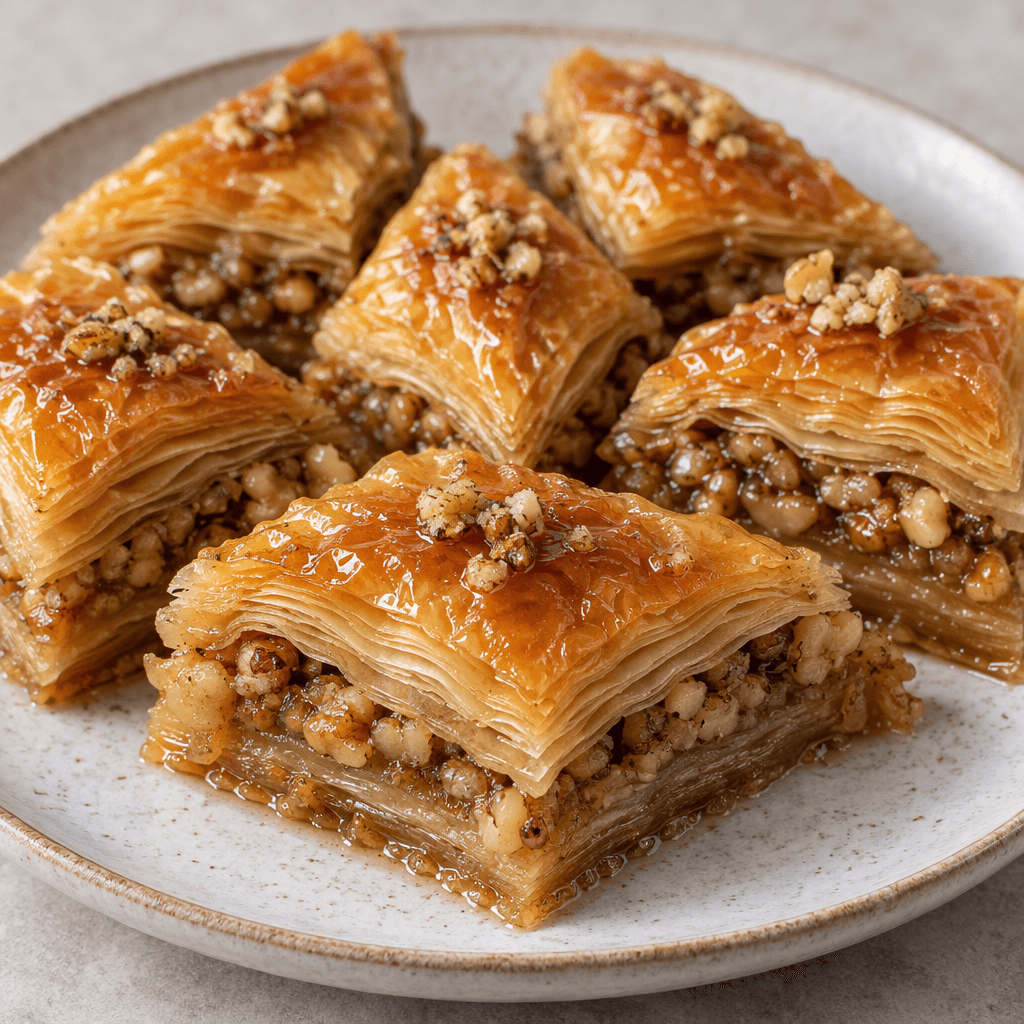
Baklava with walnuts and butter Calories
Traditional walnut & butter baklava; high energy, rich in sugar and fat
In season: Spring · Summer · Autumn · Winter
CALORIES
GI
POTASSIUM
FIBER
Quick answer
1 piece (medium) of Baklava with walnuts and butter (50 g) has 210 calories. That works out to 420 calories per 100 g. It contains 27 g of carbs, 2.6 g of protein, 10.5 g of fat and 1.2 g of fiber. Its 0.1 mg of Copper covers 16% of the Daily Value. Its glycemic index is 65 (high), so it raises blood sugar quickly.
What is Baklava with walnuts and butter?
Baklava with walnuts and butter is a layered pastry: thin sheets of dough are brushed with butter, filled with chopped walnuts, baked until crisp and finished with syrup. It is closely associated with Ottoman cuisine and is enjoyed in Turkey and across parts of the Middle East and the Balkans, with local variations in the filling and syrup.
Its flaky layers contrast with the nutty centre, while the syrup makes each bite rich and sweet. It is commonly served in small pieces with tea or coffee, especially at celebrations and when welcoming guests. The pastry is energy-dense and high in sugar and fat; 100 g provides 420 kcal. A small piece alongside unsweetened tea or coffee makes a satisfying treat without needing a large serving.
Baklava with walnuts and butter Nutrition Facts
Selected: 100 g
420
KCAL / 100G
Carbs
54g
· 20% DV
Protein
5.2g
· 10% DV
Fat
21g
· 27% DV
Fiber
2.4g
· 9% DV
DV is the share of the daily value covered, on a 2,000 kcal reference diet.
Calories come from: Carbs 51% · Protein 5% · Fat 44%
Baklava with walnuts and butter Vitamins & Minerals
Vitamins
B2
0.13mg · 10% DV
B1
0.09mg · 8% DV
Biotin
2.5µg · 8% DV
Vitamin A
60µg · 7% DV
Minerals
Manganese
1mg · 43% DV
Zinc
1mg · 9% DV
Phosphorus
62mg · 9% DV
Sodium
180mg · 8% DV
How Nutritious Is Baklava with walnuts and butter?
Nutrient density
Low
How many vitamins, minerals and how much fiber this food carries per calorie. A high score means a lot of nutrition for few calories.
Satiety score
Low
An EatBetter score computed from fiber, protein and calorie density. A high score means staying full longer on the same calories.
Both scores are calculated per 100 g and do not change with the selected portion. The satiety score is EatBetter's own calculation, not a clinical measure.
Baklava with walnuts and butter Glycemic Index
GLYCEMIC INDEX
GLYCEMIC LOAD
Accounts for portion size — a more realistic measure than GI alone.
How to Burn Off Baklava with walnuts and butter
To burn the 420 calories in 100 g:
🚶
Walking (5 km/h)
🏃
Running (8 km/h)
🚴
Cycling
🏊
Swimming
Times are calculated with the MET equation for a 70 kg adult. Actual burn varies with your weight, age and pace.
Is Baklava with walnuts and butter Processed?
NOVA 3
Processed
1. Unprocessed
2. Minimally Processed
3. Processed
4. Ultra-Processed
NOVA classifies foods into 4 groups by industrial processing. NOVA 1 (unprocessed) is the healthiest.
Does Baklava with walnuts and butter Contain Allergens?
Contains these allergens:
Which Diets Is Baklava with walnuts and butter Good For?
Vegan
— Not suitable
Vegetarian
✓ Suitable
Gluten-Free
— Not suitable
Dairy-Free
— Not suitable
Mediterranean
✓ Suitable
Paleo
— Not suitable
Whole30
— Not suitable
DASH
— Not suitable
Keto
— Not suitable
Low FODMAP
— Not suitable
Baklava with walnuts and butter Fat Profile
SATURATED
7.8g
MONOUNSATURATED
7.2g
POLYUNSATURATED
5.9g
Omega 6:3 ratio 8.7:1
Above the ideal 4:1 (8.7:1).
Compare Baklava with walnuts and butter
Foods Similar to Baklava with walnuts and butter
Frequently Asked Questions About Baklava with walnuts and butter
What is baklava with walnuts and butter made of?
Baklava with walnuts and butter is made with thin pastry sheets layered with walnuts and butter, baked, then soaked in sugar syrup. Recipes vary in the number of layers and may flavor the syrup with lemon or spices.
How is baklava with walnuts and butter traditionally made?
Baklava with walnuts and butter is traditionally assembled by brushing pastry sheets with melted butter, adding a layer of chopped walnuts, and repeating the layers. It is cut before baking, then finished with syrup after it comes out of the oven.
Is baklava with walnuts and butter Turkish or Greek?
Baklava with walnuts and butter is made in Turkey and across several neighboring cuisines, so it is not exclusive to one modern country. Turkish baklava has its own regional styles, ingredients, and preparation traditions.
What should you serve with baklava with walnuts and butter?
Baklava with walnuts and butter pairs well with unsweetened Turkish coffee or tea, which balances its sweet syrup. Fresh fruit can also make a refreshing accompaniment; another rich dessert is usually unnecessary.
Can you reheat baklava with walnuts and butter?
Yes, baklava with walnuts and butter can be gently reheated in a low oven to refresh its crisp pastry. Avoid the microwave, which can make the layers soft or chewy, and let the piece cool briefly before serving.
How do you cut baklava with walnuts and butter without crushing it?
Cut baklava with walnuts and butter with a sharp knife before baking, using decisive downward strokes rather than sawing. If it is already baked, wipe the knife between cuts and press gently through the crisp top layers.
Does baklava with walnuts and butter need to be refrigerated?
No, baklava with walnuts and butter generally does not need refrigeration. Keep it covered in an airtight container in a cool, dry place; chilling can make the pastry firm and affect its crisp texture.
Can you make baklava with walnuts and butter ahead of time?
Yes, baklava with walnuts and butter can be made ahead and stored covered at room temperature in a cool, dry place. For the best texture, protect it from humidity and avoid sealing it while it is still warm.
Can you use other nuts instead of walnuts in baklava with walnuts and butter?
Yes, you can replace the walnuts in baklava with walnuts and butter with pistachios or another finely chopped nut, but the result is a variation rather than the walnut version. The nut changes the flavor and texture of the filling.
Why is baklava with walnuts and butter cut into diamond shapes?
Diamond cuts are a traditional way to portion baklava with walnuts and butter, and cutting the pastry before baking helps the syrup reach the layers. Squares and other shapes are also used, depending on the tray and regional style.
Have another question about Baklava with walnuts and butter?
Ask the AI nutrition coach — calories, portions, alternatives and more, answered in seconds in the app.

Scan calories with your camera
Instant AI nutrition analysis

Nutrition data compiled from USDA FoodData Central and scientific sources.