

Ready & Packaged Foods
All →Vegetables & Legumes
All →Desserts & Confectionery
All →Meat & Protein
All →Grains & Bakery
All →Beverages
All →Milk & Dairy
All →

Unsweetened ashure Calories
No-added-sugar traditional pudding with grains and legumes
CALORIES
GI
POTASSIUM
FIBER
Quick answer
100 g of Unsweetened ashure has 112 calories. It contains 20.1 g of carbs, 3.4 g of protein, 2.1 g of fat and 3.2 g of fiber. Its 0.4 mg of Manganese covers 18% of the Daily Value. Its glycemic index is 48 (low), so it raises blood sugar slowly.
What is Unsweetened ashure?
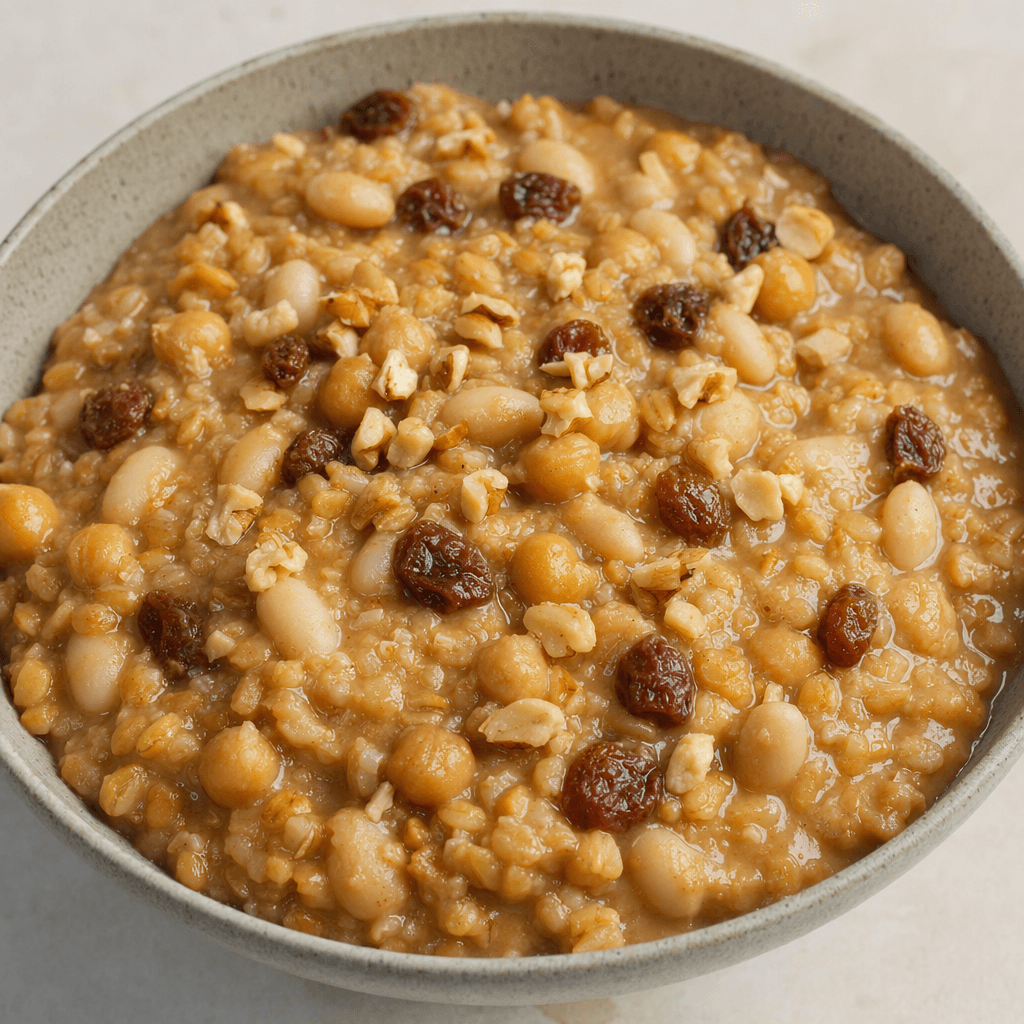
Unsweetened ashure is a traditional Turkish pudding made by simmering wheat with legumes such as chickpeas and white beans, then adding dried fruit and often nuts. With no sugar added, its sweetness comes mainly from ingredients such as raisins, apricots or figs, though recipes vary from household to household.
It has a thick, spoonable texture with soft grains and beans, and is usually served chilled or at room temperature, often topped with cinnamon or chopped nuts. In Turkey, it is especially associated with Muharram and is commonly made to share with neighbours; elsewhere, it works well as a make-ahead dessert or filling snack. The grains, legumes and fruit give it a mix of carbohydrates and fibre, with 3.2 g of fibre per 100 g. For a lighter topping, use just a small sprinkle of nuts.
Unsweetened ashure Nutrition Facts
Selected: 100 g
112
KCAL / 100G
Carbs
20.1g
· 7% DV
Protein
3.4g
· 7% DV
Fat
2.1g
· 3% DV
Fiber
3.2g
· 11% DV
DV is the share of the daily value covered, on a 2,000 kcal reference diet.
Calories come from: Carbs 71% · Protein 12% · Fat 17%
Unsweetened ashure Vitamins & Minerals
Vitamins
B1
0.08mg · 7% DV
Biotin
1.8µg · 6% DV
B6
0.09mg · 5% DV
Folate
18µg · 5% DV
Minerals
Phosphorus
78mg · 11% DV
Zinc
1mg · 9% DV
Magnesium
28mg · 7% DV
Iron
1mg · 6% DV
How Nutritious Is Unsweetened ashure?
Nutrient density
Medium
How many vitamins, minerals and how much fiber this food carries per calorie. A high score means a lot of nutrition for few calories.
Satiety score
Medium
An EatBetter score computed from fiber, protein and calorie density. A high score means staying full longer on the same calories.
Both scores are calculated per 100 g and do not change with the selected portion. The satiety score is EatBetter's own calculation, not a clinical measure.
Unsweetened ashure Glycemic Index
GLYCEMIC INDEX
GLYCEMIC LOAD
Accounts for portion size — a more realistic measure than GI alone.
How to Burn Off Unsweetened ashure
To burn the 112 calories in 100 g:
🚶
Walking (5 km/h)
🏃
Running (8 km/h)
🚴
Cycling
🏊
Swimming
Times are calculated with the MET equation for a 70 kg adult. Actual burn varies with your weight, age and pace.
Is Unsweetened ashure Processed?
NOVA 2
Minimally Processed
1. Unprocessed
2. Minimally Processed
3. Processed
4. Ultra-Processed
NOVA classifies foods into 4 groups by industrial processing. NOVA 1 (unprocessed) is the healthiest.
Does Unsweetened ashure Contain Allergens?
No known major allergens
Which Diets Is Unsweetened ashure Good For?
Vegan
— Not suitable
Vegetarian
✓ Suitable
Gluten-Free
— Not suitable
Dairy-Free
— Not suitable
Mediterranean
✓ Suitable
Paleo
— Not suitable
Whole30
— Not suitable
DASH
— Not suitable
Keto
— Not suitable
Low FODMAP
— Not suitable
Unsweetened ashure Fat Profile
SATURATED
0.24g
MONOUNSATURATED
0.48g
POLYUNSATURATED
0.58g
Omega 6:3 ratio 17.3:1
Above the ideal 4:1 (17.3:1).
Compare Unsweetened ashure
Foods Similar to Unsweetened ashure
Frequently Asked Questions About Unsweetened ashure
How do you make unsweetened ashure?
To make unsweetened ashure, cook soaked wheat until tender, then add separately cooked chickpeas and beans. Simmer with dried fruit until the mixture thickens. Let it cool before judging the consistency, since the grains continue to absorb liquid.
What is unsweetened ashure made of?
Unsweetened ashure is usually made with wheat berries, chickpeas, and white beans, often combined with raisins or other dried fruit. Recipes vary by household and region; nuts, pomegranate seeds, and cinnamon are common toppings.
Can ashure be made without sugar?
Yes, ashure can be prepared without adding sugar. Dried fruit such as raisins, figs, or apricots can provide sweetness, though they still contain naturally occurring sugars, so the finished pudding is not necessarily sugar-free.
How can you sweeten unsweetened ashure without adding sugar?
Use chopped dried figs, apricots, or raisins to sweeten unsweetened ashure without adding table sugar. Simmer them with the grains so their flavor spreads through the pudding; keep in mind that dried fruit contributes natural sugars.
Why does unsweetened ashure get thicker as it cools?
Unsweetened ashure thickens as it cools because starch released from the wheat and the cooked grains absorb more of the liquid. If it looks slightly loose in the pot, allow it to cool before adding more water or cooking it down further.
Is unsweetened ashure the same as Noah’s pudding?
They commonly refer to the same Turkish pudding: aşure, also known in English as Noah’s pudding. The grain-and-legume base is similar, but the exact ingredients and toppings vary between families; leaving out added sugar is one recipe variation.
How long does unsweetened ashure last in the fridge?
Unsweetened ashure generally keeps for 3–4 days in a covered container in the refrigerator. Cool it promptly after cooking, and serve portions from a clean bowl rather than leaving the whole batch out for an extended time.
Can you freeze unsweetened ashure?
Yes, you can freeze unsweetened ashure in airtight, portion-sized containers. The wheat and beans may soften and the pudding may separate slightly after thawing, so defrost it in the refrigerator and stir well before serving.
What toppings go well on unsweetened ashure?
Cinnamon, pomegranate seeds, walnuts, hazelnuts, and almonds are classic toppings for unsweetened ashure. Add nuts just before serving to keep them crisp, and use pomegranate for a fresh, tart contrast to the grains and dried fruit.
Can people with diabetes eat unsweetened ashure?
People with diabetes may be able to include unsweetened ashure, but wheat, beans, and dried fruit all contribute carbohydrates. Portion size and the rest of the meal matter; ask your doctor or dietitian how it fits your individual blood-glucose plan.
Have another question about Unsweetened ashure?
Ask the AI nutrition coach — calories, portions, alternatives and more, answered in seconds in the app.

Scan calories with your camera
Instant AI nutrition analysis

Nutrition data compiled from USDA FoodData Central and scientific sources.