

Ready & Packaged Foods
All →Vegetables & Legumes
All →Desserts & Confectionery
All →Meat & Protein
All →Grains & Bakery
All →Beverages
All →Milk & Dairy
All →

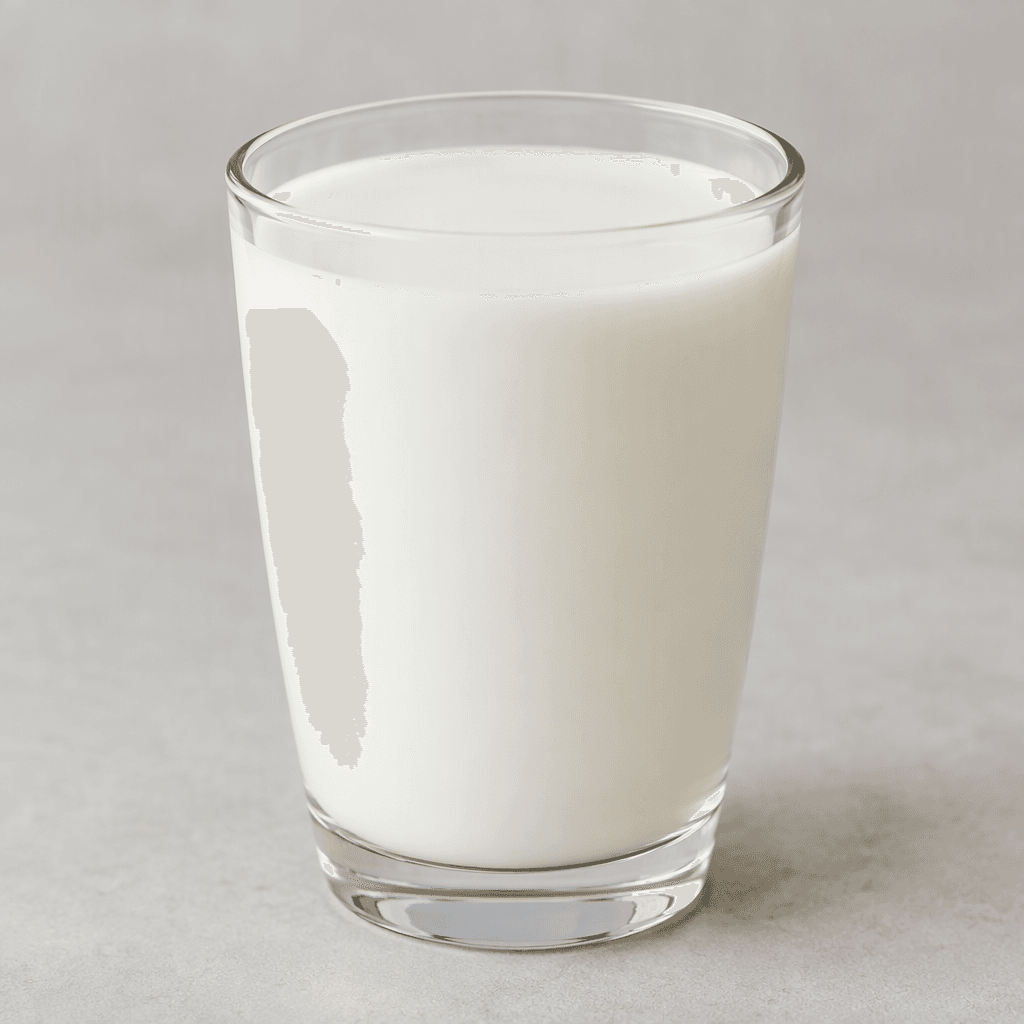
3% fat milk Calories
Good source of protein and calcium
CALORIES
GI
POTASSIUM
FIBER
Quick answer
1 cup (medium) of 3% fat milk (244 g) has 149 calories. That works out to 61 calories per 100 g. It contains 11.7 g of carbs, 7.8 g of protein, 7.3 g of fat and 0 g of fiber. Its 1.1 µg of B12 covers 46% of the Daily Value. Its glycemic index is 31 (low), so it raises blood sugar slowly.
What is 3% fat milk?
3% fat milk is cow’s milk with around three percent fat, commonly sold as a standard everyday milk. It can be enjoyed on its own or used in drinks and cooking. Depending on where you live, it may be poured over cereal, added to tea or coffee, or used in sauces, soups and baking.
Its flavour is gently sweet and its smooth texture has a noticeable creaminess without being especially rich. It provides protein and calcium, making it an easy fit for breakfast or a snack. Serve it chilled with fruit or cereal, or use it in place of water when you want a softer, creamier result in porridge.
3% fat milk Nutrition Facts
Selected: 100 g
61
KCAL / 100G
Carbs
4.8g
· 2% DV
Protein
3.2g
· 6% DV
Fat
3g
· 4% DV
Fiber
0g
· 0% DV
DV is the share of the daily value covered, on a 2,000 kcal reference diet.
Calories come from: Carbs 33% · Protein 22% · Fat 45%
3% fat milk Vitamins & Minerals
Vitamins
B12
0.45µg · 19% DV
B2
0.18mg · 14% DV
Biotin
3.2µg · 11% DV
B5
0.35mg · 7% DV
Minerals
Phosphorus
84mg · 12% DV
Calcium
113mg · 11% DV
Iodine
16µg · 11% DV
Selenium
3.7µg · 7% DV
How Nutritious Is 3% fat milk?
Nutrient density
High
How many vitamins, minerals and how much fiber this food carries per calorie. A high score means a lot of nutrition for few calories.
Satiety score
Medium
An EatBetter score computed from fiber, protein and calorie density. A high score means staying full longer on the same calories.
Both scores are calculated per 100 g and do not change with the selected portion. The satiety score is EatBetter's own calculation, not a clinical measure.
3% fat milk Glycemic Index
GLYCEMIC INDEX
GLYCEMIC LOAD
Accounts for portion size — a more realistic measure than GI alone.
How to Burn Off 3% fat milk
To burn the 61 calories in 100 g:
🚶
Walking (5 km/h)
🏃
Running (8 km/h)
🚴
Cycling
🏊
Swimming
Times are calculated with the MET equation for a 70 kg adult. Actual burn varies with your weight, age and pace.
Is 3% fat milk Processed?
NOVA 2
Minimally Processed
1. Unprocessed
2. Minimally Processed
3. Processed
4. Ultra-Processed
NOVA classifies foods into 4 groups by industrial processing. NOVA 1 (unprocessed) is the healthiest.
Does 3% fat milk Contain Allergens?
Contains these allergens:
Which Diets Is 3% fat milk Good For?
Vegan
— Not suitable
Vegetarian
✓ Suitable
Gluten-Free
✓ Suitable
Dairy-Free
— Not suitable
Mediterranean
✓ Suitable
Paleo
— Not suitable
Whole30
— Not suitable
DASH
— Not suitable
Keto
✓ Suitable
Low FODMAP
— Not suitable
3% fat milk Fat Profile
SATURATED
1.9g
MONOUNSATURATED
0.8g
POLYUNSATURATED
0.14g
Omega 6:3 ratio 1.8:1
Below the ideal 4:1 — a good omega balance.
Compare 3% fat milk
Foods Similar to 3% fat milk
Frequently Asked Questions About 3% fat milk
Is 3% fat milk the same as whole milk?
Not always. 3% fat milk describes its fat content, while “whole milk” is a category whose standard varies between countries. Compare the stated fat percentage rather than assuming the two names mean exactly the same thing.
Can you use 3% fat milk instead of whole milk in baking?
Yes, 3% fat milk can usually replace whole milk in cakes, pancakes, and sauces. The result may be slightly less rich if the recipe expects milk with more fat, but the substitution generally works without changing the quantity.
Should you boil 3% fat milk before drinking it?
No, not if the 3% fat milk is pasteurized or UHT; it is ready to drink, and boiling can alter its taste or cause it to boil over. Raw milk should be handled differently and boiled before use.
How long does 3% fat milk last after opening?
Keep opened 3% fat milk tightly closed in the refrigerator and use it within a few days, or sooner if the package says so. Store it on a cold shelf rather than in the refrigerator door, where temperatures fluctuate more.
Can you freeze 3% fat milk?
Yes, 3% fat milk can be frozen, but it may separate and look grainy after thawing. Leave room in the container for expansion, thaw it in the refrigerator, and shake it well before using it in drinks or cooking.
Can you make yogurt with 3% fat milk?
Yes, 3% fat milk works for homemade yogurt. Heat the milk, let it cool to a suitable starter temperature, then mix in yogurt culture; the finished yogurt may be less thick and creamy than one made with higher-fat milk.
Is 3% fat milk lactose-free?
No, ordinary 3% fat milk contains lactose; the percentage refers to fat, not milk sugar. Choose a product specifically labeled lactose-free if you need to avoid lactose, since lactose-free milk is available at different fat levels.
Why does 3% fat milk curdle in coffee?
3% fat milk can curdle when cold milk meets very hot, acidic coffee, especially if the milk is starting to spoil. Add it gradually, warm it first, and discard it if it smells or looks unusual.
Does 3% fat milk cause weight gain?
No single serving of 3% fat milk determines weight gain. Regularly taking in more energy than your body uses can lead to weight gain, so consider how much milk you drink and what you add to it.
Can toddlers drink 3% fat milk?
Children under 12 months should not have 3% fat milk as their main drink; breast milk or infant formula is appropriate instead. After the first birthday, milk can be part of a toddler’s diet, alongside varied foods.
Have another question about 3% fat milk?
Ask the AI nutrition coach — calories, portions, alternatives and more, answered in seconds in the app.

Scan calories with your camera
Instant AI nutrition analysis

Nutrition data compiled from USDA FoodData Central and scientific sources.