

Ready & Packaged Foods
All →Vegetables & Legumes
All →Desserts & Confectionery
All →Meat & Protein
All →Grains & Bakery
All →Beverages
All →Milk & Dairy
All →

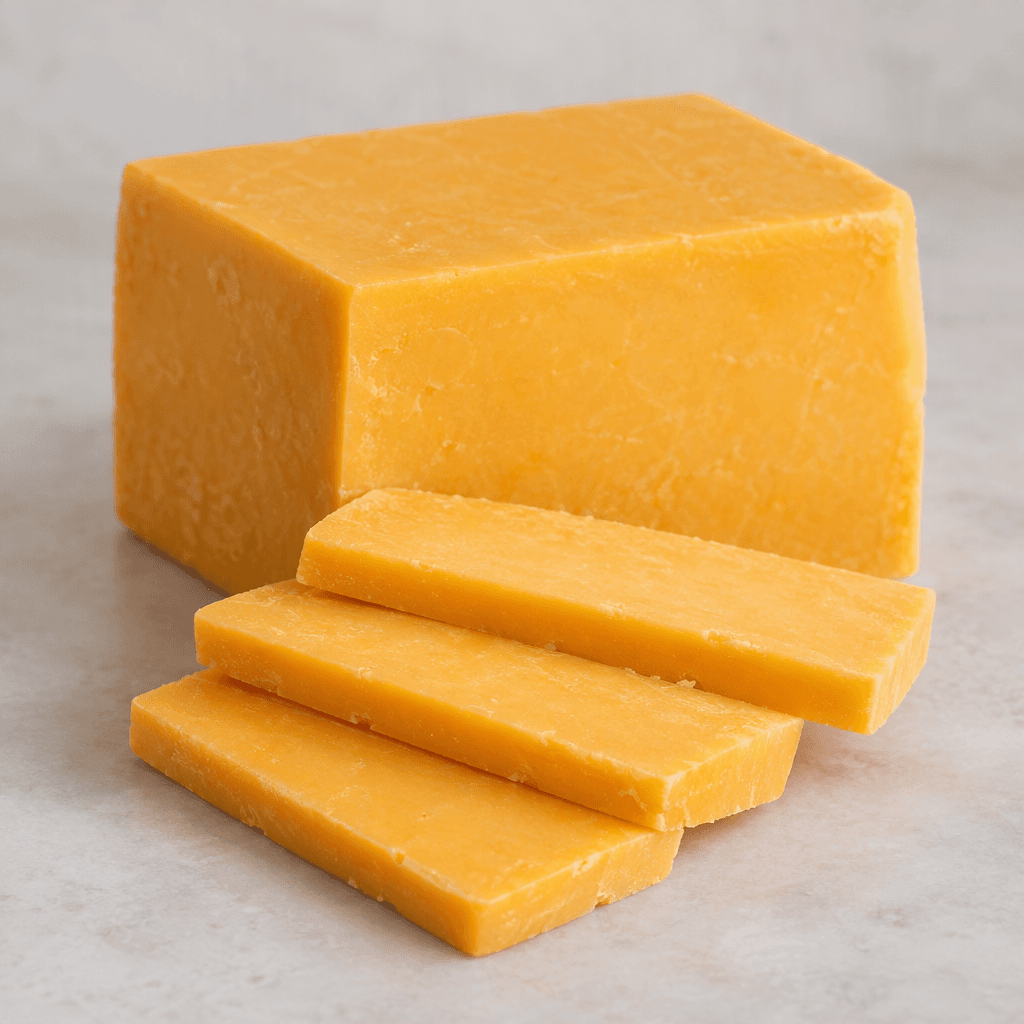
Cheddar cheese Calories
Rich in protein and calcium, flavorful hard cheese
In season: Spring · Summer · Autumn · Winter
CALORIES
GI
POTASSIUM
FIBER
Quick answer
1 slice (medium) of Cheddar cheese (25 g) has 101 calories. That works out to 402 calories per 100 g. It contains 0.3 g of carbs, 6.3 g of protein, 8.3 g of fat and 0 g of fiber. Its 6 µg of Vitamin D covers 30% of the Daily Value. Its glycemic index is 0 (low), so it raises blood sugar slowly.
What is Cheddar cheese?
Cheddar cheese is a firm cow’s-milk cheese that takes its name from the village of Cheddar in Somerset, England. Its colour ranges from pale yellow to golden orange, and its flavour can be mild and creamy or sharper and more pronounced, depending on how it has matured. The texture is dense when sliced, but it melts smoothly in hot dishes.
In Britain it is a familiar choice for sandwiches, cheese on toast and savoury cooking; worldwide, it is also popular in burgers, baked potatoes and macaroni cheese. Cheddar cheese is rich in protein and calcium, and its full flavour means a little can go a long way. Pair it with apple or chutney, or use a thinner slice when you want a lighter sandwich.
Cheddar cheese Nutrition Facts
Selected: 100 g
402
KCAL / 100G
Carbs
1.3g
· 0% DV
Protein
25g
· 50% DV
Fat
33g
· 42% DV
Fiber
0g
· 0% DV
DV is the share of the daily value covered, on a 2,000 kcal reference diet.
Calories come from: Carbs 1% · Protein 25% · Fat 74%
Cheddar cheese Vitamins & Minerals
Vitamins
Vitamin D
24µg · 120% DV
B12
1µg · 42% DV
Vitamin A
265µg · 29% DV
B2
0.35mg · 27% DV
Minerals
Phosphorus
512mg · 73% DV
Calcium
721mg · 72% DV
Zinc
3mg · 27% DV
Sodium
621mg · 27% DV
How Nutritious Is Cheddar cheese?
Nutrient density
High
How many vitamins, minerals and how much fiber this food carries per calorie. A high score means a lot of nutrition for few calories.
Satiety score
Low
An EatBetter score computed from fiber, protein and calorie density. A high score means staying full longer on the same calories.
Both scores are calculated per 100 g and do not change with the selected portion. The satiety score is EatBetter's own calculation, not a clinical measure.
Cheddar cheese Glycemic Index
GLYCEMIC INDEX
GLYCEMIC LOAD
Accounts for portion size — a more realistic measure than GI alone.
How to Burn Off Cheddar cheese
To burn the 402 calories in 100 g:
🚶
Walking (5 km/h)
🏃
Running (8 km/h)
🚴
Cycling
🏊
Swimming
Times are calculated with the MET equation for a 70 kg adult. Actual burn varies with your weight, age and pace.
Is Cheddar cheese Processed?
NOVA 3
Processed
1. Unprocessed
2. Minimally Processed
3. Processed
4. Ultra-Processed
NOVA classifies foods into 4 groups by industrial processing. NOVA 1 (unprocessed) is the healthiest.
Does Cheddar cheese Contain Allergens?
Contains these allergens:
Which Diets Is Cheddar cheese Good For?
Vegan
— Not suitable
Vegetarian
✓ Suitable
Gluten-Free
✓ Suitable
Dairy-Free
— Not suitable
Mediterranean
✓ Suitable
Paleo
— Not suitable
Whole30
— Not suitable
DASH
— Not suitable
Keto
✓ Suitable
Low FODMAP
— Not suitable
Cheddar cheese Fat Profile
SATURATED
21g
MONOUNSATURATED
9.4g
POLYUNSATURATED
1g
Omega 6:3 ratio 3.5:1
Below the ideal 4:1 — a good omega balance.
Compare Cheddar cheese
Foods Similar to Cheddar cheese
Frequently Asked Questions About Cheddar cheese
What is cheddar cheese known for?
Cheddar cheese is known for its firm texture and flavour that ranges from mild to sharp as it matures. It originated in the English village of Cheddar, where the traditional curd-cutting and stacking process became known as cheddaring.
What is the difference between mild and sharp cheddar cheese?
Sharp cheddar cheese has been aged longer than mild cheddar, so it tends to taste more pronounced and have a drier, crumblier texture. Mild cheddar is usually softer and melts more readily, making it a popular everyday choice.
Why is some cheddar cheese orange?
Some cheddar cheese is orange because annatto, a plant-derived colouring, is added during production. White cheddar is not a different cheese style, and the colour does not reliably tell you how old or flavourful the cheese is.
Is cheddar cheese lactose-free?
No, cheddar cheese is not necessarily lactose-free, although aged cheddar usually contains very little lactose because much of it is removed or broken down during cheesemaking and maturation. The amount varies, so people with lactose intolerance may react differently.
How long does cheddar cheese last after opening?
Opened cheddar cheese keeps best when tightly wrapped and refrigerated, with the cut surface protected from air. A block generally stays in good condition longer than shredded or sliced cheddar; discard it if it develops an unusual smell or a slimy texture.
Can you freeze cheddar cheese?
Yes, cheddar cheese can be frozen, but thawing may make it drier and more crumbly. Freeze it well wrapped, preferably in portions, and use it in cooked dishes such as sauces or casseroles rather than relying on its original slicing texture.
Can you eat the rind on cheddar cheese?
Usually, cheddar cheese does not have a natural edible rind: its outer covering may be wax, cloth, or another protective material. Remove that covering before eating, and check what it is made of if the packaging does not make it clear.
How do you melt cheddar cheese without it getting oily?
Melt cheddar cheese gently over low heat and stir it into a warm sauce gradually rather than heating it hard on its own. High heat can separate the fat from the cheese, leaving an oily, grainy result.
Can dogs eat cheddar cheese?
Dogs can have a small piece of cheddar cheese as an occasional treat, but it is rich and may upset a dog that is sensitive to dairy. Avoid giving it regularly, and do not offer it to a dog with a known dairy intolerance.
Is cheddar cheese safe to eat during pregnancy?
Yes, cheddar cheese made with pasteurized milk is generally safe during pregnancy. If the cheddar is made from unpasteurized milk, avoid eating it cold; ask your maternity care provider if you are unsure about a particular product.
Have another question about Cheddar cheese?
Ask the AI nutrition coach — calories, portions, alternatives and more, answered in seconds in the app.

Scan calories with your camera
Instant AI nutrition analysis

Nutrition data compiled from USDA FoodData Central and scientific sources.