

Ready & Packaged Foods
All →Vegetables & Legumes
All →Desserts & Confectionery
All →Meat & Protein
All →Grains & Bakery
All →Beverages
All →Milk & Dairy
All →

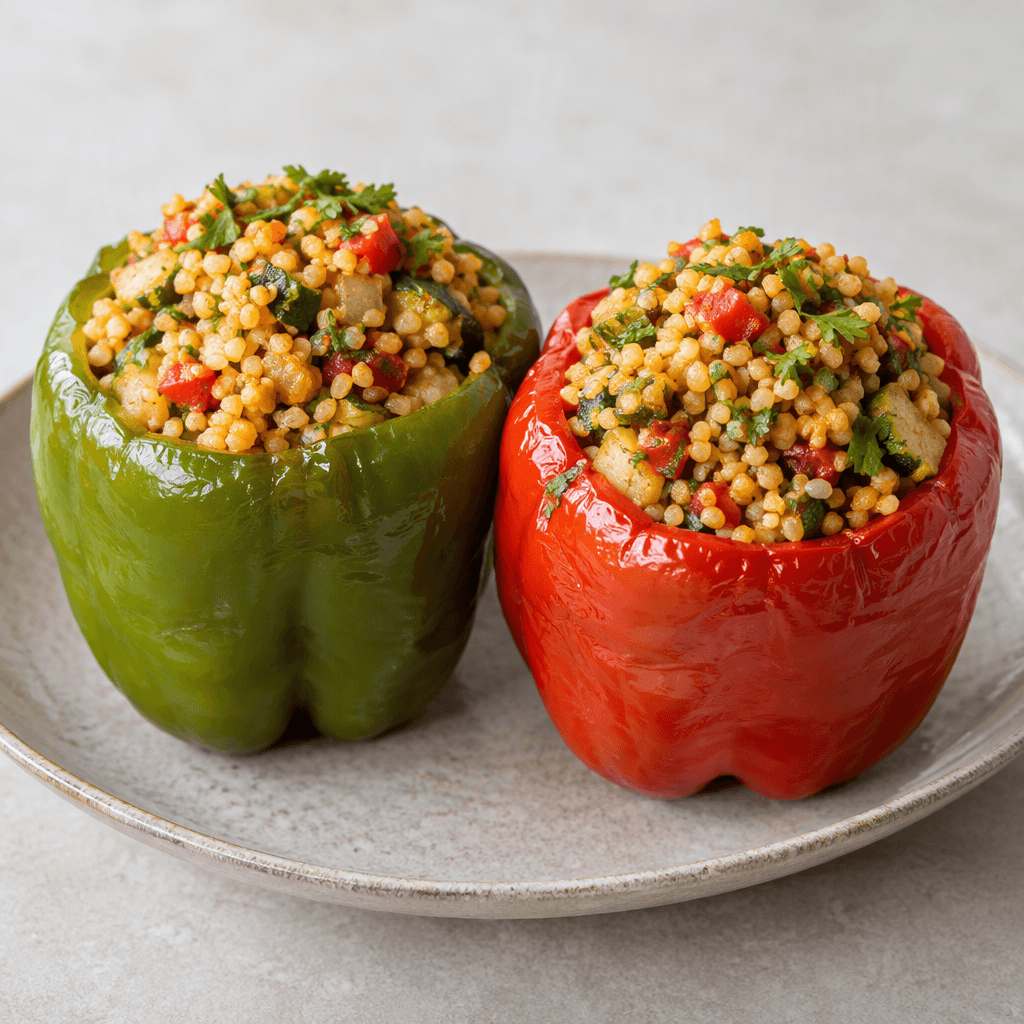
Stuffed Peppers with Bulgur Calories
Peppers stuffed with bulgur, olive oil, vegetables; healthy main dish
In season: Summer · Autumn
CALORIES
GI
POTASSIUM
FIBER
Quick answer
1 piece (medium) of Stuffed Peppers with Bulgur (160 g) has 176 calories. That works out to 110 calories per 100 g. It contains 29.1 g of carbs, 5 g of protein, 4.3 g of fat and 5.1 g of fiber. Its 76.8 mg of Vitamin C covers 85% of the Daily Value. Its glycemic index is 55 (medium), so it raises blood sugar at a moderate pace.
Stuffed Peppers with Bulgur Nutrition Facts
Selected: 100 g
110
KCAL / 100G
Carbs
18.2g
· 7% DV
Protein
3.1g
· 6% DV
Fat
2.7g
· 3% DV
Fiber
3.2g
· 11% DV
DV is the share of the daily value covered, on a 2,000 kcal reference diet.
Calories come from: Carbs 66% · Protein 11% · Fat 23%
Stuffed Peppers with Bulgur Vitamins & Minerals
Vitamins
Vitamin C
48mg · 53% DV
Vitamin A
140µg · 16% DV
B6
0.18mg · 11% DV
Vitamin E
1.3mg · 9% DV
Minerals
Zinc
1mg · 9% DV
Phosphorus
54mg · 8% DV
Iron
1mg · 6% DV
Potassium ⭐
210mg · 6% DV
How Nutritious Is Stuffed Peppers with Bulgur?
Nutrient density
Medium
How many vitamins, minerals and how much fiber this food carries per calorie. A high score means a lot of nutrition for few calories.
Satiety score
Medium
An EatBetter score computed from fiber, protein and calorie density. A high score means staying full longer on the same calories.
Both scores are calculated per 100 g and do not change with the selected portion. The satiety score is EatBetter's own calculation, not a clinical measure.
Stuffed Peppers with Bulgur Glycemic Index
GLYCEMIC INDEX
GLYCEMIC LOAD
Accounts for portion size — a more realistic measure than GI alone.
How to Burn Off Stuffed Peppers with Bulgur
To burn the 110 calories in 100 g:
🚶
Walking (5 km/h)
🏃
Running (8 km/h)
🚴
Cycling
🏊
Swimming
Times are calculated with the MET equation for a 70 kg adult. Actual burn varies with your weight, age and pace.
Is Stuffed Peppers with Bulgur Processed?
NOVA 2
Minimally Processed
1. Unprocessed
2. Minimally Processed
3. Processed
4. Ultra-Processed
NOVA classifies foods into 4 groups by industrial processing. NOVA 1 (unprocessed) is the healthiest.
Does Stuffed Peppers with Bulgur Contain Allergens?
No known major allergens
Which Diets Is Stuffed Peppers with Bulgur Good For?
Vegan
✓ Suitable
Vegetarian
✓ Suitable
Gluten-Free
— Not suitable
Dairy-Free
— Not suitable
Mediterranean
✓ Suitable
Paleo
— Not suitable
Whole30
— Not suitable
DASH
— Not suitable
Keto
— Not suitable
Low FODMAP
— Not suitable
Stuffed Peppers with Bulgur Fat Profile
SATURATED
0.37g
MONOUNSATURATED
1.22g
POLYUNSATURATED
0.32g
Omega 6:3 ratio 7.3:1
Above the ideal 4:1 (7.3:1).
Compare Stuffed Peppers with Bulgur
Foods Similar to Stuffed Peppers with Bulgur
Frequently Asked Questions About Stuffed Peppers with Bulgur
Is stuffed peppers with bulgur better as a main dish or a side?
It can work as either, depending on portion size. Adding yogurt, a bean dish, or a salad makes it feel more complete and satisfying as a meal.
Why does the bulgur filling sometimes turn out dry, and how can I fix it?
Dry filling usually comes from too little liquid, too little oil, or overcooking. A bit more water, grated tomato, or olive oil in the filling helps keep it softer.
How do you cook stuffed peppers without making the peppers bitter?
Very high heat and long cooking can toughen the peppers and bring out bitterness. Gentle simmering with enough liquid usually gives a sweeter, softer result.
Is stuffed peppers with bulgur better before or after a workout?
It is often easier to use as a pre-workout meal a couple of hours beforehand because bulgur provides steady energy but also contains fibre. After training, pairing it with a protein-rich side can make it more recovery-friendly.
Can you eat stuffed peppers with bulgur at night?
Yes, but a very large portion late in the evening may feel heavy for some people. Keeping the portion moderate and the sides simple is usually more comfortable.
How does bulgur-stuffed pepper compare with rice-stuffed pepper?
Bulgur usually gives a nuttier taste and a firmer, grainier texture than rice. Many people also find it more filling because it contains fibre.
How long does stuffed peppers with bulgur keep in the fridge?
Once cooked and cooled, it generally keeps for up to 3 days in an airtight container in the fridge. It should not be left at room temperature for long.
Can stuffed peppers with bulgur be frozen?
Yes, it freezes well enough, though the pepper texture may soften after thawing. Freezing in single-meal portions makes reheating easier.
What goes well with stuffed peppers with bulgur?
Yogurt, tzatziki-style sides, tomato salad, and lentil dishes pair especially well with it. These combinations can add freshness or extra protein, depending on what the meal needs.
Who should be careful with stuffed peppers with bulgur?
People with sensitive digestion, reflux, or symptoms triggered by onion, garlic, or peppers may tolerate it less well. If it is made salty, those monitoring sodium intake should also pay attention to the recipe and portion.
Have another question about Stuffed Peppers with Bulgur?
Ask the AI nutrition coach — calories, portions, alternatives and more, answered in seconds in the app.

Scan calories with your camera
Instant AI nutrition analysis

Nutrition data compiled from USDA FoodData Central and scientific sources.