

Ready & Packaged Foods
All →Vegetables & Legumes
All →Desserts & Confectionery
All →Meat & Protein
All →Grains & Bakery
All →Beverages
All →Milk & Dairy
All →

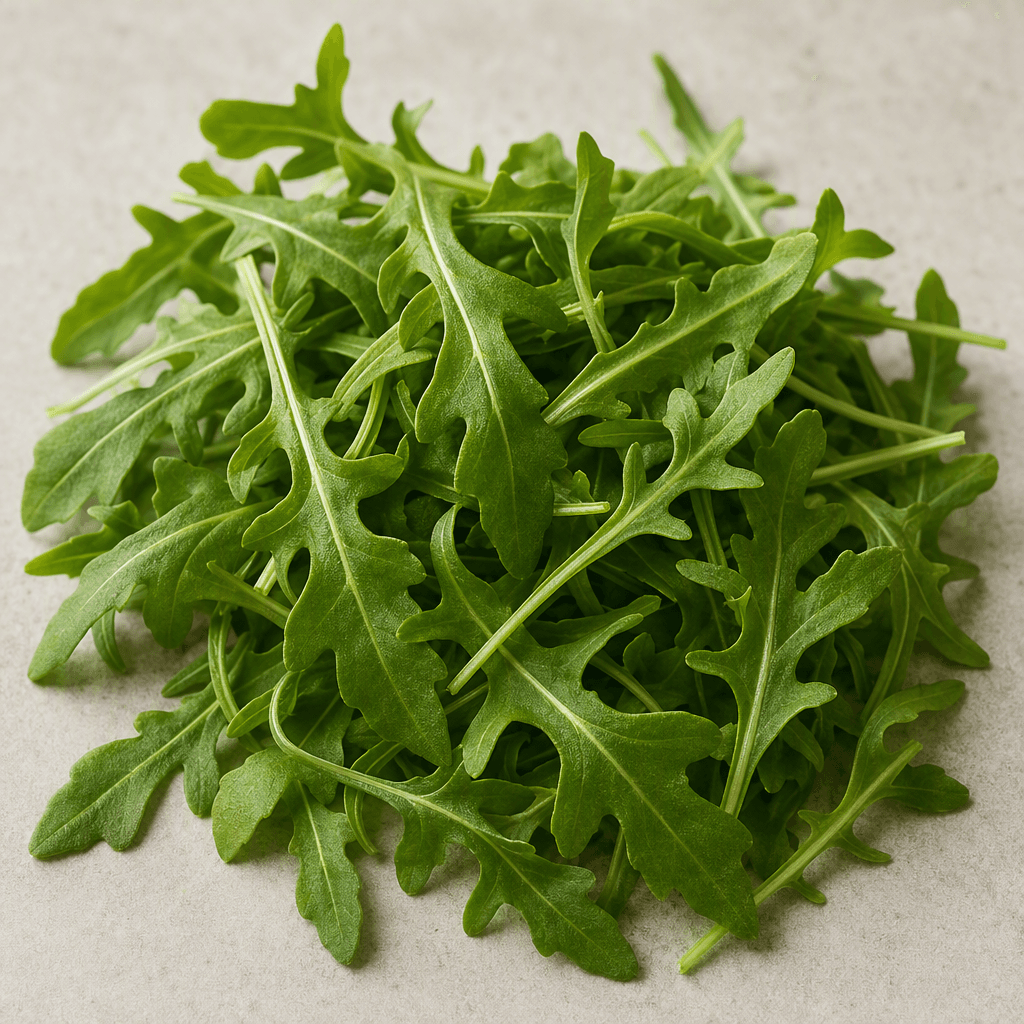
Arugula Calories
Leafy green, rich in vitamin K and C, low calorie
In season: Spring · Summer · Autumn
CALORIES
GI
POTASSIUM
FIBER
Quick answer
1 cup (medium) of Arugula (20 g) has 5 calories. That works out to 25 calories per 100 g. It contains 0.7 g of carbs, 0.5 g of protein, 0.1 g of fat and 0.3 g of fiber. Its 21.7 µg of Vitamin K covers 18% of the Daily Value. Its glycemic index is 15 (low), so it raises blood sugar slowly.
What is Arugula?
Arugula is a leafy green with slender stems and distinctive, deeply lobed leaves. Common around the Mediterranean, it is usually eaten raw, either as a salad leaf or added to dishes just before serving.
Its crisp texture and peppery, slightly bitter flavour bring freshness to salads, sandwiches and pizzas. In Italy it is often served with tomatoes, cheese or cured meats; elsewhere, it works well alongside grilled fish or roasted vegetables. Arugula is low in calories and provides fibre as well as vitamins C and K. For a simple, lighter salad, dress it with lemon juice and a little olive oil shortly before eating.
Arugula Nutrition Facts
Selected: 100 g
25
KCAL / 100G
Carbs
3.7g
· 1% DV
Protein
2.6g
· 5% DV
Fat
0.7g
· 1% DV
Fiber
1.6g
· 6% DV
DV is the share of the daily value covered, on a 2,000 kcal reference diet.
Calories come from: Carbs 47% · Protein 33% · Fat 20%
Arugula Vitamins & Minerals
Vitamins
Vitamin K
108.6µg · 90% DV
Folate
97µg · 24% DV
Vitamin C
15mg · 17% DV
Vitamin A
119µg · 13% DV
Minerals
Calcium
160mg · 16% DV
Iron
2mg · 11% DV
Magnesium
47mg · 11% DV
Potassium ⭐
369mg · 11% DV
How Nutritious Is Arugula?
Nutrient density
Very high
How many vitamins, minerals and how much fiber this food carries per calorie. A high score means a lot of nutrition for few calories.
Satiety score
Medium
An EatBetter score computed from fiber, protein and calorie density. A high score means staying full longer on the same calories.
Both scores are calculated per 100 g and do not change with the selected portion. The satiety score is EatBetter's own calculation, not a clinical measure.
Arugula Glycemic Index
GLYCEMIC INDEX
GLYCEMIC LOAD
Accounts for portion size — a more realistic measure than GI alone.
How to Burn Off Arugula
To burn the 25 calories in 100 g:
🚶
Walking (5 km/h)
🏃
Running (8 km/h)
🚴
Cycling
🏊
Swimming
Times are calculated with the MET equation for a 70 kg adult. Actual burn varies with your weight, age and pace.
Is Arugula Processed?
NOVA 1
Unprocessed
1. Unprocessed
2. Minimally Processed
3. Processed
4. Ultra-Processed
NOVA classifies foods into 4 groups by industrial processing. NOVA 1 (unprocessed) is the healthiest.
Does Arugula Contain Allergens?
No known major allergens
Which Diets Is Arugula Good For?
Vegan
✓ Suitable
Vegetarian
✓ Suitable
Gluten-Free
✓ Suitable
Dairy-Free
— Not suitable
Mediterranean
✓ Suitable
Paleo
✓ Suitable
Whole30
— Not suitable
DASH
— Not suitable
Keto
✓ Suitable
Low FODMAP
— Not suitable
Arugula Fat Profile
SATURATED
0.08g
MONOUNSATURATED
0.04g
POLYUNSATURATED
0.26g
Omega 6:3 ratio 1.9:1
Below the ideal 4:1 — a good omega balance.
Compare Arugula
Foods Similar to Arugula
Frequently Asked Questions About Arugula
What does arugula taste like?
Arugula has a peppery, slightly bitter taste, especially when the leaves are mature. Baby arugula is usually milder. Pairing it with citrus, olive oil, or creamy cheese can balance its sharp flavor.
Can you eat arugula raw?
Yes, arugula is commonly eaten raw in salads, sandwiches, and as a pizza topping. Rinse the leaves under running water and dry them before eating, since grit can collect around the stems.
How do you wash arugula?
Separate the leaves and rinse them gently under cold running water, paying attention to the stem ends where dirt can cling. Dry them thoroughly in a salad spinner or with a clean towel so they stay crisp.
How do you store arugula so it stays fresh?
Keep unwashed arugula in the refrigerator, loosely wrapped in a dry paper towel inside a bag or container. Moisture makes the leaves wilt and spoil faster, so wash them just before using.
Can you cook arugula?
Yes, arugula can be cooked, but its tender leaves wilt quickly. Stir it into hot pasta or soup just before serving, or sauté it briefly; prolonged cooking can make the flavor more bitter.
What goes well with arugula?
Arugula pairs well with grilled fish, roasted vegetables, tomatoes, citrus, and rich cheeses. Its peppery bite also works as a fresh topping for pizza, where it contrasts with melted cheese and savory toppings.
Can you make pesto with arugula?
Yes, arugula makes a flavorful pesto. Blend it with olive oil, garlic, nuts, and cheese; because its taste is sharper than basil’s, start with less garlic and adjust to taste.
Can you freeze arugula?
Yes, but thawed arugula becomes limp, so it will not work well in salads. Freeze clean, dry leaves for use in cooked dishes such as soups, sauces, or pasta, where the change in texture matters less.
Are arugula and rocket the same thing?
Yes, arugula and rocket are two names for the same leafy green. “Arugula” is common in the United States, while “rocket” is more usual in the United Kingdom and some other English-speaking countries.
Can you put arugula in a smoothie?
Yes, arugula can go in a smoothie, and its peppery flavor is easiest to balance with sweet fruit such as mango, pear, or banana. Start with a small handful and blend it thoroughly.
Have another question about Arugula?
Ask the AI nutrition coach — calories, portions, alternatives and more, answered in seconds in the app.

Scan calories with your camera
Instant AI nutrition analysis

Nutrition data compiled from USDA FoodData Central and scientific sources.