

Ready & Packaged Foods
All →Vegetables & Legumes
All →Desserts & Confectionery
All →Meat & Protein
All →Grains & Bakery
All →Beverages
All →Milk & Dairy
All →

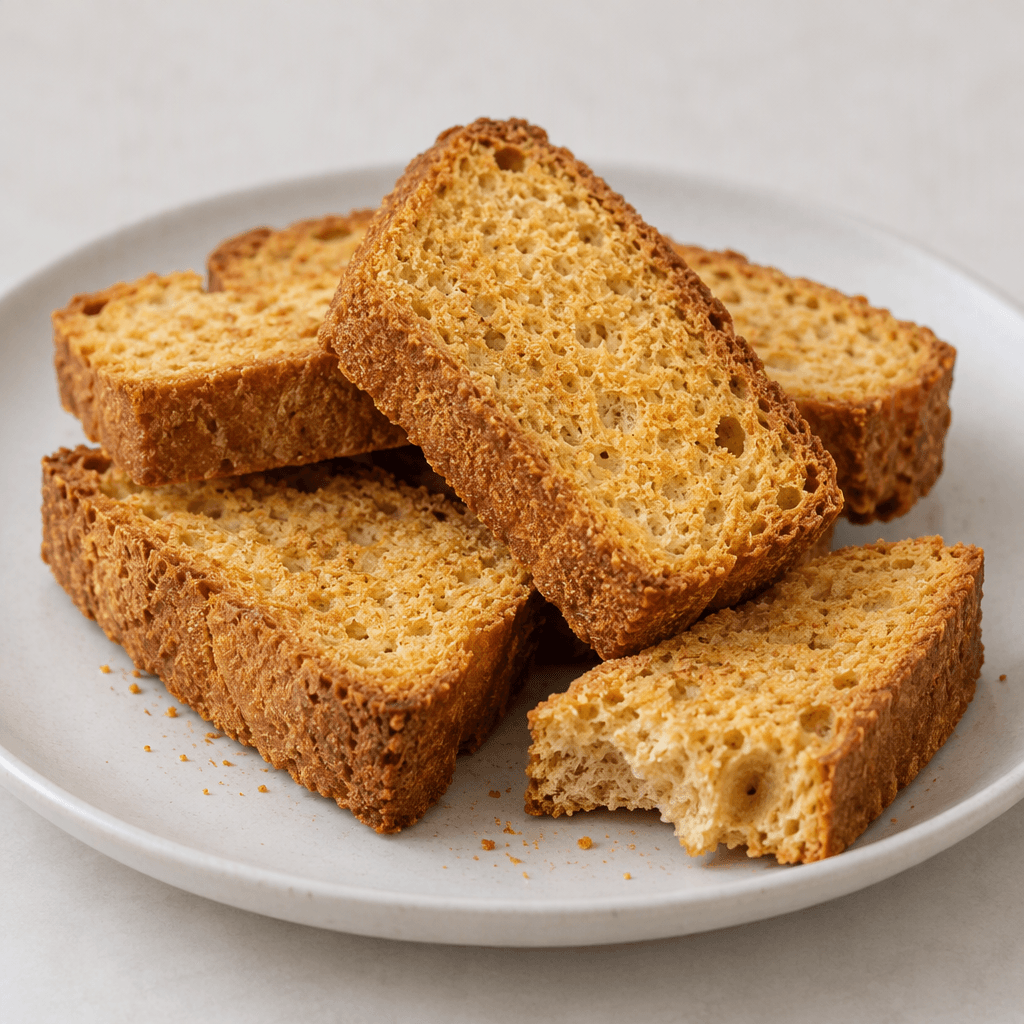
Rusk Calories
Dry, crisp bread; long shelf life, used for breakfast or with soups.
In season: Spring · Summer · Autumn · Winter
CALORIES
GI
POTASSIUM
FIBER
Quick answer
2 piece (medium) of Rusk (30 g) has 111 calories. That works out to 370 calories per 100 g. It contains 23.1 g of carbs, 3.2 g of protein, 0.8 g of fat and 1.3 g of fiber. Its 0.2 mg of Manganese covers 8% of the Daily Value. Its glycemic index is 70 (high), so it raises blood sugar quickly.
What is Rusk?
Rusk is a dry, crisp bread made by baking dough and drying or baking it again, which helps it keep well. Turkish peksimet is usually unsweetened, with thick slices, a porous crumb and a firm bite; shapes and recipes vary by region.
In Turkey, it is often served at breakfast with tea, softened by dipping, or alongside soup. Its long keeping quality also makes it handy for travel. It is mainly a source of carbohydrates and is relatively low in fat. Pair it with cheese, olives or eggs for a more filling breakfast, or let it soften in soup if you prefer a gentler crunch.
Rusk Nutrition Facts
Selected: 100 g
370
KCAL / 100G
Carbs
77g
· 28% DV
Protein
10.5g
· 21% DV
Fat
2.5g
· 3% DV
Fiber
4.5g
· 16% DV
DV is the share of the daily value covered, on a 2,000 kcal reference diet.
Calories come from: Carbs 83% · Protein 11% · Fat 6%
Rusk Vitamins & Minerals
Vitamins
B1
0.22mg · 18% DV
B3
2.2mg · 14% DV
B2
0.15mg · 12% DV
Folate
30µg · 8% DV
Minerals
Manganese
1mg · 43% DV
Selenium
10µg · 18% DV
Iron
3mg · 17% DV
Sodium
400mg · 17% DV
How Nutritious Is Rusk?
Nutrient density
Low
How many vitamins, minerals and how much fiber this food carries per calorie. A high score means a lot of nutrition for few calories.
Satiety score
Medium
An EatBetter score computed from fiber, protein and calorie density. A high score means staying full longer on the same calories.
Both scores are calculated per 100 g and do not change with the selected portion. The satiety score is EatBetter's own calculation, not a clinical measure.
Rusk Glycemic Index
GLYCEMIC INDEX
GLYCEMIC LOAD
Accounts for portion size — a more realistic measure than GI alone.
How to Burn Off Rusk
To burn the 370 calories in 100 g:
🚶
Walking (5 km/h)
🏃
Running (8 km/h)
🚴
Cycling
🏊
Swimming
Times are calculated with the MET equation for a 70 kg adult. Actual burn varies with your weight, age and pace.
Is Rusk Processed?
NOVA 3
Processed
1. Unprocessed
2. Minimally Processed
3. Processed
4. Ultra-Processed
NOVA classifies foods into 4 groups by industrial processing. NOVA 1 (unprocessed) is the healthiest.
Does Rusk Contain Allergens?
Contains these allergens:
Which Diets Is Rusk Good For?
Vegan
— Not suitable
Vegetarian
✓ Suitable
Gluten-Free
— Not suitable
Dairy-Free
— Not suitable
Mediterranean
— Not suitable
Paleo
— Not suitable
Whole30
— Not suitable
DASH
— Not suitable
Keto
— Not suitable
Low FODMAP
— Not suitable
Rusk Fat Profile
SATURATED
0.5g
MONOUNSATURATED
0.5g
POLYUNSATURATED
0.6g
Omega 6:3 ratio 15:1
Above the ideal 4:1 (15:1).
Compare Rusk
Foods Similar to Rusk
Frequently Asked Questions About Rusk
What is rusk?
Rusk is a dry, crisp bread product made by baking bread or dough until much of its moisture is removed. Its low moisture gives it a firm crunch and makes it keep longer than fresh bread when stored dry.
How is rusk made?
Bread-style rusk is usually sliced and baked again at a low temperature until dry and crisp. Some varieties are made from dough baked specifically for rusk, so recipes and shapes differ between countries.
How do you eat rusk?
Rusk can be eaten plain, topped with cheese or jam, or softened in tea, coffee, or soup. If you dip it, do so briefly: it absorbs liquid quickly and can crumble if left to soak.
Is rusk the same as toast?
No. Toast is usually bread browned on the outside while still soft inside; rusk is baked until it is dry and crisp throughout. Rusk may be made by baking sliced bread a second time.
Is rusk the same as biscotti?
No. Both can be crisp and twice-baked, but biscotti are typically shaped as sweet cookies and may contain nuts or dried fruit. Rusk usually refers to a dry bread product, though recipes vary by region.
Can you make rusk from stale bread?
Yes, you can turn stale bread into rusk by slicing it and baking the pieces until thoroughly dry and crisp. Use bread that is merely dry, not moldy; baking does not make moldy bread safe to eat.
How should rusk be stored?
Keep rusk in an airtight container in a cool, dry place, away from steam and dampness. Moisture softens its crisp texture, so reseal the package promptly after opening.
Can babies eat rusk?
Babies should only be offered rusk when they are developmentally ready for solid foods, and a hard piece can pose a choking risk. Choose an age-appropriate texture, supervise closely, and do not use rusk as a teething biscuit.
Is rusk good for weight loss?
Rusk is not automatically a weight-loss food. Because it is dry and easy to eat quickly, portions can add up; having it with a filling topping such as egg or cheese can make a snack more satisfying.
Can people with diabetes eat rusk?
People with diabetes can eat rusk, but its starchy bread base can raise blood glucose. A modest portion eaten with protein, such as cheese or egg, is generally a more balanced choice than rusk on its own.
Have another question about Rusk?
Ask the AI nutrition coach — calories, portions, alternatives and more, answered in seconds in the app.

Scan calories with your camera
Instant AI nutrition analysis

Nutrition data compiled from USDA FoodData Central and scientific sources.