

Ready & Packaged Foods
All →Vegetables & Legumes
All →Desserts & Confectionery
All →Meat & Protein
All →Grains & Bakery
All →Beverages
All →Milk & Dairy
All →

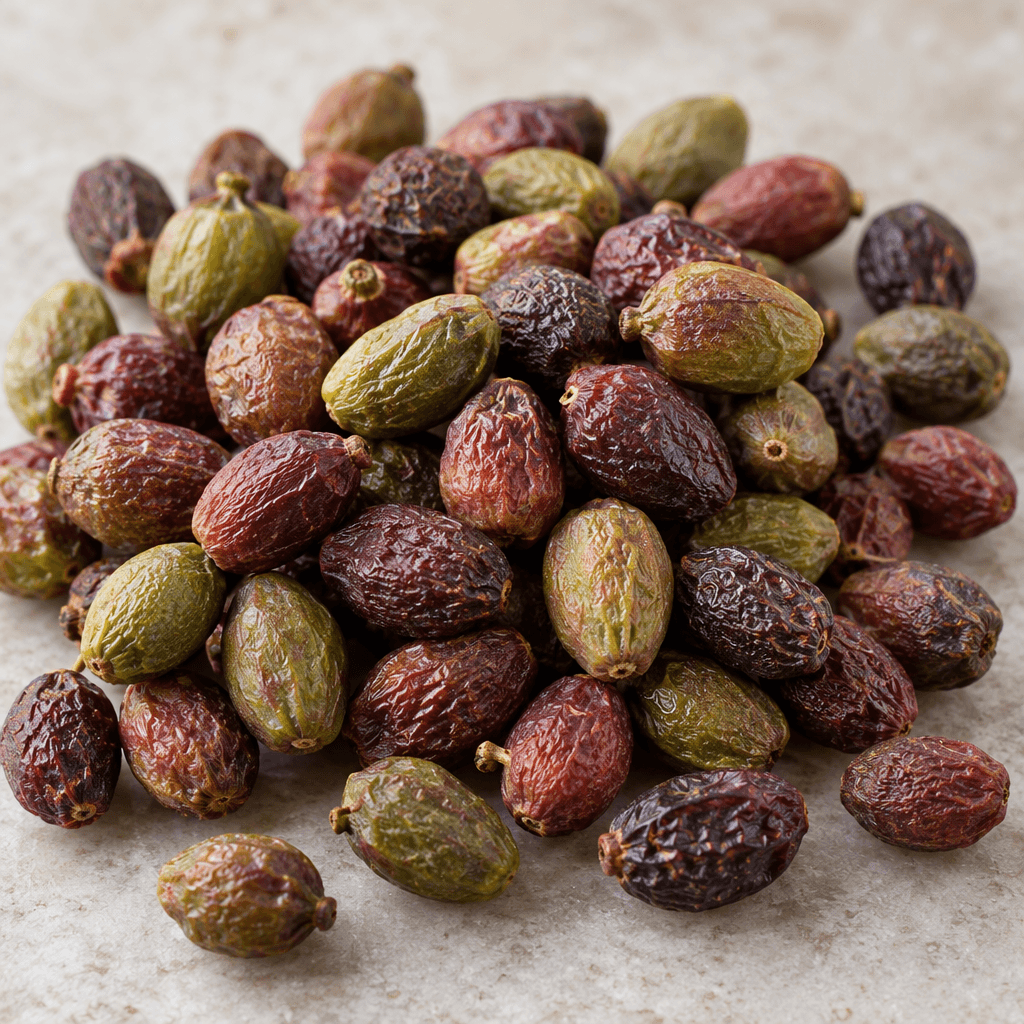
Menengic (Terebinth berry) Calories
Wild Anatolian fruit, high fiber, healthy fats, antioxidant
In season: Autumn · Winter
CALORIES
GI
POTASSIUM
FIBER
Quick answer
1 tablespoon (medium) of Menengic (Terebinth berry) (12 g) has 58 calories. That works out to 480 calories per 100 g. It contains 3.8 g of carbs, 1 g of protein, 4.3 g of fat and 1.3 g of fiber. Its 0.1 mg of Manganese covers 6% of the Daily Value. Its glycemic index is 25 (low), so it raises blood sugar slowly.
What is Menengic (Terebinth berry)?
Menengic, also called a terebinth berry, is the small, oily fruit of a wild tree native to Anatolia and parts of the Mediterranean. Dried and roasted, it is ground to make menengic coffee; it can also be used as a paste or added to some regional baked goods.
Its flavour is gently resinous and becomes more nutty with roasting, while the fruit itself has a rich, oily texture. In Turkey, menengic coffee is commonly simmered with milk and served in small cups as a convivial alternative to coffee. The berries are substantial in fibre and fats, so a little can go a long way. For a milder cup, use less ground menengic or adjust the milk to taste.
Menengic (Terebinth berry) Nutrition Facts
Selected: 100 g
480
KCAL / 100G
Carbs
32g
· 12% DV
Protein
8.5g
· 17% DV
Fat
36g
· 46% DV
Fiber
11g
· 39% DV
DV is the share of the daily value covered, on a 2,000 kcal reference diet.
Calories come from: Carbs 26% · Protein 7% · Fat 67%
Menengic (Terebinth berry) Vitamins & Minerals
Vitamins
B1
0.32mg · 27% DV
Vitamin E
3.2mg · 21% DV
B5
0.65mg · 13% DV
B6
0.21mg · 12% DV
Minerals
Manganese
1mg · 43% DV
Phosphorus
210mg · 30% DV
Magnesium
85mg · 20% DV
Zinc
2mg · 18% DV
How Nutritious Is Menengic (Terebinth berry)?
Nutrient density
High
How many vitamins, minerals and how much fiber this food carries per calorie. A high score means a lot of nutrition for few calories.
Satiety score
Medium
An EatBetter score computed from fiber, protein and calorie density. A high score means staying full longer on the same calories.
Both scores are calculated per 100 g and do not change with the selected portion. The satiety score is EatBetter's own calculation, not a clinical measure.
Menengic (Terebinth berry) Glycemic Index
GLYCEMIC INDEX
GLYCEMIC LOAD
Accounts for portion size — a more realistic measure than GI alone.
How to Burn Off Menengic (Terebinth berry)
To burn the 480 calories in 100 g:
🚶
Walking (5 km/h)
🏃
Running (8 km/h)
🚴
Cycling
🏊
Swimming
Times are calculated with the MET equation for a 70 kg adult. Actual burn varies with your weight, age and pace.
Is Menengic (Terebinth berry) Processed?
NOVA 1
Unprocessed
1. Unprocessed
2. Minimally Processed
3. Processed
4. Ultra-Processed
NOVA classifies foods into 4 groups by industrial processing. NOVA 1 (unprocessed) is the healthiest.
Does Menengic (Terebinth berry) Contain Allergens?
No known major allergens
Which Diets Is Menengic (Terebinth berry) Good For?
Vegan
✓ Suitable
Vegetarian
✓ Suitable
Gluten-Free
✓ Suitable
Dairy-Free
— Not suitable
Mediterranean
✓ Suitable
Paleo
✓ Suitable
Whole30
— Not suitable
DASH
— Not suitable
Keto
✓ Suitable
Low FODMAP
— Not suitable
Menengic (Terebinth berry) Fat Profile
SATURATED
6.8g
MONOUNSATURATED
21.5g
POLYUNSATURATED
7.8g
Omega 6:3 ratio 16:1
Above the ideal 4:1 (16:1).
Compare Menengic (Terebinth berry)
Foods Similar to Menengic (Terebinth berry)
Frequently Asked Questions About Menengic (Terebinth berry)
What is Menengic?
Menengic is the fruit of the terebinth tree, a wild Pistacia species native to parts of the Mediterranean and Anatolia. It is related to the pistachio but is not the same nut. Menengic fruit can be eaten or dried and roasted for use in drinks and foods.
How do you make Menengic coffee?
Menengic coffee is made by simmering roasted, ground Menengic fruit in water or milk. Stir it over low heat until it foams, then pour it into cups with the grounds. Using milk gives the drink a creamier texture and mellower taste.
Does Menengic coffee contain caffeine?
No, pure Menengic coffee is naturally caffeine-free because it is made from terebinth fruit rather than coffee beans. Some blends may contain added coffee, so check the ingredients if you need to avoid caffeine.
What does Menengic taste like?
Menengic has a mildly resinous, nutty flavor that becomes more pronounced when the fruit is roasted. Menengic coffee is often described as smooth and earthy; preparing it with milk makes its flavor softer and creamier.
Can you eat Menengic berries raw?
Yes, Menengic fruit can be eaten raw, although it is also commonly dried, roasted, or ground for cooking and drinks. Remove any damaged fruit and rinse the rest under running water before eating.
Is Menengic the same as pistachio?
No, Menengic is not the same as the familiar edible pistachio, though both belong to the Pistacia genus. Menengic comes from the terebinth tree and is often used as a roasted fruit for making a coffee-like drink.
How is Menengic used in cooking?
Menengic is commonly roasted and ground for a coffee-like drink, and it can also be used in regional spreads and other savory or sweet preparations. Its distinctive earthy, nutty flavor works well in small amounts; ground Menengic can be stirred into a recipe.
How should you store Menengic?
Store whole Menengic fruit in a sealed container in a cool, dry place away from sunlight. Keep ground Menengic and Menengic coffee tightly closed and protected from moisture, since their aroma fades faster once ground.
What are the health benefits of Menengic?
Menengic provides fiber and unsaturated fats, and its fruit contains antioxidant compounds. It can be part of a varied diet, but it is not a treatment for disease and should not be relied on to produce a particular health outcome.
Can people with diabetes eat Menengic?
Many people with diabetes can include Menengic in meals while accounting for their portion and overall eating plan. Sweetening Menengic coffee with sugar or honey can affect blood glucose; ask your clinician or dietitian for individualized advice if needed.
Have another question about Menengic (Terebinth berry)?
Ask the AI nutrition coach — calories, portions, alternatives and more, answered in seconds in the app.

Scan calories with your camera
Instant AI nutrition analysis

Nutrition data compiled from USDA FoodData Central and scientific sources.