

Ready & Packaged Foods
All →Vegetables & Legumes
All →Desserts & Confectionery
All →Meat & Protein
All →Grains & Bakery
All →Beverages
All →Milk & Dairy
All →

Walnut Calories
Omega-3 source, healthy fats, antioxidants, plant protein
In season: Autumn
CALORIES
GI
POTASSIUM
FIBER
Quick answer
1 piece (whole) of Walnut (8 g) has 52 calories. That works out to 654 calories per 100 g. It contains 1.1 g of carbs, 1.2 g of protein, 5.2 g of fat and 0.5 g of fiber. Its 0.1 mg of Copper covers 14% of the Daily Value. Its glycemic index is 15 (low), so it raises blood sugar slowly.
What is Walnut?
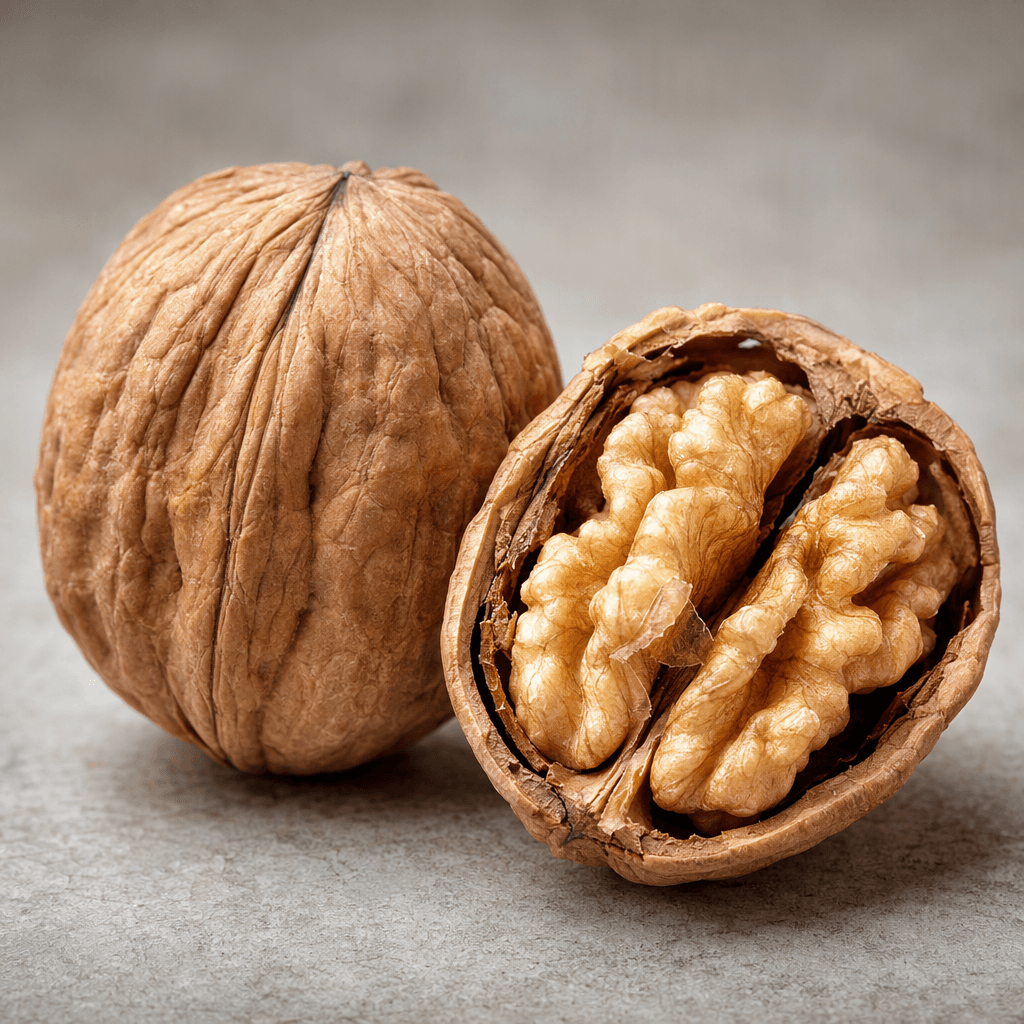
A walnut is the edible kernel of a tree nut, enclosed in a hard, deeply ridged shell. Its pale, lobed interior has a thin papery skin and can be eaten raw or toasted, whole or chopped.
Walnuts are enjoyed around the world as a snack and added to porridge, salads, breads and cakes; they also feature in dishes from regions where walnut trees are widely grown. They are energy-dense and rich in fats, including plant-based omega-3, with some protein and fibre. For a simple snack, pair a few walnut halves with fruit or stir them into plain yoghurt.
Walnut Nutrition Facts
Selected: 100 g
654
KCAL / 100G
Carbs
13.7g
· 5% DV
Protein
15.2g
· 30% DV
Fat
65.2g
· 84% DV
Fiber
6.7g
· 24% DV
DV is the share of the daily value covered, on a 2,000 kcal reference diet.
Calories come from: Carbs 8% · Protein 9% · Fat 83%
Walnut Vitamins & Minerals
Vitamins
B6
0.54mg · 32% DV
B1
0.34mg · 28% DV
Folate
98µg · 25% DV
Biotin
6µg · 20% DV
Minerals
Copper
2mg · 222% DV
Manganese
3mg · 130% DV
Phosphorus
346mg · 49% DV
Magnesium
158mg · 38% DV
How Nutritious Is Walnut?
Nutrient density
Very high
How many vitamins, minerals and how much fiber this food carries per calorie. A high score means a lot of nutrition for few calories.
Satiety score
Medium
An EatBetter score computed from fiber, protein and calorie density. A high score means staying full longer on the same calories.
Both scores are calculated per 100 g and do not change with the selected portion. The satiety score is EatBetter's own calculation, not a clinical measure.
Walnut Glycemic Index
GLYCEMIC INDEX
GLYCEMIC LOAD
Accounts for portion size — a more realistic measure than GI alone.
How to Burn Off Walnut
To burn the 654 calories in 100 g:
🚶
Walking (5 km/h)
🏃
Running (8 km/h)
🚴
Cycling
🏊
Swimming
Times are calculated with the MET equation for a 70 kg adult. Actual burn varies with your weight, age and pace.
Is Walnut Processed?
NOVA 1
Unprocessed
1. Unprocessed
2. Minimally Processed
3. Processed
4. Ultra-Processed
NOVA classifies foods into 4 groups by industrial processing. NOVA 1 (unprocessed) is the healthiest.
Does Walnut Contain Allergens?
Contains these allergens:
Which Diets Is Walnut Good For?
Vegan
✓ Suitable
Vegetarian
✓ Suitable
Gluten-Free
✓ Suitable
Dairy-Free
— Not suitable
Mediterranean
✓ Suitable
Paleo
✓ Suitable
Whole30
— Not suitable
DASH
— Not suitable
Keto
✓ Suitable
Low FODMAP
— Not suitable
Walnut Fat Profile
SATURATED
6.1g
MONOUNSATURATED
8.9g
POLYUNSATURATED
47.2g
Omega 6:3 ratio 4.2:1
Above the ideal 4:1 (4.2:1).
Compare Walnut
Foods Similar to Walnut
Frequently Asked Questions About Walnut
What are the health benefits of walnuts?
Walnuts provide plant-based omega-3 fats, fibre and antioxidants, making them a nutritious addition to meals or snacks. They can support an overall balanced eating pattern, but they are not a treatment or cure for any condition.
How many walnuts should you eat a day?
A small handful is a practical daily portion for many people. Walnuts are energy-dense, so portioning them into a bowl rather than eating straight from a large bag can help keep servings moderate.
Do walnuts make you gain weight?
Walnuts do not automatically cause weight gain, but eating more than your body needs can add substantially to your overall energy intake. A measured portion can make them easier to include in meals or snacks.
How should you store walnuts to keep them fresh?
Keep in-shell walnuts in a cool, dry, dark place, and store shelled walnuts in an airtight container. Refrigerate or freeze them for longer storage, since heat, light and air can make their oils turn rancid.
Why do walnuts taste bitter?
Walnuts can taste slightly bitter because of tannins in the thin skin around the kernel. A sharp, stale-oil or paint-like smell and flavour, however, suggest rancidity rather than the walnut’s usual mild bitterness.
Is the skin on a walnut edible?
Yes, the thin brown skin on a walnut kernel is edible. It contributes a slightly astringent taste, so there is no need to remove it unless you want a milder flavour for a particular recipe.
Do walnuts need to be soaked before eating?
No, walnuts do not need soaking before you eat them. Soaking softens the kernels and changes their texture, but it is not necessary to make walnuts nutritious or to remove a proven health hazard.
Are walnuts really good for your brain because they look like one?
A walnut’s brain-like shape is a coincidence, not evidence that it boosts brain function. Walnuts are nutritious and contain omega-3 fats, but eating them does not guarantee better memory or prevent brain disease.
How do you crack walnuts without crushing the kernels?
Use a nutcracker and apply gentle pressure at the seam of the shell rather than squeezing hard across the kernel. Crack one walnut at a time over a bowl so the pieces are easier to collect.
Can you freeze walnuts?
Yes, walnuts freeze well, whether shelled or still in their shells. Place shelled kernels in an airtight freezer-safe container to limit exposure to air and odours, then take out only what you need.
Have another question about Walnut?
Ask the AI nutrition coach — calories, portions, alternatives and more, answered in seconds in the app.

Scan calories with your camera
Instant AI nutrition analysis

Nutrition data compiled from USDA FoodData Central and scientific sources.