

Ready & Packaged Foods
All →Vegetables & Legumes
All →Desserts & Confectionery
All →Meat & Protein
All →Grains & Bakery
All →Beverages
All →Milk & Dairy
All →

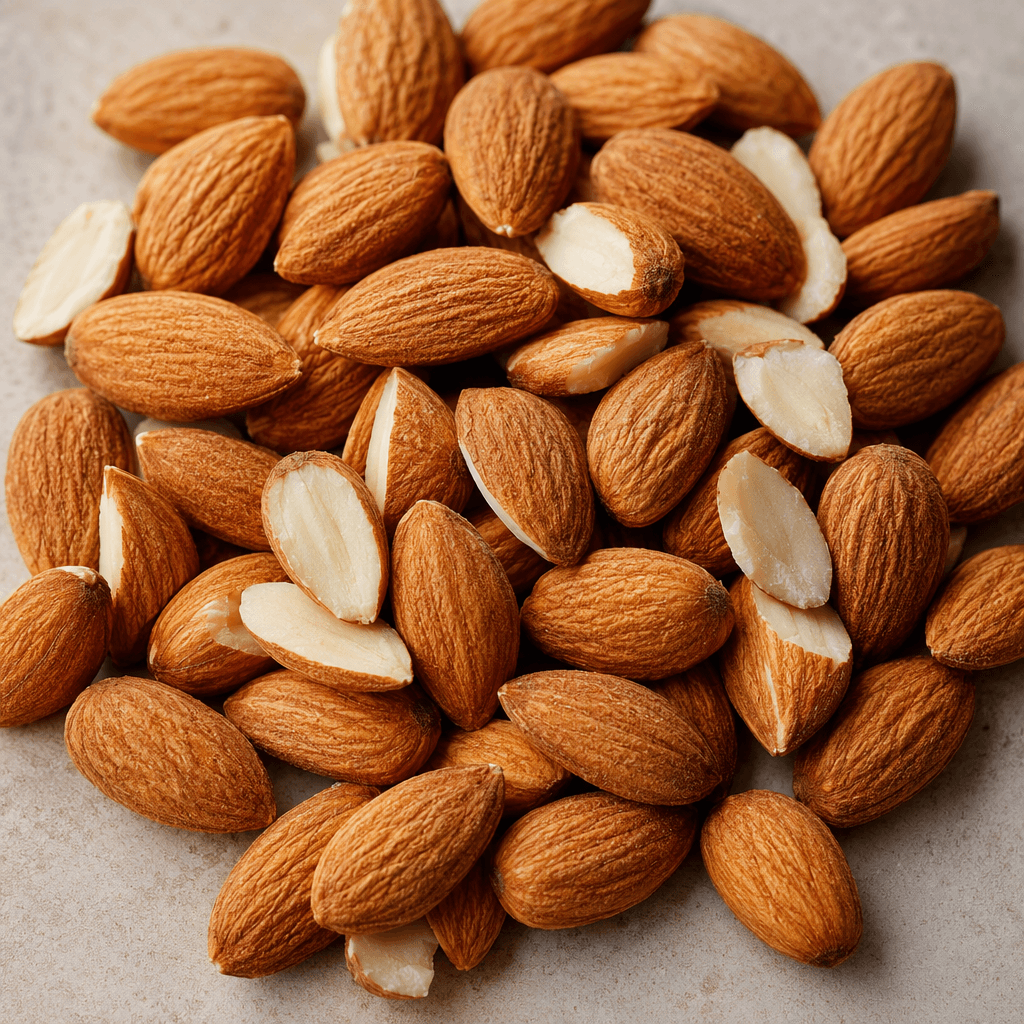
Almond Calories
High in vitamin E, magnesium, and healthy fats.
In season: Autumn · Winter
CALORIES
GI
POTASSIUM
FIBER
Quick answer
1 ounce (medium) of Almond (28 g) has 162 calories. That works out to 579 calories per 100 g. It contains 6 g of carbs, 5.9 g of protein, 14 g of fat and 3.5 g of fiber. Its 7.2 mg of Vitamin E covers 48% of the Daily Value. Its glycemic index is 15 (low), so it raises blood sugar slowly.
What is Almond?
Almonds are the edible seeds of the almond tree, enjoyed whole as a snack and used in both sweet and savoury cooking. They’re common in Mediterranean and Middle Eastern cuisines, while almond butter and almond milk are familiar options in many English-speaking countries.
Their mild sweetness and crisp bite work well raw or toasted; toasting brings out a deeper, nuttier flavour. Add them to porridge, salads, rice dishes or baked goods, or have a small handful between meals. Almonds are rich in unsaturated fats and fibre, with 12.5 g of fibre per 100 g. For an easy, satisfying topping, scatter a few chopped almonds over yoghurt or fruit.
Almond Nutrition Facts
Selected: 100 g
579
KCAL / 100G
Carbs
21.6g
· 8% DV
Protein
21.2g
· 42% DV
Fat
49.9g
· 64% DV
Fiber
12.5g
· 45% DV
DV is the share of the daily value covered, on a 2,000 kcal reference diet.
Calories come from: Carbs 14% · Protein 14% · Fat 72%
Almond Vitamins & Minerals
Vitamins
Vitamin E
25.6mg · 171% DV
B2
1.14mg · 88% DV
Biotin
17.5µg · 58% DV
B3
3.62mg · 23% DV
Minerals
Copper
1mg · 111% DV
Manganese
2mg · 87% DV
Phosphorus
481mg · 69% DV
Magnesium
270mg · 64% DV
How Nutritious Is Almond?
Nutrient density
Very high
How many vitamins, minerals and how much fiber this food carries per calorie. A high score means a lot of nutrition for few calories.
Satiety score
High
An EatBetter score computed from fiber, protein and calorie density. A high score means staying full longer on the same calories.
Both scores are calculated per 100 g and do not change with the selected portion. The satiety score is EatBetter's own calculation, not a clinical measure.
Almond Glycemic Index
GLYCEMIC INDEX
GLYCEMIC LOAD
Accounts for portion size — a more realistic measure than GI alone.
How to Burn Off Almond
To burn the 579 calories in 100 g:
🚶
Walking (5 km/h)
🏃
Running (8 km/h)
🚴
Cycling
🏊
Swimming
Times are calculated with the MET equation for a 70 kg adult. Actual burn varies with your weight, age and pace.
Is Almond Processed?
NOVA 1
Unprocessed
1. Unprocessed
2. Minimally Processed
3. Processed
4. Ultra-Processed
NOVA classifies foods into 4 groups by industrial processing. NOVA 1 (unprocessed) is the healthiest.
Does Almond Contain Allergens?
Contains these allergens:
Which Diets Is Almond Good For?
Vegan
✓ Suitable
Vegetarian
✓ Suitable
Gluten-Free
✓ Suitable
Dairy-Free
— Not suitable
Mediterranean
✓ Suitable
Paleo
✓ Suitable
Whole30
— Not suitable
DASH
— Not suitable
Keto
✓ Suitable
Low FODMAP
— Not suitable
Almond Fat Profile
SATURATED
3.8g
MONOUNSATURATED
31.6g
POLYUNSATURATED
12.3g
Compare Almond
Foods Similar to Almond
Frequently Asked Questions About Almond
How do you make almond milk at home?
Blend soaked almonds with fresh water, then strain the mixture through a fine cloth or nut-milk bag. Add vanilla or a date if you want sweetness. Keep homemade almond milk refrigerated and use it within a few days because it has no commercial preservatives.
Can dogs eat almonds?
It is best not to feed almonds to dogs. They are not considered typically toxic to dogs, but they can be difficult to digest and may cause choking or stomach upset. Salted, seasoned, or chocolate-coated almonds are especially unsuitable.
Do you need to peel almonds before eating them?
No, you can eat almonds with their thin brown skins on. The skin is edible, and peeling is mainly useful when a recipe calls for a pale color or especially smooth texture. To loosen it, briefly soak the almonds in hot water and slip the skins off.
Are raw or roasted almonds healthier?
Both raw and dry-roasted almonds can be part of a healthy diet. Roasting changes the flavor and crunch more than it changes the overall nutrition. Choose unsalted, dry-roasted almonds if you want a stronger toasted taste without added salt or frying oil.
How should you store almonds so they stay fresh?
Store almonds in an airtight container in a cool, dark, dry place. Their natural oils can turn rancid faster with heat, light, and air. For longer storage, refrigerate or freeze them, and keep them sealed while they come back to room temperature to avoid moisture.
Are bitter almonds safe to eat?
No, do not eat raw bitter almonds. Some bitter almond varieties contain compounds that can release cyanide. These are not the same as the sweet almonds sold as everyday snacks; avoid bitter almonds or almonds with an uncertain source.
How do you make almond flour from whole almonds?
Pulse blanched or skin-on almonds in a food processor until finely ground, stopping before they turn into almond butter. Work in small batches and make sure the almonds are dry. For a smoother texture, sift the flour and regrind any coarse pieces.
Can you use almond butter instead of peanut butter?
Yes, almond butter can replace peanut butter in many spreads, smoothies, and baking recipes. Its flavor is milder and its texture varies by brand, so a recipe may need a little adjustment in sweetness or salt. Stir natural almond butter before using it.
Do almonds help with weight loss?
Almonds can fit into a weight-loss eating plan because their fiber, protein, and fat can make a snack satisfying. They are energy-dense, though, so eating straight from a large bag can add up quickly; portion some into a bowl instead.
Can almonds lower blood sugar?
Almonds do not treat diabetes or reliably lower blood sugar on their own. Their fiber, protein, and fat may slow digestion when eaten with a meal, but they do not replace prescribed care. People using glucose-lowering medication should account for their usual meal plan.
Have another question about Almond?
Ask the AI nutrition coach — calories, portions, alternatives and more, answered in seconds in the app.

Scan calories with your camera
Instant AI nutrition analysis

Nutrition data compiled from USDA FoodData Central and scientific sources.