

Ready & Packaged Foods
All →Vegetables & Legumes
All →Desserts & Confectionery
All →Meat & Protein
All →Grains & Bakery
All →Beverages
All →Milk & Dairy
All →

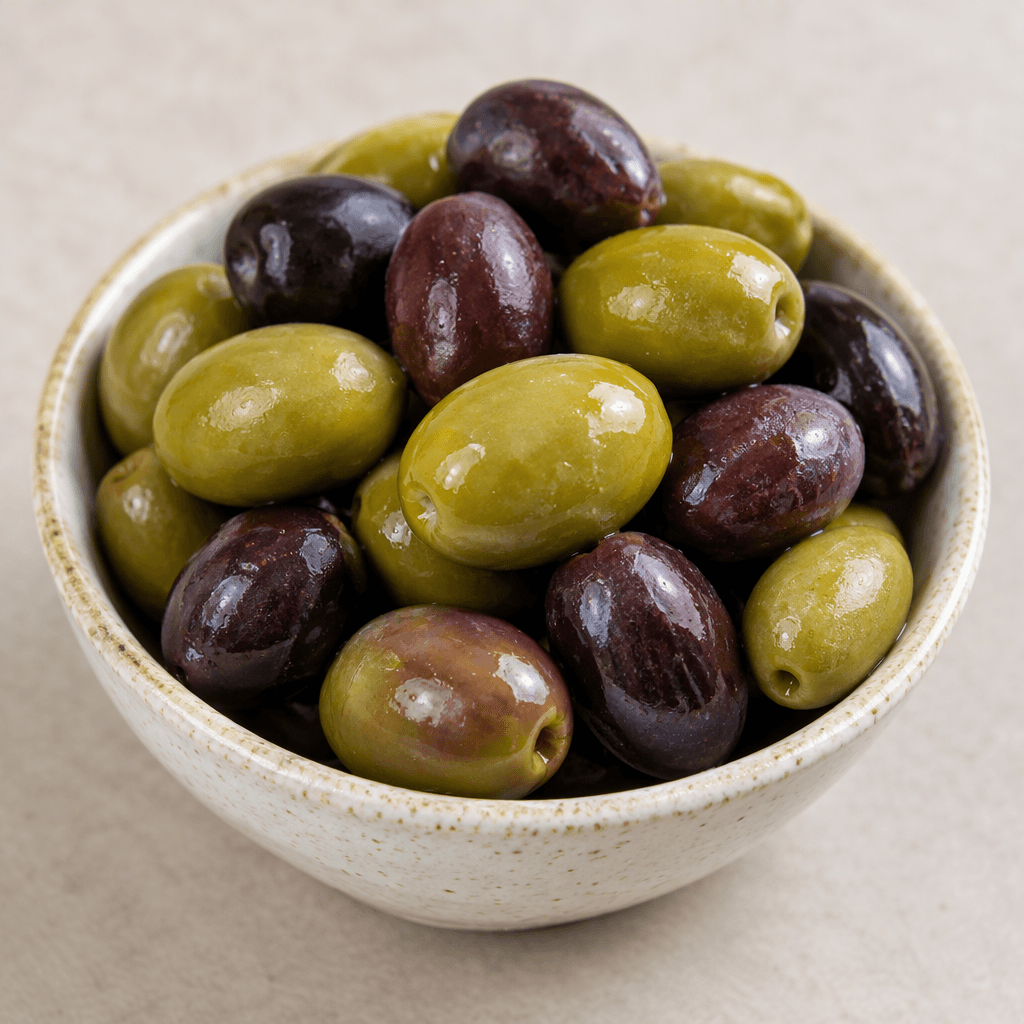
Low salt olives Calories
Low salt, source of fiber and healthy fats
In season: Summer · Autumn
CALORIES
GI
POTASSIUM
FIBER
Quick answer
10 piece (medium) of Low salt olives (35 g) has 40 calories. That works out to 115 calories per 100 g. It contains 2.1 g of carbs, 0.4 g of protein, 3.7 g of fat and 1.1 g of fiber. Its 122.5 mg of Sodium covers 5% of the Daily Value. Its glycemic index is 15 (low), so it raises blood sugar slowly.
Low salt olives Nutrition Facts
Selected: 100 g
115
KCAL / 100G
Carbs
6g
· 2% DV
Protein
1g
· 2% DV
Fat
10.5g
· 13% DV
Fiber
3.2g
· 11% DV
DV is the share of the daily value covered, on a 2,000 kcal reference diet.
Calories come from: Carbs 20% · Protein 3% · Fat 77%
Low salt olives Vitamins & Minerals
Vitamins
Vitamin E
1.7mg · 11% DV
B5
0.3mg · 6% DV
B1
0.03mg · 3% DV
Vitamin A
20µg · 2% DV
Minerals
Sodium
350mg · 15% DV
Iron
1mg · 6% DV
Calcium
52mg · 5% DV
Magnesium
11mg · 3% DV
How Nutritious Is Low salt olives?
Nutrient density
High
How many vitamins, minerals and how much fiber this food carries per calorie. A high score means a lot of nutrition for few calories.
Satiety score
Medium
An EatBetter score computed from fiber, protein and calorie density. A high score means staying full longer on the same calories.
Both scores are calculated per 100 g and do not change with the selected portion. The satiety score is EatBetter's own calculation, not a clinical measure.
Low salt olives Glycemic Index
GLYCEMIC INDEX
GLYCEMIC LOAD
Accounts for portion size — a more realistic measure than GI alone.
How to Burn Off Low salt olives
To burn the 115 calories in 100 g:
🚶
Walking (5 km/h)
🏃
Running (8 km/h)
🚴
Cycling
🏊
Swimming
Times are calculated with the MET equation for a 70 kg adult. Actual burn varies with your weight, age and pace.
Is Low salt olives Processed?
NOVA 2
Minimally Processed
1. Unprocessed
2. Minimally Processed
3. Processed
4. Ultra-Processed
NOVA classifies foods into 4 groups by industrial processing. NOVA 1 (unprocessed) is the healthiest.
Does Low salt olives Contain Allergens?
No known major allergens
Which Diets Is Low salt olives Good For?
Vegan
✓ Suitable
Vegetarian
✓ Suitable
Gluten-Free
✓ Suitable
Dairy-Free
— Not suitable
Mediterranean
✓ Suitable
Paleo
✓ Suitable
Whole30
— Not suitable
DASH
— Not suitable
Keto
✓ Suitable
Low FODMAP
— Not suitable
Low salt olives Fat Profile
SATURATED
1.9g
MONOUNSATURATED
7.7g
POLYUNSATURATED
0.9g
Omega 6:3 ratio 6.8:1
Above the ideal 4:1 (6.8:1).
Compare Low salt olives
Foods Similar to Low salt olives
Frequently Asked Questions About Low salt olives
Do low salt olives spoil faster than regular olives?
They can be a bit more perishable because salt helps preservation. Once opened, keep them refrigerated and submerged in their brine when possible.
How should low salt olives be stored after opening?
Store them in the fridge in a sealed container, ideally covered by their original brine. Using a clean utensil each time also helps reduce spoilage.
Can low salt olives be frozen?
Yes, but freezing often softens their texture after thawing. They are usually better used in cooked dishes, spreads, or sauces afterward rather than served plain.
How can I make low salt olives taste less bitter?
A short soak in water can mellow bitterness. Keep in mind that soaking may also reduce some of their flavor.
Are low salt olives better at breakfast or as a snack?
They usually work better as part of a meal than on their own. Pairing them with foods like eggs, cheese, vegetables, or whole grains makes the meal more balanced and satisfying.
Are low salt olives a good pre-workout food?
They are not usually the main pre-workout choice on their own because they are mostly a savory, fatty add-on rather than a quick energy source. If you want them before exercise, keep the portion modest and pair them with a carbohydrate-rich food.
What foods pair well with low salt olives?
They go well with tomatoes, cucumbers, feta, hummus, yogurt-based dips, and whole-grain bread. They also add flavor to salads and grain bowls without relying only on extra salt.
Does “low salt” mean the olives are salt-free?
No, low salt does not mean salt-free. People who need to strictly limit sodium should still check the label and portion size.
Who should still be careful with low salt olives?
People with high blood pressure, kidney disease, or those on sodium-restricted diets should still be cautious. Sodium levels can vary a lot between brands even when both are marketed as low salt.
Do low salt olives lose their flavor in cooking?
Their flavor can soften with heat, but they still work well in pasta sauces, vegetable dishes, and tapenades. Adding them near the end of cooking often keeps their taste more noticeable.
Have another question about Low salt olives?
Ask the AI nutrition coach — calories, portions, alternatives and more, answered in seconds in the app.

Scan calories with your camera
Instant AI nutrition analysis

Nutrition data compiled from USDA FoodData Central and scientific sources.