

Ready & Packaged Foods
All →Vegetables & Legumes
All →Desserts & Confectionery
All →Meat & Protein
All →Grains & Bakery
All →Beverages
All →Milk & Dairy
All →

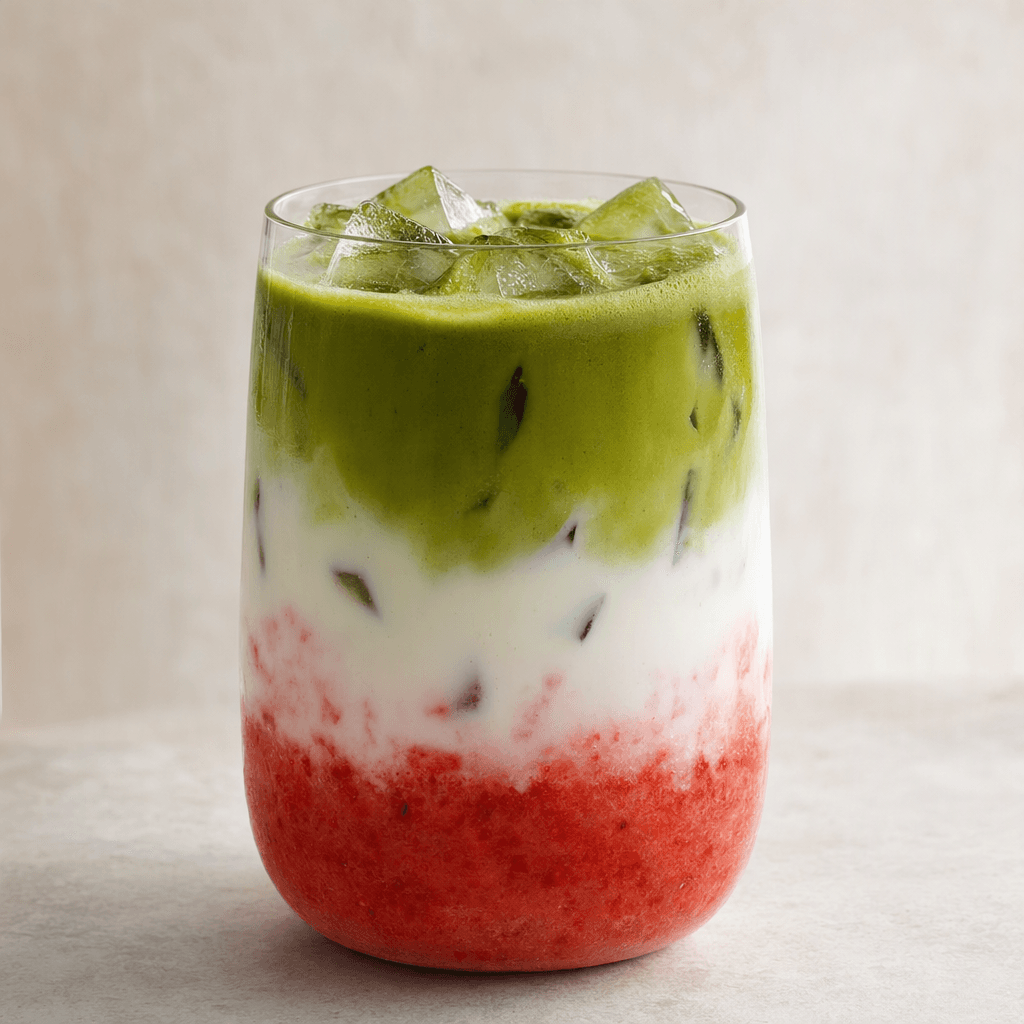
Lactose-Free Strawberry Iced Matcha Latte Calories
Cold drink with lactose-free milk, matcha and strawberry flavor
In season: Spring · Summer
CALORIES
GI
POTASSIUM
FIBER
Quick answer
1 cup (medium) of Lactose-Free Strawberry Iced Matcha Latte (350 g) has 193 calories. That works out to 55 calories per 100 g. It contains 30.1 g of carbs, 8.4 g of protein, 4.9 g of fat and 1.8 g of fiber. Its 1.1 µg of B12 covers 47% of the Daily Value. Its glycemic index is 43 (low), so it raises blood sugar slowly.
What is Lactose-Free Strawberry Iced Matcha Latte?
A lactose-free strawberry iced matcha latte brings together matcha, milk and ice, with strawberry purée adding fruity sweetness. Matcha is finely powdered Japanese green tea; the iced latte is a modern café-style combination rather than a traditional Japanese preparation. Often served in a clear glass, its pink, pale and green layers make for a striking first sip. The matcha’s gently grassy, slightly bitter taste balances the strawberry, and you can stir the layers together or taste them one at a time. It suits a warm-weather café break or an afternoon pick-me-up. At 55 kcal per 100 g, it is a relatively light option among sweet café drinks; ask for less strawberry purée if you prefer a less-sweet cup.
Lactose-Free Strawberry Iced Matcha Latte Nutrition Facts
Selected: 100 g
55
KCAL / 100G
Carbs
8.6g
· 3% DV
Protein
2.4g
· 5% DV
Fat
1.4g
· 2% DV
Fiber
0.5g
· 2% DV
DV is the share of the daily value covered, on a 2,000 kcal reference diet.
Calories come from: Carbs 61% · Protein 17% · Fat 22%
Lactose-Free Strawberry Iced Matcha Latte Vitamins & Minerals
Vitamins
B12
0.32µg · 13% DV
B2
0.13mg · 10% DV
B5
0.32mg · 6% DV
Vitamin C
5.2mg · 6% DV
Minerals
Phosphorus
72mg · 10% DV
Calcium
92mg · 9% DV
Iodine
14µg · 9% DV
Selenium
2.1µg · 4% DV
How Nutritious Is Lactose-Free Strawberry Iced Matcha Latte?
Nutrient density
Medium
How many vitamins, minerals and how much fiber this food carries per calorie. A high score means a lot of nutrition for few calories.
Satiety score
Medium
An EatBetter score computed from fiber, protein and calorie density. A high score means staying full longer on the same calories.
Both scores are calculated per 100 g and do not change with the selected portion. The satiety score is EatBetter's own calculation, not a clinical measure.
Lactose-Free Strawberry Iced Matcha Latte Glycemic Index
GLYCEMIC INDEX
GLYCEMIC LOAD
Accounts for portion size — a more realistic measure than GI alone.
How to Burn Off Lactose-Free Strawberry Iced Matcha Latte
To burn the 55 calories in 100 g:
🚶
Walking (5 km/h)
🏃
Running (8 km/h)
🚴
Cycling
🏊
Swimming
Times are calculated with the MET equation for a 70 kg adult. Actual burn varies with your weight, age and pace.
Is Lactose-Free Strawberry Iced Matcha Latte Processed?
NOVA 3
Processed
1. Unprocessed
2. Minimally Processed
3. Processed
4. Ultra-Processed
NOVA classifies foods into 4 groups by industrial processing. NOVA 1 (unprocessed) is the healthiest.
Does Lactose-Free Strawberry Iced Matcha Latte Contain Allergens?
Contains these allergens:
Which Diets Is Lactose-Free Strawberry Iced Matcha Latte Good For?
Vegan
— Not suitable
Vegetarian
✓ Suitable
Gluten-Free
✓ Suitable
Dairy-Free
— Not suitable
Mediterranean
✓ Suitable
Paleo
— Not suitable
Whole30
— Not suitable
DASH
— Not suitable
Keto
— Not suitable
Low FODMAP
— Not suitable
Lactose-Free Strawberry Iced Matcha Latte Fat Profile
SATURATED
0.82g
MONOUNSATURATED
0.36g
POLYUNSATURATED
0.08g
Omega 6:3 ratio 2.5:1
Below the ideal 4:1 — a good omega balance.
Compare Lactose-Free Strawberry Iced Matcha Latte
Foods Similar to Lactose-Free Strawberry Iced Matcha Latte
Frequently Asked Questions About Lactose-Free Strawberry Iced Matcha Latte
Does a lactose-free strawberry iced matcha latte have caffeine?
Yes. The caffeine comes from the matcha, not the strawberry or milk. The amount varies with the matcha used and how much goes into the drink, so it is not caffeine-free even though it contains no coffee.
How do you make a lactose-free strawberry iced matcha latte at home?
Whisk matcha with a little cold water until smooth. Add strawberry purée and ice to a glass, pour in lactose-free milk, then slowly add the matcha on top. Sweeten only if your strawberry purée needs it.
What is in a lactose-free strawberry iced matcha latte?
It is typically made with matcha, strawberry purée or strawberry syrup, lactose-free milk, and ice. Café versions may include added sweetener, while a homemade version lets you choose fresh strawberries and control whether any sugar or syrup goes in.
Does a lactose-free strawberry iced matcha latte contain added sugar?
It may, but not necessarily. Strawberries contain natural sugars, while syrups and sweetened purées add more. Ask for no syrup when ordering, or make it at home with unsweetened strawberry purée for a less-sweet drink.
Why does a lactose-free strawberry iced matcha latte separate into layers?
The strawberry purée, milk, and matcha have different densities, so they can settle into visible layers when poured gently. Stirring blends them together; for the layered look, add the matcha slowly as the final step.
How do you stop matcha clumps in a lactose-free strawberry iced matcha latte?
Whisk the matcha with a small amount of water before adding it to the milk. Sifting the powder first and using a matcha whisk or small milk frother helps make a smooth mixture instead of leaving dry clumps.
Can you make a lactose-free strawberry iced matcha latte ahead of time?
It tastes and looks best freshly made. If left assembled, the ice melts and dilutes the drink, and the matcha can lose some of its fresh flavor. Prepare the components separately and combine them just before serving.
Is a lactose-free strawberry iced matcha latte dairy-free?
No, not usually. It is commonly made with cow’s milk in which the lactose has been broken down, so it still contains milk. “Lactose-free” describes the lactose, not the source of the milk.
Is it a bad idea to drink a lactose-free strawberry iced matcha latte at night?
It can be, if caffeine affects your sleep. Matcha contains caffeine, and people vary in how sensitive they are to it; choosing an earlier time is a practical option if you notice trouble falling asleep after drinking it.
Is a lactose-free strawberry iced matcha latte the same as a strawberry matcha latte?
They are similar drinks, but the lactose-free version uses milk with the lactose removed or broken down. A regular strawberry matcha latte may use standard dairy milk, so the names do not guarantee the same milk or recipe.
Have another question about Lactose-Free Strawberry Iced Matcha Latte?
Ask the AI nutrition coach — calories, portions, alternatives and more, answered in seconds in the app.

Scan calories with your camera
Instant AI nutrition analysis

Nutrition data compiled from USDA FoodData Central and scientific sources.