

Ready & Packaged Foods
All →Vegetables & Legumes
All →Desserts & Confectionery
All →Meat & Protein
All →Grains & Bakery
All →Beverages
All →Milk & Dairy
All →

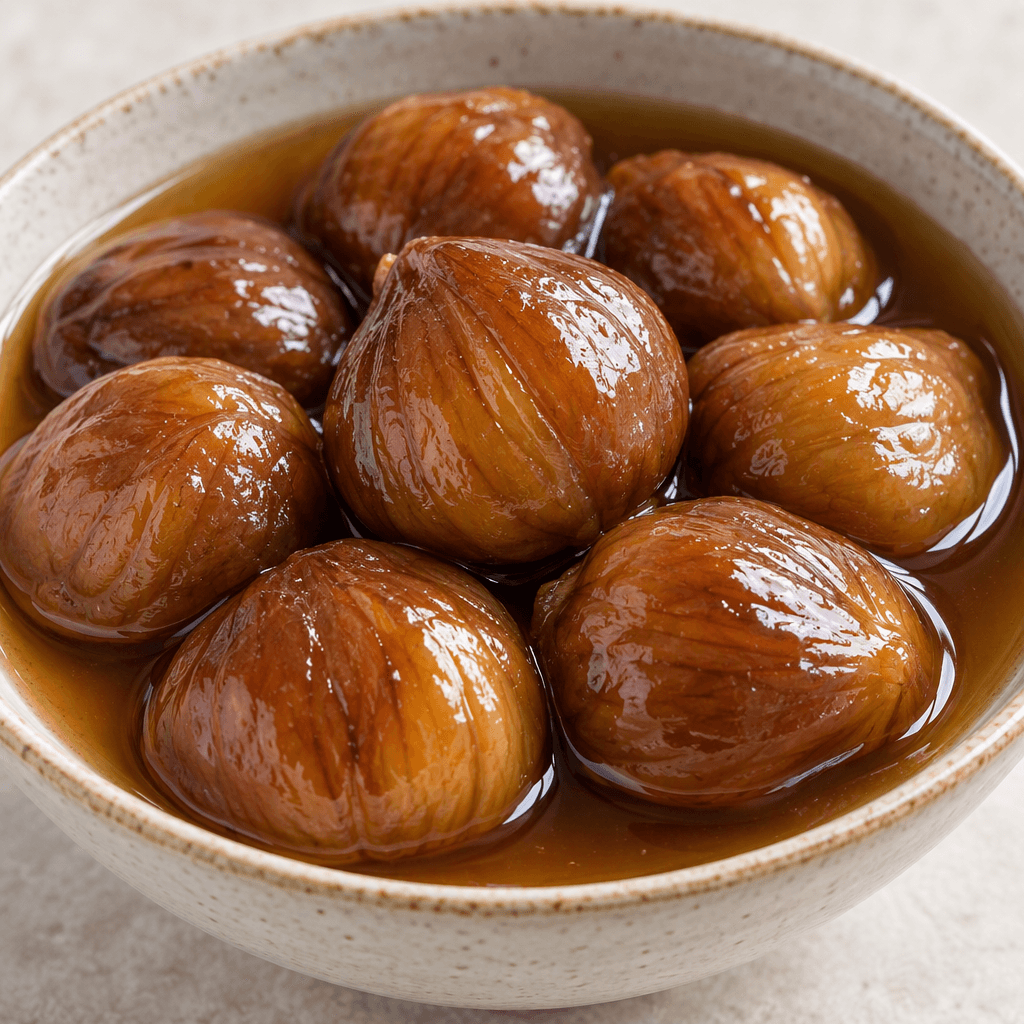
Candied chestnut (in syrup) Calories
Sweet chestnut, rich sugar syrup, energy-dense treat
In season: Autumn · Winter
CALORIES
GI
POTASSIUM
FIBER
Quick answer
2 piece (medium) of Candied chestnut (in syrup) (50 g) has 130 calories. That works out to 260 calories per 100 g. It contains 31 g of carbs, 0.6 g of protein, 0.2 g of fat and 1.3 g of fiber. Its 0.1 mg of Copper covers 11% of the Daily Value. Its glycemic index is 70 (high), so it raises blood sugar quickly.
What is Candied chestnut (in syrup)?
Candied chestnut (in syrup) is made by cooking chestnuts in sugar syrup, and is especially associated with Bursa, Turkey. The chestnuts become tender and glossy as they absorb the syrup, while keeping their gently floury, substantial texture. The result is distinctly sweet, rather than a lightly glazed nut.
In Turkey, it is commonly offered in small portions with coffee or tea, or served as a dessert after a meal. Elsewhere, it works well as a sweet accompaniment to coffee, or alongside plain yogurt to temper its richness. It is carbohydrate- and energy-dense, with very little fat, so a modest portion is often satisfying.
Candied chestnut (in syrup) Nutrition Facts
Selected: 100 g
260
KCAL / 100G
Carbs
62g
· 23% DV
Protein
1.2g
· 2% DV
Fat
0.4g
· 1% DV
Fiber
2.5g
· 9% DV
DV is the share of the daily value covered, on a 2,000 kcal reference diet.
Calories come from: Carbs 97% · Protein 2% · Fat 1%
Candied chestnut (in syrup) Vitamins & Minerals
Vitamins
Vitamin C
12mg · 13% DV
B6
0.15mg · 9% DV
B1
0.07mg · 6% DV
B5
0.3mg · 6% DV
Minerals
Iron
1mg · 6% DV
Magnesium
20mg · 5% DV
Phosphorus
35mg · 5% DV
Potassium ⭐
160mg · 5% DV
How Nutritious Is Candied chestnut (in syrup)?
Nutrient density
Low
How many vitamins, minerals and how much fiber this food carries per calorie. A high score means a lot of nutrition for few calories.
Satiety score
Low
An EatBetter score computed from fiber, protein and calorie density. A high score means staying full longer on the same calories.
Both scores are calculated per 100 g and do not change with the selected portion. The satiety score is EatBetter's own calculation, not a clinical measure.
Candied chestnut (in syrup) Glycemic Index
GLYCEMIC INDEX
GLYCEMIC LOAD
Accounts for portion size — a more realistic measure than GI alone.
How to Burn Off Candied chestnut (in syrup)
To burn the 260 calories in 100 g:
🚶
Walking (5 km/h)
🏃
Running (8 km/h)
🚴
Cycling
🏊
Swimming
Times are calculated with the MET equation for a 70 kg adult. Actual burn varies with your weight, age and pace.
Is Candied chestnut (in syrup) Processed?
NOVA 3
Processed
1. Unprocessed
2. Minimally Processed
3. Processed
4. Ultra-Processed
NOVA classifies foods into 4 groups by industrial processing. NOVA 1 (unprocessed) is the healthiest.
Does Candied chestnut (in syrup) Contain Allergens?
No known major allergens
Which Diets Is Candied chestnut (in syrup) Good For?
Vegan
✓ Suitable
Vegetarian
✓ Suitable
Gluten-Free
— Not suitable
Dairy-Free
— Not suitable
Mediterranean
✓ Suitable
Paleo
— Not suitable
Whole30
— Not suitable
DASH
— Not suitable
Keto
— Not suitable
Low FODMAP
— Not suitable
Candied chestnut (in syrup) Fat Profile
SATURATED
0.07g
MONOUNSATURATED
0.1g
POLYUNSATURATED
0.08g
Omega 6:3 ratio 7:1
Above the ideal 4:1 (7:1).
Compare Candied chestnut (in syrup)
Foods Similar to Candied chestnut (in syrup)
Frequently Asked Questions About Candied chestnut (in syrup)
What is candied chestnut in syrup?
Candied chestnut in syrup is a sweet made from peeled chestnuts cooked until tender and preserved or served in sugar syrup. The chestnuts are kept as whole as possible, giving the treat a soft texture and a concentrated chestnut flavor.
How is candied chestnut in syrup made?
Candied chestnut in syrup is made by peeling chestnuts, cooking them gently, and soaking them in sugar syrup. Gradual cooking helps keep the chestnuts intact; the syrupy version is served with some of that sweet syrup around the chestnuts.
How should you store candied chestnut in syrup after opening?
After opening, keep candied chestnut in syrup in a clean, covered container in the refrigerator, with the chestnuts submerged. Use a clean utensil each time and follow the package’s instructions for the specific product.
Does candied chestnut in syrup go bad?
Yes, candied chestnut in syrup can spoil. Discard it if you see mold, notice an unusual sour or fermented smell, see bubbling, or find a swollen package; sugar syrup does not make the product immune to spoilage.
What is the difference between candied chestnut and marron glacé?
The terms overlap: marron glacé generally refers to a whole chestnut slowly candied in syrup and given a glossy finish. Candied chestnut in syrup may be served with more syrup and can be less elaborately glazed, depending on the producer.
Why is candied chestnut in syrup so expensive?
Candied chestnut in syrup can be costly because chestnuts must be peeled and cooked carefully without breaking, then treated with syrup over time. Keeping the pieces whole takes more labor than making sweets from chopped or puréed chestnuts.
Can you freeze candied chestnut in syrup?
Yes, you can freeze candied chestnut in syrup, but thawed chestnuts may be softer or break apart, and the syrup’s texture can change. Freeze it in an airtight container and thaw it in the refrigerator.
How do you serve candied chestnut in syrup?
Serve candied chestnut in syrup in small portions, either with the syrup or drained. It works as a sweet with coffee or tea, and can also be served alongside plain yogurt or used as a dessert topping.
Can you use candied chestnut in syrup in baking?
Yes, candied chestnut in syrup can be chopped into cakes, layered desserts, or pastry fillings. Drain the pieces first if the recipe needs a firmer texture, and reduce other sweeteners because the chestnuts and syrup are already sweet.
Can people with diabetes eat candied chestnut in syrup?
Candied chestnut in syrup is a sugar-rich sweet and can raise blood glucose. Whether and how much to eat depends on an individual diabetes plan, so ask your doctor or dietitian if you use glucose-lowering medication or insulin.
Have another question about Candied chestnut (in syrup)?
Ask the AI nutrition coach — calories, portions, alternatives and more, answered in seconds in the app.

Scan calories with your camera
Instant AI nutrition analysis

Nutrition data compiled from USDA FoodData Central and scientific sources.