

Ready & Packaged Foods
All →Vegetables & Legumes
All →Desserts & Confectionery
All →Meat & Protein
All →Grains & Bakery
All →Beverages
All →Milk & Dairy
All →

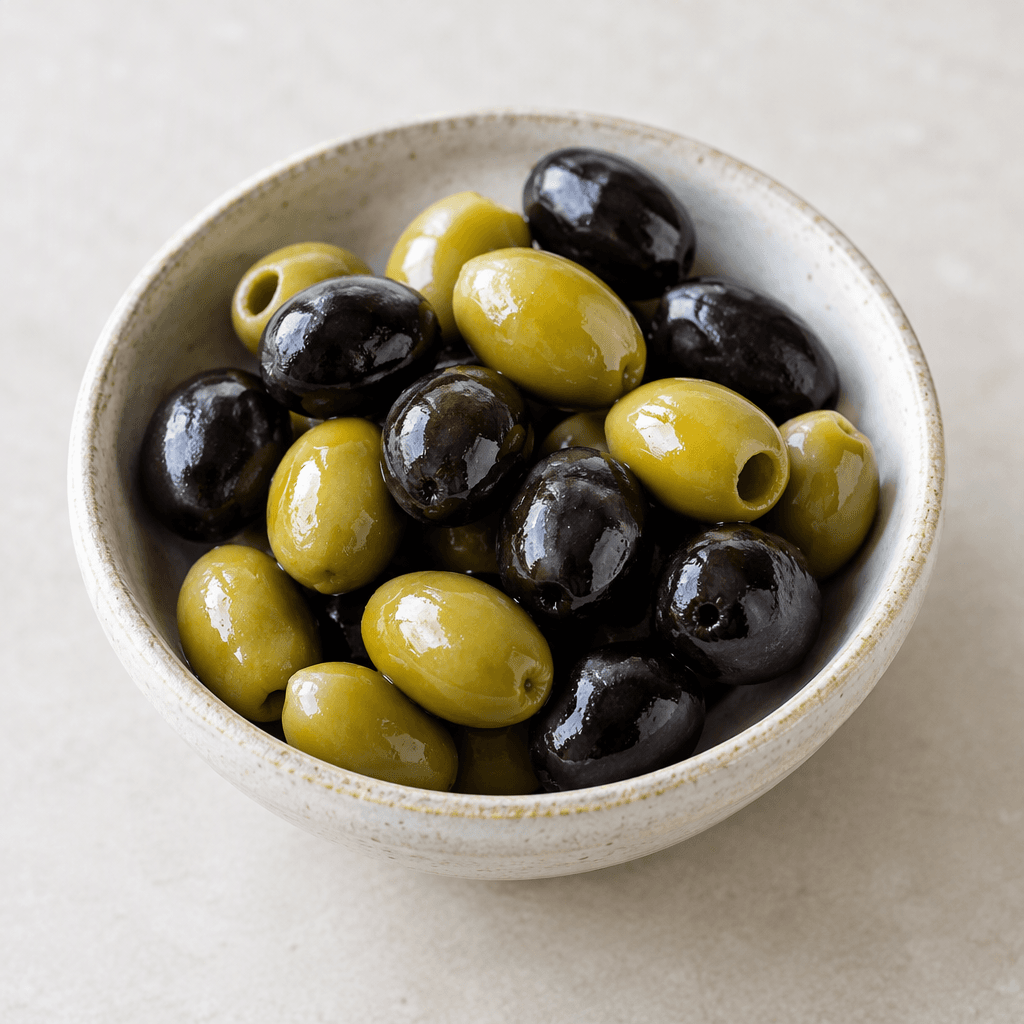
Black and green olives Calories
Contains healthy fats and vitamin E
In season: Spring · Summer · Autumn · Winter
CALORIES
GI
POTASSIUM
FIBER
Quick answer
8 piece (medium) of Black and green olives (32 g) has 46 calories. That works out to 145 calories per 100 g. It contains 1.2 g of carbs, 0.3 g of protein, 4.9 g of fat and 1.1 g of fiber. Its 235.2 mg of Sodium covers 10% of the Daily Value. Its glycemic index is 15 (low), so it raises blood sugar slowly.
What is Black and green olives?
Black and green olives are the fruit of the olive tree, which has long been cultivated around the Mediterranean. Fresh olives are naturally bitter, so they are cured—often in brine or salt—before eating. Green olives tend to be firmer and sharper in flavour, while black ones are often softer and rounder, though varieties and curing methods make a difference.
In Mediterranean cooking they’re served as a snack or part of an antipasto spread, and added to salads, breads and cooked dishes; they’re just as easy to enjoy with a simple meal anywhere. They provide mostly fat, along with fibre and vitamin E, and are low in carbohydrate. If you’d like a milder, less salty taste, rinse them briefly before serving.
Black and green olives Nutrition Facts
Selected: 100 g
145
KCAL / 100G
Carbs
3.8g
· 1% DV
Protein
1g
· 2% DV
Fat
15.3g
· 20% DV
Fiber
3.3g
· 12% DV
DV is the share of the daily value covered, on a 2,000 kcal reference diet.
Calories come from: Carbs 10% · Protein 3% · Fat 87%
Black and green olives Vitamins & Minerals
Vitamins
Vitamin E
3.8mg · 25% DV
Vitamin A
20µg · 2% DV
B1
0.02mg · 2% DV
B3
0.24mg · 2% DV
Minerals
Sodium
735mg · 32% DV
Calcium
52mg · 5% DV
Magnesium
11mg · 3% DV
Selenium
0.9µg · 2% DV
How Nutritious Is Black and green olives?
Nutrient density
Medium
How many vitamins, minerals and how much fiber this food carries per calorie. A high score means a lot of nutrition for few calories.
Satiety score
Medium
An EatBetter score computed from fiber, protein and calorie density. A high score means staying full longer on the same calories.
Both scores are calculated per 100 g and do not change with the selected portion. The satiety score is EatBetter's own calculation, not a clinical measure.
Black and green olives Glycemic Index
GLYCEMIC INDEX
GLYCEMIC LOAD
Accounts for portion size — a more realistic measure than GI alone.
How to Burn Off Black and green olives
To burn the 145 calories in 100 g:
🚶
Walking (5 km/h)
🏃
Running (8 km/h)
🚴
Cycling
🏊
Swimming
Times are calculated with the MET equation for a 70 kg adult. Actual burn varies with your weight, age and pace.
Is Black and green olives Processed?
NOVA 3
Processed
1. Unprocessed
2. Minimally Processed
3. Processed
4. Ultra-Processed
NOVA classifies foods into 4 groups by industrial processing. NOVA 1 (unprocessed) is the healthiest.
Does Black and green olives Contain Allergens?
No known major allergens
Which Diets Is Black and green olives Good For?
Vegan
✓ Suitable
Vegetarian
✓ Suitable
Gluten-Free
✓ Suitable
Dairy-Free
— Not suitable
Mediterranean
✓ Suitable
Paleo
✓ Suitable
Whole30
— Not suitable
DASH
— Not suitable
Keto
✓ Suitable
Low FODMAP
— Not suitable
Black and green olives Fat Profile
SATURATED
2.03g
MONOUNSATURATED
11.3g
POLYUNSATURATED
1.35g
Omega 6:3 ratio 14:1
Above the ideal 4:1 (14:1).
Compare Black and green olives
Foods Similar to Black and green olives
Frequently Asked Questions About Black and green olives
What is the difference between black and green olives?
Black and green olives are generally picked at different stages of ripeness and may be cured differently. Green olives are usually harvested earlier, while naturally black olives ripen longer; curing methods also shape their flavour and texture.
Are black olives naturally black, or are they dyed?
Some black olives darken naturally as they ripen, while others are picked green and darkened during processing. Uniformly dark colour can result from this processing method, so black olives do not all get their colour in the same way.
Why are green olives often stuffed with pimentos?
Green olives are often stuffed with pimentos because their firm texture holds the filling well and the mild, sweet pepper complements their briny taste. They are also sold plain or stuffed with other ingredients, such as garlic or almonds.
How are black and green olives cured?
Black and green olives are cured in brine, dry salt, or other solutions to reduce their natural bitterness and develop flavour. Freshly picked olives are intensely bitter, so curing is an essential step before they are eaten.
Should you rinse black and green olives before eating them?
You can rinse black and green olives to remove some surface brine and make their flavour less salty. A quick rinse will not remove all the salt, since some is absorbed during curing.
How should you store black and green olives after opening?
Keep opened black and green olives refrigerated in a clean, covered container, ideally submerged in their brine. Use a clean utensil to serve them, and avoid leaving the container out at room temperature for extended periods.
Can you cook with black and green olives?
Yes, black and green olives work well in salads, pasta, stews, and baked dishes. Remove the pits before chopping, and add them near the end of cooking when you want to preserve more of their texture and distinct briny flavour.
Can dogs eat black and green olives?
Dogs can eat a plain, pitted black or green olive in a small amount, but olives in brine can be very salty. Avoid olives stuffed with ingredients such as garlic, and never give a dog an olive with its pit.
Do black and green olives help with weight loss?
Black and green olives can fit into a weight-conscious eating pattern, but they are easy to eat in large portions because they are small and savoury. Their fat can make them satisfying; keep an eye on portion size and salty accompaniments.
How can you tell if black and green olives have gone bad?
Discard black and green olives if you see mould, notice an unpleasant or yeasty smell, or find that their texture has become unusually slimy. Cloudy brine alone can occur during fermentation, but visible spoilage or a foul odour is a reason not to eat them.
Have another question about Black and green olives?
Ask the AI nutrition coach — calories, portions, alternatives and more, answered in seconds in the app.

Scan calories with your camera
Instant AI nutrition analysis

Nutrition data compiled from USDA FoodData Central and scientific sources.