

Ready & Packaged Foods
All →Vegetables & Legumes
All →Desserts & Confectionery
All →Meat & Protein
All →Grains & Bakery
All →Beverages
All →Milk & Dairy
All →

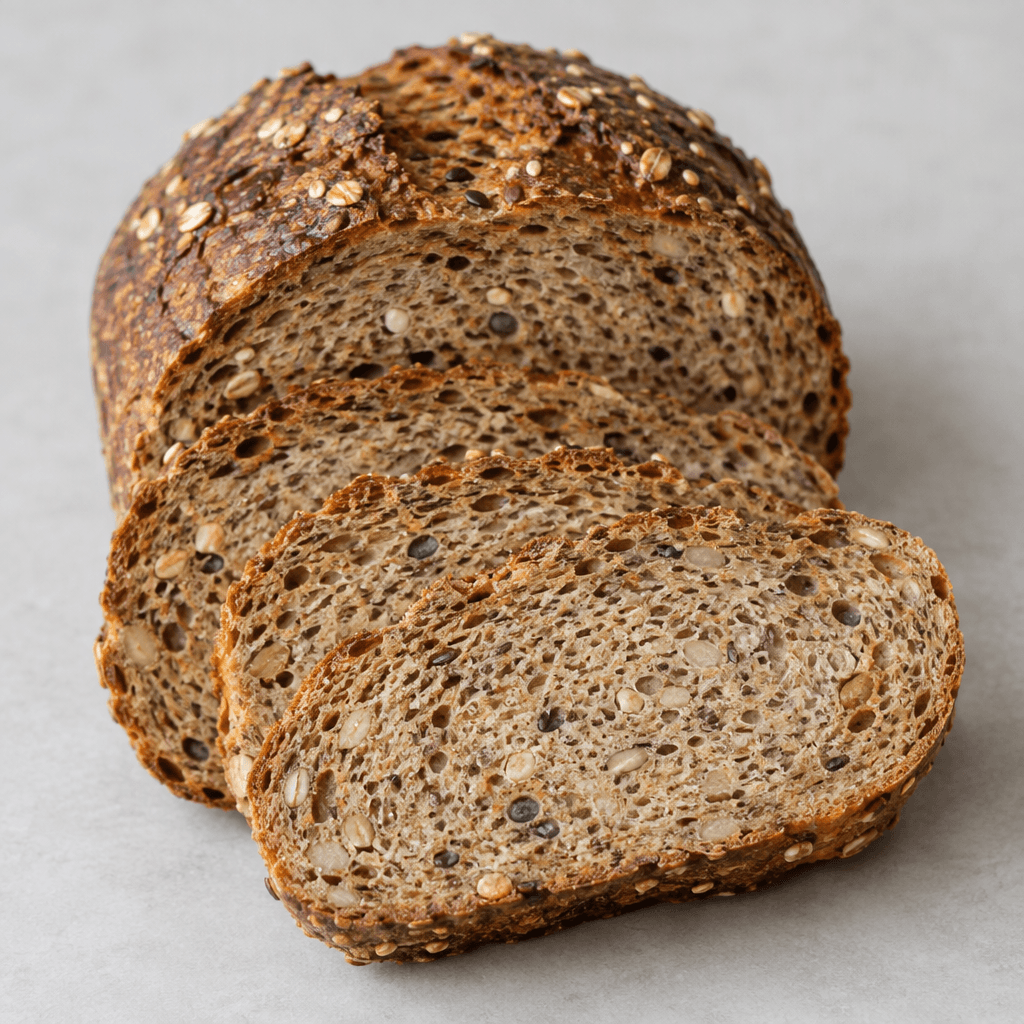
Whole grain high-fiber bread Calories
High-fiber whole grain bread
CALORIES
GI
POTASSIUM
FIBER
Quick answer
2 slice (medium) of Whole grain high-fiber bread (56 g) has 138 calories. That works out to 247 calories per 100 g. It contains 23.1 g of carbs, 7 g of protein, 2.4 g of fat and 6 g of fiber. Its 1.1 mg of Manganese covers 46% of the Daily Value. Its glycemic index is 50 (low), so it raises blood sugar slowly.
What is Whole grain high-fiber bread?
Whole grain high-fiber bread is made with flour that retains the grain’s bran and germ, and may also include visible grains or seeds. It is often baked as a substantial loaf with a firm crust and a close, hearty crumb rather than the light texture of white bread.
Across many English-speaking countries, it is a familiar choice for toast, sandwiches and alongside soups; toasting brings out its nutty, earthy flavour. Its whole grains make it a fibre-rich option, with 10.8 g of fibre per 100 g. Pair it with eggs, hummus or fresh vegetables for a satisfying meal, or choose a modest topping if you want to keep the slice lighter.
Whole grain high-fiber bread Nutrition Facts
Selected: 100 g
247
KCAL / 100G
Carbs
41.3g
· 15% DV
Protein
12.5g
· 25% DV
Fat
4.2g
· 5% DV
Fiber
10.8g
· 39% DV
DV is the share of the daily value covered, on a 2,000 kcal reference diet.
Calories come from: Carbs 65% · Protein 20% · Fat 15%
Whole grain high-fiber bread Vitamins & Minerals
Vitamins
B1
0.45mg · 38% DV
B3
4.8mg · 30% DV
Biotin
4µg · 13% DV
B5
0.55mg · 11% DV
Minerals
Manganese
2mg · 87% DV
Selenium
28µg · 51% DV
Phosphorus
245mg · 35% DV
Magnesium
82mg · 20% DV
How Nutritious Is Whole grain high-fiber bread?
Nutrient density
High
How many vitamins, minerals and how much fiber this food carries per calorie. A high score means a lot of nutrition for few calories.
Satiety score
High
An EatBetter score computed from fiber, protein and calorie density. A high score means staying full longer on the same calories.
Both scores are calculated per 100 g and do not change with the selected portion. The satiety score is EatBetter's own calculation, not a clinical measure.
Whole grain high-fiber bread Glycemic Index
GLYCEMIC INDEX
GLYCEMIC LOAD
Accounts for portion size — a more realistic measure than GI alone.
How to Burn Off Whole grain high-fiber bread
To burn the 247 calories in 100 g:
🚶
Walking (5 km/h)
🏃
Running (8 km/h)
🚴
Cycling
🏊
Swimming
Times are calculated with the MET equation for a 70 kg adult. Actual burn varies with your weight, age and pace.
Is Whole grain high-fiber bread Processed?
NOVA 3
Processed
1. Unprocessed
2. Minimally Processed
3. Processed
4. Ultra-Processed
NOVA classifies foods into 4 groups by industrial processing. NOVA 1 (unprocessed) is the healthiest.
Does Whole grain high-fiber bread Contain Allergens?
Contains these allergens:
Which Diets Is Whole grain high-fiber bread Good For?
Vegan
✓ Suitable
Vegetarian
✓ Suitable
Gluten-Free
— Not suitable
Dairy-Free
— Not suitable
Mediterranean
✓ Suitable
Paleo
— Not suitable
Whole30
— Not suitable
DASH
— Not suitable
Keto
— Not suitable
Low FODMAP
— Not suitable
Whole grain high-fiber bread Fat Profile
SATURATED
0.7g
MONOUNSATURATED
0.9g
POLYUNSATURATED
1.6g
Omega 6:3 ratio 18.1:1
Above the ideal 4:1 (18.1:1).
Compare Whole grain high-fiber bread
Foods Similar to Whole grain high-fiber bread
Frequently Asked Questions About Whole grain high-fiber bread
Is whole grain high-fiber bread a healthy everyday choice?
Yes, whole grain high-fiber bread can be a nutritious everyday choice because it provides fiber and retains more of the grain than bread made with refined flour. Pair it with protein-rich toppings, such as eggs or hummus, for a more satisfying meal.
Does whole grain high-fiber bread help with weight loss?
It can support fullness, since fiber slows digestion, but whole grain high-fiber bread does not cause weight loss by itself. Portion size and what you put on it matter too; generous spreads can add substantially to a meal.
Can you eat whole grain high-fiber bread if you have diabetes?
Yes, people with diabetes can often include whole grain high-fiber bread, but its carbohydrates still affect blood glucose. The amount that fits a meal varies by person, so ask your clinician or dietitian for advice tailored to your treatment plan.
Why does whole grain high-fiber bread make me bloated?
Whole grain high-fiber bread may cause gas or bloating when you are not used to eating much fiber, or when you eat a large serving at once. Try a smaller portion and increase fiber gradually while drinking enough fluids.
Does toasting whole grain high-fiber bread destroy its fiber?
No, toasting whole grain high-fiber bread does not remove a meaningful amount of fiber. Toasting mainly dries and browns the surface. The toppings you add, rather than the toasting itself, can change the meal’s nutrition substantially.
How can you tell if whole grain high-fiber bread is really whole grain?
Look for whole-grain flour or whole-wheat flour near the beginning of the ingredients list on whole grain high-fiber bread. A brown color, visible seeds, or words such as “multigrain” do not by themselves prove that the flour is whole grain.
Is whole grain high-fiber bread the same as whole-wheat bread?
Not always. Whole-wheat bread is made with whole wheat, while whole grain high-fiber bread may use other whole grains as well. Both can be genuinely whole grain, but names alone do not tell you which grains or flours are in a particular loaf.
Can whole grain high-fiber bread be frozen?
Yes, whole grain high-fiber bread freezes well. Slice the loaf first, seal the slices in a freezer-safe bag, and take out only what you need. You can toast slices straight from frozen or let them thaw at room temperature.
How should you store whole grain high-fiber bread to prevent mold?
Keep whole grain high-fiber bread sealed in a cool, dry place if you will eat it soon. For longer storage, freeze it rather than refrigerating it, since refrigeration can make bread stale faster. Discard the whole loaf if you find mold.
Can whole grain high-fiber bread cause constipation?
It usually helps support regular bowel movements, but whole grain high-fiber bread can contribute to constipation if you suddenly increase fiber without drinking enough fluids. Add it gradually and drink water throughout the day so the extra fiber can work effectively.
Have another question about Whole grain high-fiber bread?
Ask the AI nutrition coach — calories, portions, alternatives and more, answered in seconds in the app.

Scan calories with your camera
Instant AI nutrition analysis

Nutrition data compiled from USDA FoodData Central and scientific sources.