

Ready & Packaged Foods
All →Vegetables & Legumes
All →Desserts & Confectionery
All →Meat & Protein
All →Grains & Bakery
All →Beverages
All →Milk & Dairy
All →

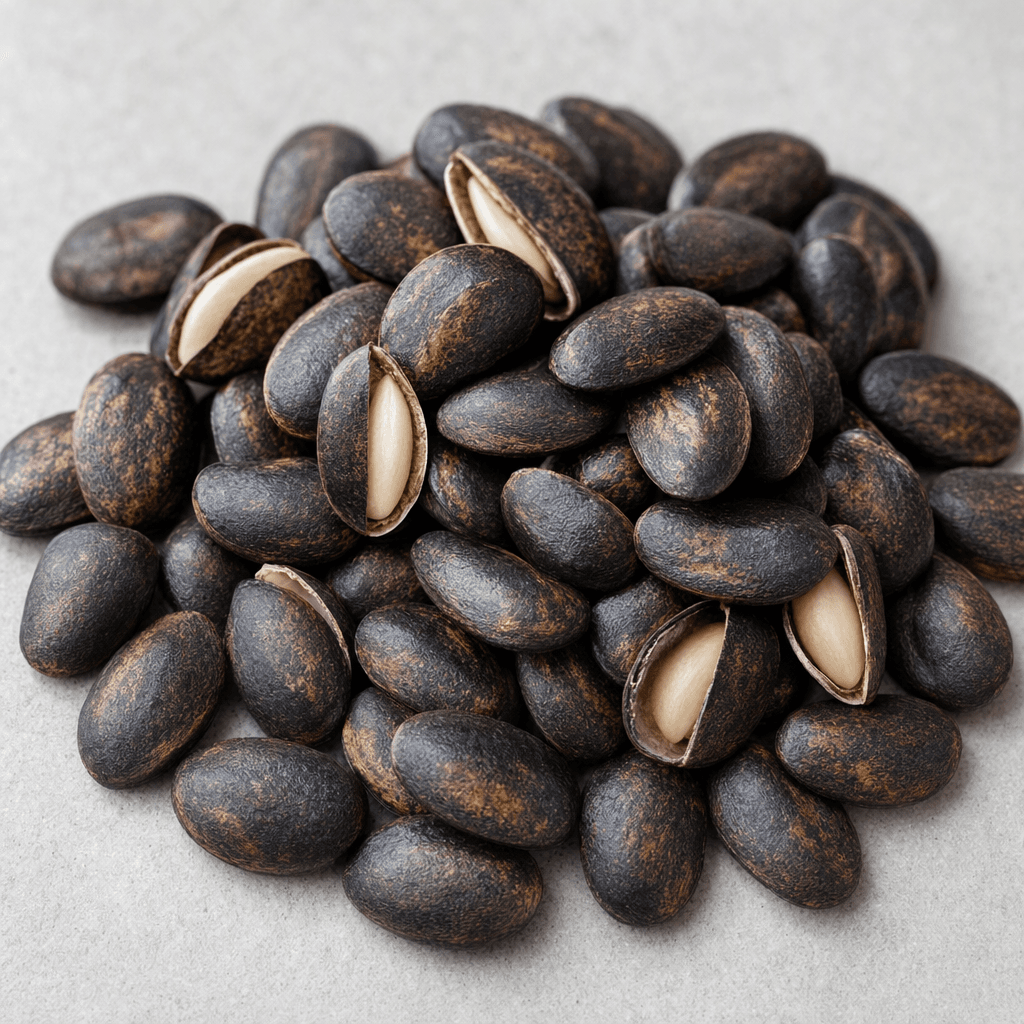
Roasted watermelon seeds Calories
Rich in protein and healthy fats, source of magnesium and iron
In season: Summer
CALORIES
GI
POTASSIUM
FIBER
Quick answer
1 serving (medium) of Roasted watermelon seeds (30 g) has 167 calories. That works out to 557 calories per 100 g. It contains 4.6 g of carbs, 8.5 g of protein, 14.2 g of fat and 1.4 g of fiber. Its 154.5 mg of Magnesium covers 37% of the Daily Value. Its glycemic index is 10 (low), so it raises blood sugar slowly.
What is Roasted watermelon seeds?
Roasted watermelon seeds are the dried seeds of the fruit, toasted until crisp. They’re enjoyed as a snack in many parts of the world, including regions of Africa, the Middle East and Asia. They may be sold with their dark shells on or as shelled kernels; crack the shell to get to the kernel if it’s tough.
Toasting brings out a mild, nutty flavour and a crunchy bite. Eat them by the handful, add them to a trail mix, or scatter shelled kernels over salads and soups. They’re rich in protein and fats, with magnesium and iron as well. A small portion makes a satisfying snack; pair it with fruit for a simple contrast, and choose an unsalted version if you’re watching your salt intake.
Roasted watermelon seeds Nutrition Facts
Selected: 100 g
557
KCAL / 100G
Carbs
15.2g
· 6% DV
Protein
28.3g
· 57% DV
Fat
47.4g
· 61% DV
Fiber
4.7g
· 17% DV
DV is the share of the daily value covered, on a 2,000 kcal reference diet.
Calories come from: Carbs 10% · Protein 19% · Fat 71%
Roasted watermelon seeds Vitamins & Minerals
Vitamins
B3
3.2mg · 20% DV
B1
0.19mg · 16% DV
B5
0.75mg · 15% DV
Folate
58µg · 14% DV
Minerals
Magnesium
515mg · 123% DV
Copper
1mg · 111% DV
Phosphorus
755mg · 108% DV
Zinc
10mg · 91% DV
How Nutritious Is Roasted watermelon seeds?
Nutrient density
Very high
How many vitamins, minerals and how much fiber this food carries per calorie. A high score means a lot of nutrition for few calories.
Satiety score
Medium
An EatBetter score computed from fiber, protein and calorie density. A high score means staying full longer on the same calories.
Both scores are calculated per 100 g and do not change with the selected portion. The satiety score is EatBetter's own calculation, not a clinical measure.
Roasted watermelon seeds Glycemic Index
GLYCEMIC INDEX
GLYCEMIC LOAD
Accounts for portion size — a more realistic measure than GI alone.
How to Burn Off Roasted watermelon seeds
To burn the 557 calories in 100 g:
🚶
Walking (5 km/h)
🏃
Running (8 km/h)
🚴
Cycling
🏊
Swimming
Times are calculated with the MET equation for a 70 kg adult. Actual burn varies with your weight, age and pace.
Is Roasted watermelon seeds Processed?
NOVA 2
Minimally Processed
1. Unprocessed
2. Minimally Processed
3. Processed
4. Ultra-Processed
NOVA classifies foods into 4 groups by industrial processing. NOVA 1 (unprocessed) is the healthiest.
Does Roasted watermelon seeds Contain Allergens?
No known major allergens
Which Diets Is Roasted watermelon seeds Good For?
Vegan
✓ Suitable
Vegetarian
✓ Suitable
Gluten-Free
✓ Suitable
Dairy-Free
— Not suitable
Mediterranean
✓ Suitable
Paleo
✓ Suitable
Whole30
— Not suitable
DASH
— Not suitable
Keto
✓ Suitable
Low FODMAP
— Not suitable
Roasted watermelon seeds Fat Profile
SATURATED
9.8g
MONOUNSATURATED
7.9g
POLYUNSATURATED
28.2g
Omega 6:3 ratio 144.6:1
Above the ideal 4:1 (144.6:1).
Compare Roasted watermelon seeds
Foods Similar to Roasted watermelon seeds
Frequently Asked Questions About Roasted watermelon seeds
Can you eat roasted watermelon seeds whole?
Yes, you can eat roasted watermelon seeds whole. Chew them thoroughly, since the shells are tough and swallowing them without chewing may mean they pass through largely undigested. You can also crack the shell and eat the kernel.
What are roasted watermelon seeds good for?
Roasted watermelon seeds make a filling, crunchy snack and provide protein, healthy fats, magnesium, and iron. They can add variety to a balanced diet, but they are not a treatment or a cure for any health condition.
How do you roast watermelon seeds at home?
Rinse the watermelon seeds and dry them thoroughly, then toast them in a pan over low to medium heat, stirring often until crisp. Add salt if you like. Drying them well first helps them roast rather than steam.
Do watermelon seeds cause appendicitis?
No, eating watermelon seeds is not known to cause appendicitis. Seeds do not grow inside the body, either. Chew roasted watermelon seeds well, especially if you find their firm shells uncomfortable to swallow.
Are roasted watermelon seed shells digestible?
Only partly: watermelon seed shells are fibrous and tough, so they may pass through without being fully broken down, especially if swallowed whole. Chewing them well helps; for a softer bite, crack the shell and eat the kernel.
How do you crack roasted watermelon seeds?
Hold a roasted watermelon seed between your teeth and gently bite the seam until the shell splits, then remove the kernel. Avoid biting too hard, which can hurt your teeth; you can also crack a small batch with a nutcracker.
Can you use roasted watermelon seeds in recipes?
Yes, roasted watermelon seeds can add crunch to salads, soups, and grain bowls. Sprinkle them on just before serving to keep them crisp, or use the shelled kernels in place of other seeds in a topping.
How should you store roasted watermelon seeds?
Keep roasted watermelon seeds in a sealed, dry container away from heat and sunlight. Moisture softens their crunch, while exposure to air can make their fats taste stale. Discard them if they develop an off smell or taste.
Can you eat watermelon seeds raw, or should they be roasted?
You can eat watermelon seeds raw, but they are firmer and less crunchy than roasted seeds. Roasting brings out a nuttier flavor. If eating them raw, rinse the seeds and dry them well before storing or eating.
Do roasted watermelon seeds cause weight gain?
Roasted watermelon seeds do not cause weight gain on their own, but they are energy-dense and easy to snack on by the handful. A small portion can fit into a snack; repeatedly eating large amounts can add substantially to your daily intake.
Have another question about Roasted watermelon seeds?
Ask the AI nutrition coach — calories, portions, alternatives and more, answered in seconds in the app.

Scan calories with your camera
Instant AI nutrition analysis

Nutrition data compiled from USDA FoodData Central and scientific sources.