

Ready & Packaged Foods
All →Vegetables & Legumes
All →Desserts & Confectionery
All →Meat & Protein
All →Grains & Bakery
All →Beverages
All →Milk & Dairy
All →

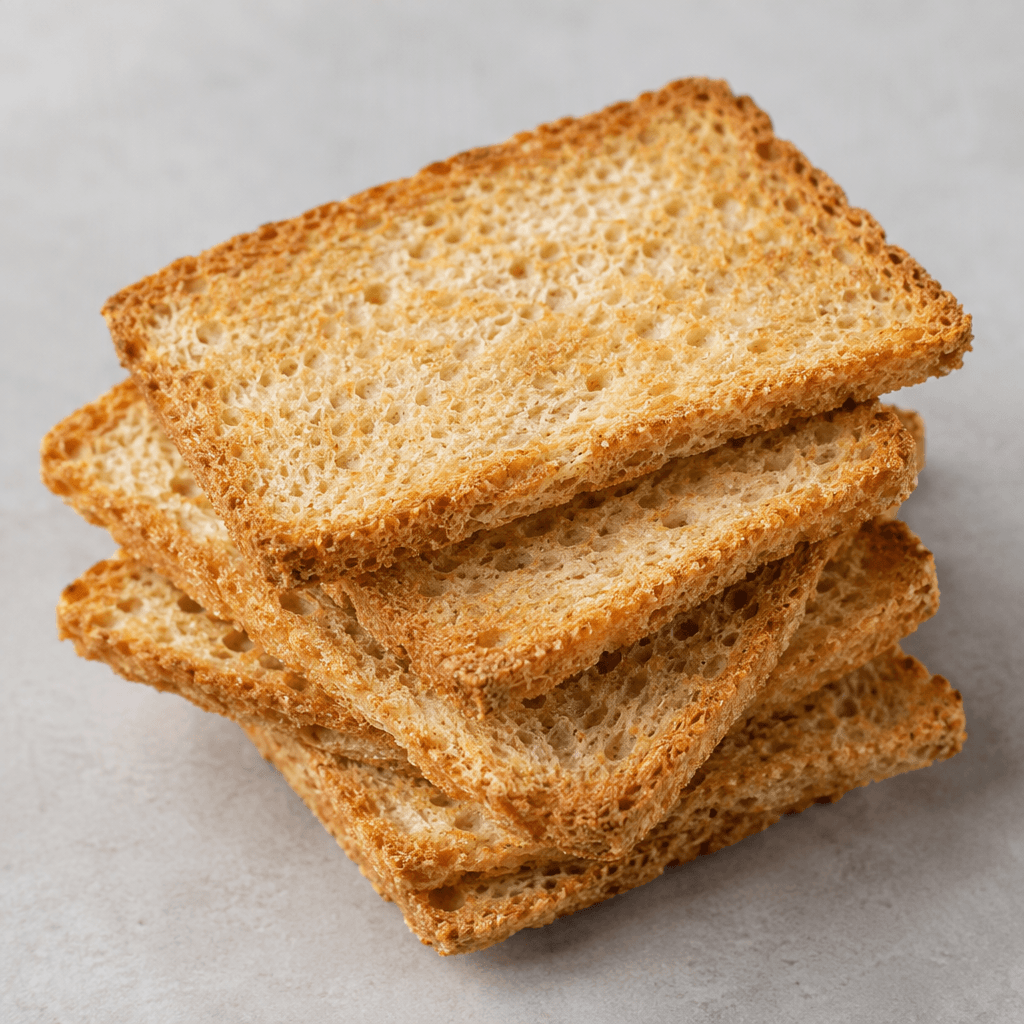
Unsalted Etimek Calories
Unsalted, crisp bread, low sodium
In season: Spring · Summer · Autumn · Winter
CALORIES
GI
POTASSIUM
FIBER
Quick answer
1 slice (medium) of Unsalted Etimek (18 g) has 67 calories. That works out to 370 calories per 100 g. It contains 13.9 g of carbs, 2 g of protein, 0.2 g of fat and 0.8 g of fiber. Its 0.1 mg of B1 covers 5% of the Daily Value. Its glycemic index is 70 (high), so it raises blood sugar quickly.
What is Unsalted Etimek?
Unsalted etimek is a Turkish pantry staple: thin slices of bread that are dried and toasted until crisp. It is especially familiar as the base for etimek tatlısı, a layered dessert, though the plain slices are useful well beyond sweets.
Its dry, airy crunch works with cheese, tomatoes or spreads, and it can be served alongside tea or used in place of fresh bread. In Turkish cooking, it is often softened with syrup for dessert; elsewhere, try it as a crisp base for savoury toppings or crumbled into a dish that needs texture. It is mostly carbohydrate, with 77 g per 100 g, and very little fat. Since it has no added salt, you can choose savoury toppings to suit your taste.
Unsalted Etimek Nutrition Facts
Selected: 100 g
370
KCAL / 100G
Carbs
77g
· 28% DV
Protein
11g
· 22% DV
Fat
1.2g
· 2% DV
Fiber
4.5g
· 16% DV
DV is the share of the daily value covered, on a 2,000 kcal reference diet.
Calories come from: Carbs 85% · Protein 12% · Fat 3%
Unsalted Etimek Vitamins & Minerals
Vitamins
B1
0.32mg · 27% DV
B3
3.5mg · 22% DV
B2
0.15mg · 12% DV
Folate
35µg · 9% DV
Minerals
Manganese
1mg · 43% DV
Phosphorus
110mg · 16% DV
Selenium
7µg · 13% DV
Iron
2mg · 11% DV
How Nutritious Is Unsalted Etimek?
Nutrient density
Medium
How many vitamins, minerals and how much fiber this food carries per calorie. A high score means a lot of nutrition for few calories.
Satiety score
Medium
An EatBetter score computed from fiber, protein and calorie density. A high score means staying full longer on the same calories.
Both scores are calculated per 100 g and do not change with the selected portion. The satiety score is EatBetter's own calculation, not a clinical measure.
Unsalted Etimek Glycemic Index
GLYCEMIC INDEX
GLYCEMIC LOAD
Accounts for portion size — a more realistic measure than GI alone.
How to Burn Off Unsalted Etimek
To burn the 370 calories in 100 g:
🚶
Walking (5 km/h)
🏃
Running (8 km/h)
🚴
Cycling
🏊
Swimming
Times are calculated with the MET equation for a 70 kg adult. Actual burn varies with your weight, age and pace.
Is Unsalted Etimek Processed?
NOVA 3
Processed
1. Unprocessed
2. Minimally Processed
3. Processed
4. Ultra-Processed
NOVA classifies foods into 4 groups by industrial processing. NOVA 1 (unprocessed) is the healthiest.
Does Unsalted Etimek Contain Allergens?
Contains these allergens:
Which Diets Is Unsalted Etimek Good For?
Vegan
✓ Suitable
Vegetarian
✓ Suitable
Gluten-Free
— Not suitable
Dairy-Free
— Not suitable
Mediterranean
✓ Suitable
Paleo
— Not suitable
Whole30
— Not suitable
DASH
— Not suitable
Keto
— Not suitable
Low FODMAP
— Not suitable
Unsalted Etimek Fat Profile
SATURATED
0.25g
MONOUNSATURATED
0.15g
POLYUNSATURATED
0.4g
Omega 6:3 ratio 17.5:1
Above the ideal 4:1 (17.5:1).
Compare Unsalted Etimek
Foods Similar to Unsalted Etimek
Frequently Asked Questions About Unsalted Etimek
What is unsalted etimek?
Unsalted etimek is a Turkish crisp bread made from thin slices of bread that are baked or toasted until dry and crunchy. “Unsalted” means salt is not added during its preparation, making it a useful base for both sweet and savory toppings.
How do you make Turkish etimek dessert with unsalted etimek?
Arrange unsalted etimek in a dish, pour hot syrup over the slices, and let them absorb it. Spread a layer of Turkish-style milk pudding on top, chill until set, then finish with a topping such as pistachios or coconut.
Is unsalted etimek the same as melba toast?
No. Unsalted etimek and melba toast are both thin, crisp bread products, but they are not identical: etimek is commonly used in Turkish home cooking, especially as the base for syrup-soaked desserts, and its shape and texture can differ.
What can you eat with unsalted etimek for breakfast?
Unsalted etimek works with soft cheese, yogurt cheese, sliced tomato, jam, or nut butter. Since the slices are dry and crisp, moist spreads make them easier to eat; add toppings shortly before serving to keep the etimek from softening.
Can unsalted etimek be used instead of rusks in a recipe?
Often, yes: unsalted etimek can stand in for plain rusks in layered desserts or as a crisp accompaniment. It may absorb liquid differently, so add syrup or other liquids gradually and allow time for the slices to soften.
How should you store unsalted etimek after opening it?
Keep unsalted etimek in an airtight container in a cool, dry cupboard. Moisture makes the slices lose their crunch, so seal the package promptly after use and avoid storing it near steam or other damp foods.
Can you crush unsalted etimek into breadcrumbs?
Yes. Crush unsalted etimek by hand or pulse it briefly in a food processor to make coarse crumbs for toppings or coatings. The crumbs are crisp and may be larger than ordinary breadcrumbs, so adjust their size to suit the recipe.
Can you eat unsalted etimek straight from the package?
Yes, unsalted etimek is ready to eat straight from the package. Its dry, crisp texture makes it convenient as a snack, though many people prefer it with a spread, cheese, or soup rather than on its own.
Does unsalted etimek go soggy in syrup desserts?
Yes, unsalted etimek softens when it absorbs syrup, which is how it forms the base of many Turkish etimek desserts. Pour the syrup evenly over the slices and give them time to soak before adding the pudding layer.
Does unsalted etimek contain any salt at all?
Unsalted etimek is made without added salt, but “unsalted” does not necessarily mean it contains absolutely no sodium. Small amounts can come naturally from its ingredients, so the term describes how the etimek is prepared.
Have another question about Unsalted Etimek?
Ask the AI nutrition coach — calories, portions, alternatives and more, answered in seconds in the app.

Scan calories with your camera
Instant AI nutrition analysis

Nutrition data compiled from USDA FoodData Central and scientific sources.