

Ready & Packaged Foods
All →Vegetables & Legumes
All →Desserts & Confectionery
All →Meat & Protein
All →Grains & Bakery
All →Beverages
All →Milk & Dairy
All →

Sumac Calories
Rich in antioxidants, tangy spice
In season: Summer · Autumn
CALORIES
GI
POTASSIUM
FIBER
Quick answer
1 teaspoon (medium) of Sumac (3 g) has 3 calories. That works out to 100 calories per 100 g. It contains 1.1 g of carbs, 0.1 g of protein, 0 g of fat and 0.4 g of fiber. Its glycemic index is 20 (low), so it raises blood sugar slowly.
What is Sumac?
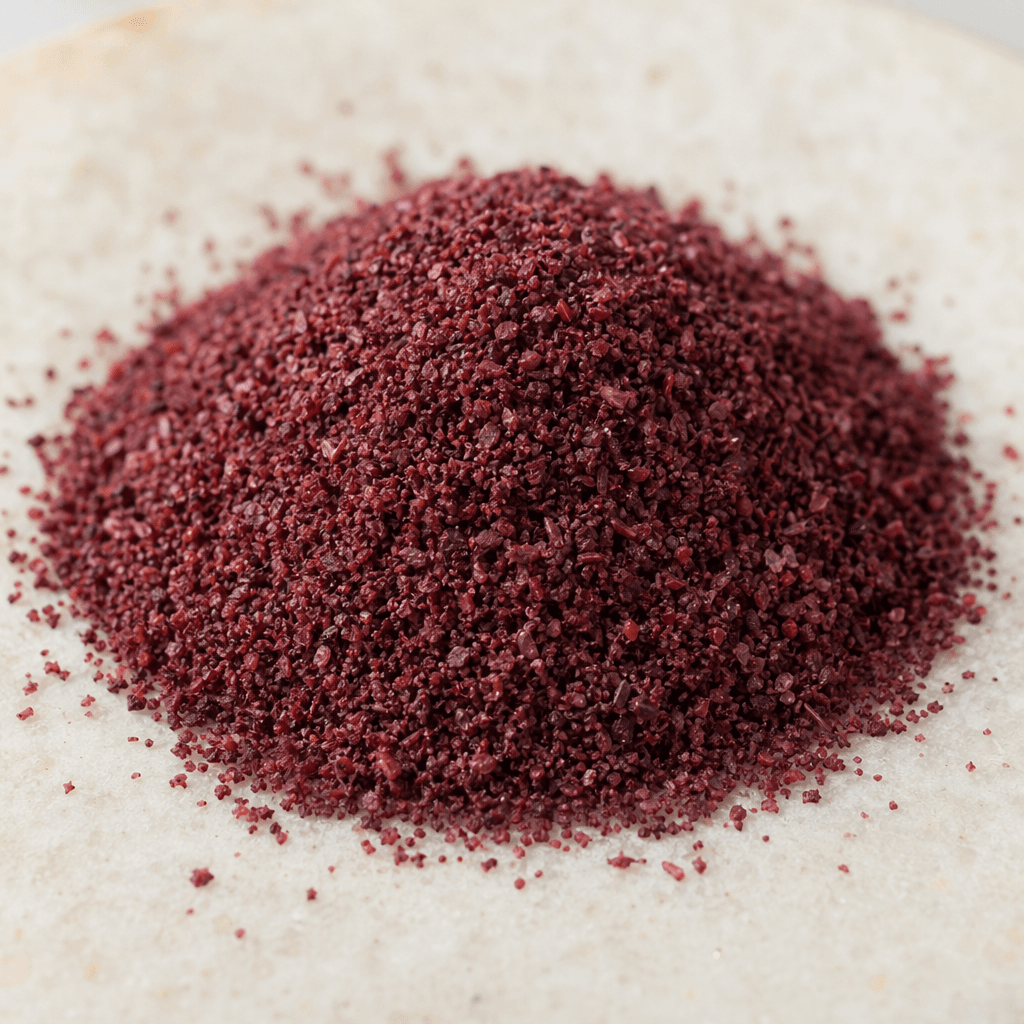
Sumac is a tangy spice made from the dried, ground berries of the sumac shrub. Its coarse, burgundy-red grains bring a bright, tart note to cooking across the Middle East and the eastern Mediterranean.
Sprinkle it over salads, grilled meats, roasted vegetables or hummus, or stir it into a dressing with olive oil. In Turkish cooking, it is especially familiar on sliced onions served alongside kebabs. Sumac contributes fibre and plant compounds, though it is usually used in small amounts, so it is best thought of as a flavourful seasoning rather than a substantial source of nutrients. Add it near the end of cooking to keep its citrusy edge lively.
Sumac Nutrition Facts
Selected: 100 g
100
KCAL / 100G
Carbs
38.2g
· 14% DV
Protein
2.3g
· 5% DV
Fat
1.6g
· 2% DV
Fiber
12.7g
· 45% DV
DV is the share of the daily value covered, on a 2,000 kcal reference diet.
Calories come from: Carbs 87% · Protein 5% · Fat 8%
Sumac Vitamins & Minerals
Vitamins
Vitamin C
36mg · 40% DV
Vitamin E
1.8mg · 12% DV
B5
0.4mg · 8% DV
B2
0.09mg · 7% DV
Minerals
Iron
4mg · 22% DV
Potassium ⭐
420mg · 12% DV
Magnesium
41mg · 10% DV
Zinc
1mg · 9% DV
How Nutritious Is Sumac?
Nutrient density
High
How many vitamins, minerals and how much fiber this food carries per calorie. A high score means a lot of nutrition for few calories.
Satiety score
High
An EatBetter score computed from fiber, protein and calorie density. A high score means staying full longer on the same calories.
Both scores are calculated per 100 g and do not change with the selected portion. The satiety score is EatBetter's own calculation, not a clinical measure.
Sumac Glycemic Index
GLYCEMIC INDEX
GLYCEMIC LOAD
Accounts for portion size — a more realistic measure than GI alone.
How to Burn Off Sumac
To burn the 100 calories in 100 g:
🚶
Walking (5 km/h)
🏃
Running (8 km/h)
🚴
Cycling
🏊
Swimming
Times are calculated with the MET equation for a 70 kg adult. Actual burn varies with your weight, age and pace.
Is Sumac Processed?
NOVA 2
Minimally Processed
1. Unprocessed
2. Minimally Processed
3. Processed
4. Ultra-Processed
NOVA classifies foods into 4 groups by industrial processing. NOVA 1 (unprocessed) is the healthiest.
Does Sumac Contain Allergens?
No known major allergens
Which Diets Is Sumac Good For?
Vegan
✓ Suitable
Vegetarian
✓ Suitable
Gluten-Free
✓ Suitable
Dairy-Free
— Not suitable
Mediterranean
✓ Suitable
Paleo
✓ Suitable
Whole30
— Not suitable
DASH
— Not suitable
Keto
✓ Suitable
Low FODMAP
— Not suitable
Sumac Fat Profile
SATURATED
0.2g
MONOUNSATURATED
0.5g
POLYUNSATURATED
0.7g
Omega 6:3 ratio 4:1
Below the ideal 4:1 — a good omega balance.
Compare Sumac
Foods Similar to Sumac
Frequently Asked Questions About Sumac
What does sumac taste like?
Sumac tastes tart, fruity, and slightly astringent, with a lemon-like brightness. Its flavor is usually less sharp than straight lemon juice, so it can add acidity without making a dish taste distinctly citrusy.
How do you use sumac in cooking?
Use sumac as a finishing spice or add it near the end of cooking to preserve its aroma. Sprinkle it over salads, roasted vegetables, grilled meat, rice, or dips, or mix it into a marinade.
What is sumac spice made from?
Sumac spice is made from the dried, red fruit of edible sumac shrubs, commonly Rhus coriaria. The fruit is ground into a coarse or fine powder, sometimes with salt added depending on the product.
Is sumac the same as za’atar?
No, sumac and za’atar are different. Sumac is a single tart spice, while za’atar is a blend that commonly includes sumac, dried herbs such as thyme or oregano, and sesame seeds.
Can you eat sumac raw?
Yes, culinary sumac can be eaten without cooking. It is often sprinkled directly onto finished dishes such as salads, hummus, or grilled foods; its tart flavor is especially noticeable when used as a finishing spice.
How do you make sumac tea?
To make sumac tea, steep sumac berries or ground sumac in hot water, then strain it before drinking. Ground sumac can leave sediment, so a fine strainer helps produce a smoother cup.
Is sumac the same as poison sumac?
No, the sumac sold as a culinary spice is not poison sumac. Edible sumac spice comes from different sumac species; avoid eating wild plants you cannot identify and use products intended for food.
What can you use instead of sumac?
Lemon zest with a little lemon juice can replace sumac when a recipe needs tartness, though it will not reproduce sumac’s fruity, slightly astringent flavor. A small amount of vinegar can also add acidity in some dishes.
How should you store sumac?
Store sumac in a tightly sealed container in a cool, dry, dark place. Keeping it away from steam, heat, and direct sunlight helps preserve its aroma and color; discard it if it develops an unusual smell or signs of moisture.
Why is sumac sprinkled on kebabs and salads?
Sumac adds a bright, tart contrast to rich grilled meats and fresh vegetables. It is often sprinkled on kebabs or salads just before serving, when its flavor and deep red color stand out.
Have another question about Sumac?
Ask the AI nutrition coach — calories, portions, alternatives and more, answered in seconds in the app.

Scan calories with your camera
Instant AI nutrition analysis

Nutrition data compiled from USDA FoodData Central and scientific sources.