

Ready & Packaged Foods
All →Vegetables & Legumes
All →Desserts & Confectionery
All →Meat & Protein
All →Grains & Bakery
All →Beverages
All →Milk & Dairy
All →

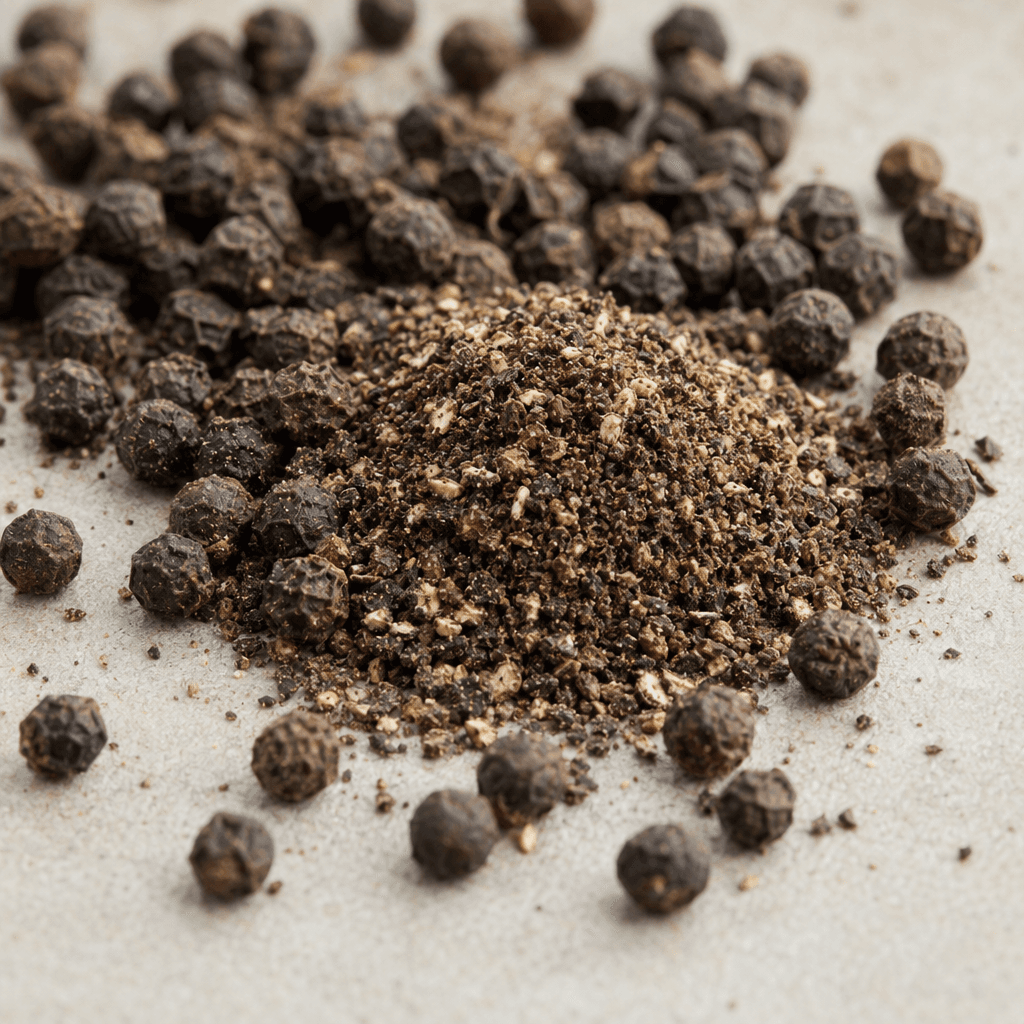
Black Pepper Calories
Intensely aromatic spice, source of antioxidants
In season: Spring · Summer · Autumn · Winter
CALORIES
GI
POTASSIUM
FIBER
Quick answer
1 teaspoon (medium) of Black Pepper (2 g) has 6 calories. That works out to 255 calories per 100 g. It contains 1.5 g of carbs, 0.2 g of protein, 0.1 g of fat and 0.6 g of fiber. Its 0.1 mg of Manganese covers 6% of the Daily Value. Its glycemic index is 15 (low), so it raises blood sugar slowly.
What is Black Pepper?
Black pepper is made from the dried berries of Piper nigrum, a climbing plant native to the Malabar Coast of India. The berries are used whole, cracked or ground, and freshly ground pepper has a sharper, more pronounced aroma than powder that has been stored for a while.
Across its native region and in kitchens worldwide, it seasons soups, vegetables, eggs, meat, fish and sauces, added during cooking or at the table. Its pungent warmth brings depth without needing much, so it is best treated as a seasoning rather than a substantial source of nutrients; despite its fibre content, a typical pinch or sprinkle is a small portion. Keep peppercorns sealed and grind them as needed for fuller flavour.
Black Pepper Nutrition Facts
Selected: 100 g
255
KCAL / 100G
Carbs
64.8g
· 24% DV
Protein
10.4g
· 21% DV
Fat
3.3g
· 4% DV
Fiber
25.3g
· 90% DV
DV is the share of the daily value covered, on a 2,000 kcal reference diet.
Calories come from: Carbs 78% · Protein 13% · Fat 9%
Black Pepper Vitamins & Minerals
Vitamins
Vitamin K
163µg · 136% DV
Biotin
12µg · 40% DV
Vitamin E
4.6mg · 31% DV
B5
1.4mg · 28% DV
Minerals
Manganese
6mg · 261% DV
Copper
1mg · 111% DV
Iron
10mg · 56% DV
Calcium
443mg · 44% DV
How Nutritious Is Black Pepper?
Nutrient density
High
How many vitamins, minerals and how much fiber this food carries per calorie. A high score means a lot of nutrition for few calories.
Satiety score
High
An EatBetter score computed from fiber, protein and calorie density. A high score means staying full longer on the same calories.
Both scores are calculated per 100 g and do not change with the selected portion. The satiety score is EatBetter's own calculation, not a clinical measure.
Black Pepper Glycemic Index
GLYCEMIC INDEX
GLYCEMIC LOAD
Accounts for portion size — a more realistic measure than GI alone.
How to Burn Off Black Pepper
To burn the 255 calories in 100 g:
🚶
Walking (5 km/h)
🏃
Running (8 km/h)
🚴
Cycling
🏊
Swimming
Times are calculated with the MET equation for a 70 kg adult. Actual burn varies with your weight, age and pace.
Is Black Pepper Processed?
NOVA 2
Minimally Processed
1. Unprocessed
2. Minimally Processed
3. Processed
4. Ultra-Processed
NOVA classifies foods into 4 groups by industrial processing. NOVA 1 (unprocessed) is the healthiest.
Does Black Pepper Contain Allergens?
No known major allergens
Which Diets Is Black Pepper Good For?
Vegan
✓ Suitable
Vegetarian
✓ Suitable
Gluten-Free
✓ Suitable
Dairy-Free
— Not suitable
Mediterranean
✓ Suitable
Paleo
✓ Suitable
Whole30
— Not suitable
DASH
— Not suitable
Keto
✓ Suitable
Low FODMAP
— Not suitable
Black Pepper Fat Profile
SATURATED
1.39g
MONOUNSATURATED
0.74g
POLYUNSATURATED
0.36g
Omega 6:3 ratio 5.5:1
Above the ideal 4:1 (5.5:1).
Compare Black Pepper
Foods Similar to Black Pepper
Frequently Asked Questions About Black Pepper
What is black pepper made from?
Black pepper is made from the dried, unripe berries of the Piper nigrum vine. The berries darken and develop their wrinkled surface as they dry, and are sold whole or ground.
Is black pepper good for you?
Black pepper contains antioxidant compounds and adds flavor to food, but it is not a treatment or cure. Using it as a seasoning is a practical way to enjoy its aroma without relying on it for a health effect.
What is the difference between black pepper and white pepper?
Black pepper and white pepper come from the same plant, but they are processed differently. Black pepper is dried with its outer layer intact, giving it a bolder aroma; white pepper has that layer removed and tastes different.
Is whole black pepper better than ground black pepper?
Whole black pepper keeps its aroma longer because fewer aromatic compounds are exposed to air. Grinding it just before use gives a fresher taste, while pre-ground pepper is convenient for quick cooking.
How should black pepper be stored?
Store black pepper in a tightly closed container in a cool, dry place away from light. Whole peppercorns generally retain their aroma longer than ground pepper, which loses flavor more quickly once exposed to air.
When should you add black pepper while cooking?
Add black pepper during cooking when you want its flavor blended into soups, sauces, or stews. For a fresher, more pronounced aroma, grind it over the dish near the end of cooking or just before serving.
Does black pepper help your body absorb turmeric?
Black pepper contains piperine, which can increase curcumin absorption in the body. The effect of a seasoning-sized amount is not a treatment, and concentrated piperine products may interact with medicines.
Can black pepper go bad?
Black pepper usually loses aroma and flavor before it becomes unsafe, especially if it has been exposed to moisture or air. Discard it if you see mold, damp clumping, or an unusual smell.
What can you use instead of black pepper?
White pepper can replace black pepper when you want a similar peppery note without dark specks. Chili flakes add heat rather than the same flavor, so use them only if that change suits the dish.
Can black pepper cause heartburn?
Yes, black pepper can trigger or worsen heartburn in some people because its sharp compounds may irritate the digestive tract. If it reliably causes symptoms, reduce the amount or leave it out of the meal.
Have another question about Black Pepper?
Ask the AI nutrition coach — calories, portions, alternatives and more, answered in seconds in the app.

Scan calories with your camera
Instant AI nutrition analysis

Nutrition data compiled from USDA FoodData Central and scientific sources.