

Ready & Packaged Foods
All →Vegetables & Legumes
All →Desserts & Confectionery
All →Meat & Protein
All →Grains & Bakery
All →Beverages
All →Milk & Dairy
All →

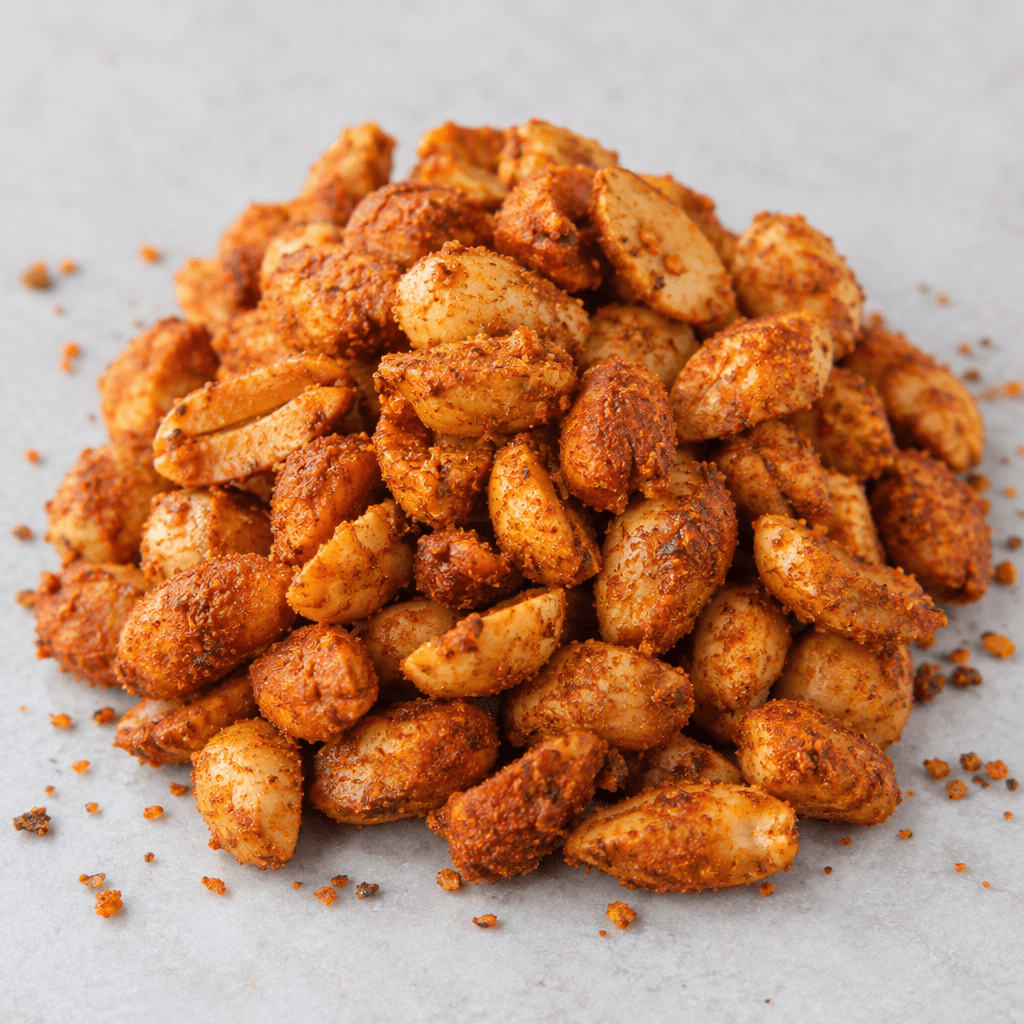
Spicy peanuts Calories
Spicy, protein and healthy fats, snack
In season: Spring · Summer · Autumn · Winter
CALORIES
GI
POTASSIUM
FIBER
Quick answer
1 serving (medium) of Spicy peanuts (30 g) has 171 calories. That works out to 570 calories per 100 g. It contains 6.3 g of carbs, 7.1 g of protein, 13.4 g of fat and 2.4 g of fiber. Its 0.3 mg of Copper covers 37% of the Daily Value. Its glycemic index is 14 (low), so it raises blood sugar slowly.
What is Spicy peanuts?
Spicy peanuts are shelled peanuts, usually roasted and coated with a seasoned mixture. There is no single recipe or place of origin: the blend may lean on chilli, paprika or other spices, and the heat can range from gentle to quite fiery. They are sold as a savoury snack and are also easy to make at home.
Their crunchy texture and bold seasoning make them a popular nibble with drinks or alongside other snack foods. For a milder spread, serve them with plain nuts or fresh vegetables rather than adding more heavily seasoned snacks.
They are rich in protein and fats, so a small handful can be satisfying but energy-dense; a typical 30 g portion is a practical snack serving. Choose or prepare a less salty blend if you want the peanut flavour to come through more clearly.
Spicy peanuts Nutrition Facts
Selected: 100 g
570
KCAL / 100G
Carbs
21g
· 8% DV
Protein
23.5g
· 47% DV
Fat
44.5g
· 57% DV
Fiber
8g
· 29% DV
DV is the share of the daily value covered, on a 2,000 kcal reference diet.
Calories come from: Carbs 15% · Protein 16% · Fat 69%
Spicy peanuts Vitamins & Minerals
Vitamins
Biotin
34µg · 113% DV
B3
13mg · 81% DV
Vitamin E
8mg · 53% DV
B1
0.6mg · 50% DV
Minerals
Copper
1mg · 111% DV
Manganese
2mg · 87% DV
Phosphorus
380mg · 54% DV
Magnesium
170mg · 40% DV
How Nutritious Is Spicy peanuts?
Nutrient density
High
How many vitamins, minerals and how much fiber this food carries per calorie. A high score means a lot of nutrition for few calories.
Satiety score
High
An EatBetter score computed from fiber, protein and calorie density. A high score means staying full longer on the same calories.
Both scores are calculated per 100 g and do not change with the selected portion. The satiety score is EatBetter's own calculation, not a clinical measure.
Spicy peanuts Glycemic Index
GLYCEMIC INDEX
GLYCEMIC LOAD
Accounts for portion size — a more realistic measure than GI alone.
How to Burn Off Spicy peanuts
To burn the 570 calories in 100 g:
🚶
Walking (5 km/h)
🏃
Running (8 km/h)
🚴
Cycling
🏊
Swimming
Times are calculated with the MET equation for a 70 kg adult. Actual burn varies with your weight, age and pace.
Is Spicy peanuts Processed?
NOVA 3
Processed
1. Unprocessed
2. Minimally Processed
3. Processed
4. Ultra-Processed
NOVA classifies foods into 4 groups by industrial processing. NOVA 1 (unprocessed) is the healthiest.
Does Spicy peanuts Contain Allergens?
Contains these allergens:
Which Diets Is Spicy peanuts Good For?
Vegan
✓ Suitable
Vegetarian
✓ Suitable
Gluten-Free
✓ Suitable
Dairy-Free
— Not suitable
Mediterranean
✓ Suitable
Paleo
✓ Suitable
Whole30
— Not suitable
DASH
— Not suitable
Keto
— Not suitable
Low FODMAP
— Not suitable
Spicy peanuts Fat Profile
SATURATED
7.5g
MONOUNSATURATED
22g
POLYUNSATURATED
13.8g
Omega 6:3 ratio 450:1
Above the ideal 4:1 (450:1).
Compare Spicy peanuts
Foods Similar to Spicy peanuts
Frequently Asked Questions About Spicy peanuts
How do you make spicy peanuts?
Spicy peanuts are made by coating peanuts with seasonings and roasting or frying them. For a homemade batch, toss peanuts with a little oil and spices, then bake until the coating is dry and crisp, stirring once so they cook evenly.
Are spicy peanuts healthy?
Spicy peanuts provide protein and unsaturated fats, but seasoning can add salt and the coating may add oil. They can fit into a snack routine; choose a less salty variety and serve a measured portion rather than eating from the bag.
Do spicy peanuts cause weight gain?
Spicy peanuts do not cause weight gain on their own, but they are energy-dense and easy to overeat while snacking. Portion some into a small bowl instead of eating straight from a large bag.
Are spicy peanuts roasted or fried?
Spicy peanuts can be roasted or fried, depending on the recipe or product. Roasting with a small amount of oil is an easy home method; frying can make the coating richer, so texture and oil content vary by preparation.
What spices are used in spicy peanuts?
Spicy peanuts may be seasoned with chili, paprika, black pepper, garlic powder, or cumin. There is no single standard blend, so the heat and saltiness can differ considerably between recipes and brands.
How do you make spicy peanuts less hot?
Make spicy peanuts milder by using less chili and adding paprika, garlic powder, or dried herbs for flavor. For a batch you are seasoning yourself, add the spices gradually and taste the coating before roasting.
How should you store spicy peanuts after opening?
Store spicy peanuts in a tightly sealed container in a cool, dry place. Exposure to air and moisture can make the coating lose its crunch, while a sealed container helps preserve the seasoning and freshness.
How long do spicy peanuts last after opening?
Spicy peanuts stay crisp longest when kept sealed and dry, but the exact shelf life depends on the product and storage conditions. Discard them if they smell stale or rancid, or if the coating has become damp.
Can you make spicy peanuts in an air fryer?
Yes, you can make spicy peanuts in an air fryer by tossing them with a little oil and seasoning, then cooking in a single layer. Check and shake them often, since small peanuts can brown quickly.
Do spicy peanuts make you thirsty?
They can, especially when the seasoning is salty or very hot. If you are serving spicy peanuts with drinks or packing them as a snack, keep water nearby and choose a less salty blend if thirst is a concern.
Have another question about Spicy peanuts?
Ask the AI nutrition coach — calories, portions, alternatives and more, answered in seconds in the app.

Scan calories with your camera
Instant AI nutrition analysis

Nutrition data compiled from USDA FoodData Central and scientific sources.