

Ready & Packaged Foods
All →Vegetables & Legumes
All →Desserts & Confectionery
All →Meat & Protein
All →Grains & Bakery
All →Beverages
All →Milk & Dairy
All →

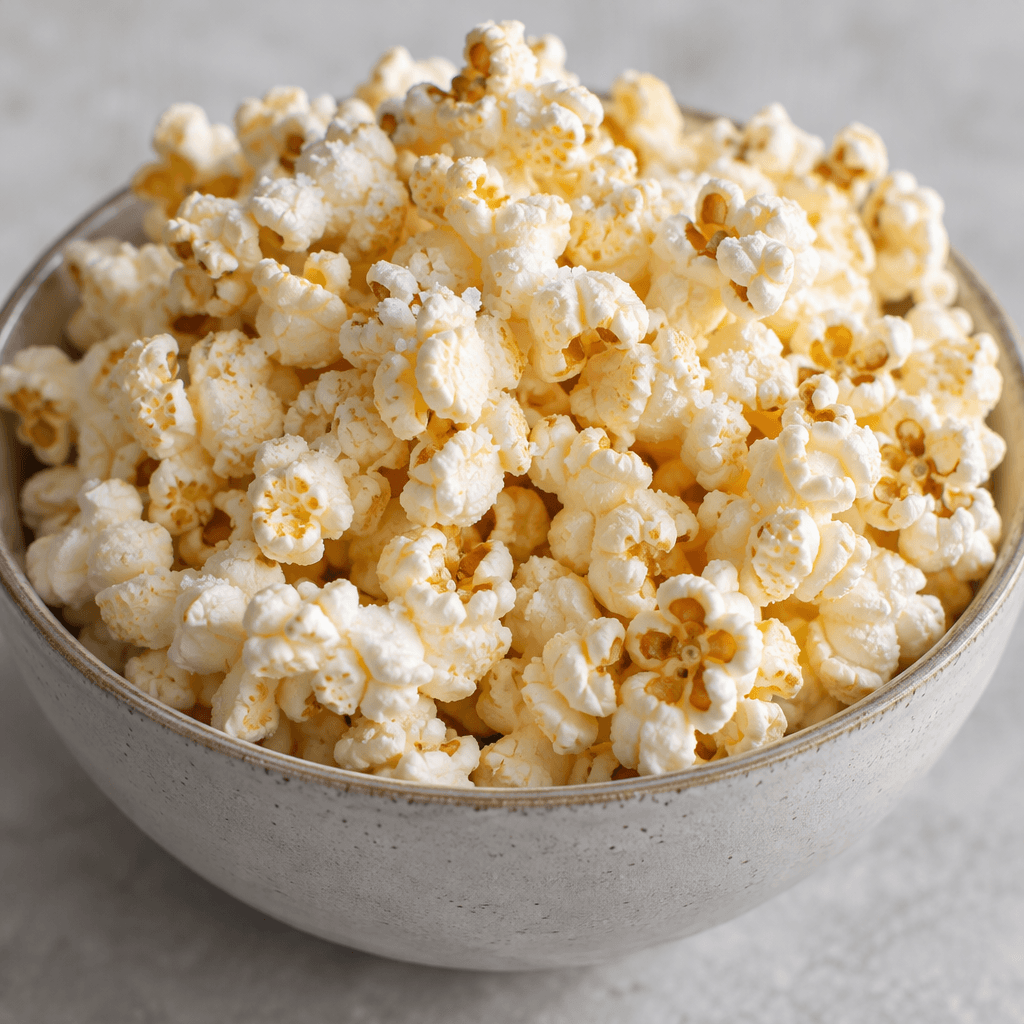
Sea salt popcorn Calories
Salty popped corn snack with fiber
CALORIES · 100 G
GI
POTASSIUM · 100 G
FIBER · 100 G
Quick answer
1 cup (medium) of Sea salt popcorn (8 g) has 31 calories. That works out to 387 calories per 100 g. It contains 6.2 g of carbs, 1 g of protein, 0.4 g of fat and 1.2 g of fiber. Its glycemic index is 72 (high), so it raises blood sugar quickly.
Sea salt popcorn Nutrition Facts
Selected: 1 cup (medium) · 8 g
31
KCAL / 8G
Carbs
6.2g
· 2% DV
Protein
1g
· 2% DV
Fat
0.4g
· 1% DV
Fiber
1.2g
· 4% DV
DV is the share of the daily value covered, on a 2,000 kcal reference diet.
Calories come from: Carbs 77% · Protein 12% · Fat 11%
Sea salt popcorn nutrition facts table · 1 cup (medium) (8 g)
| Nutrient | Amount | % DV |
|---|---|---|
| Calories | 31 kcal | |
| Total fat | 0.4 g | 1% |
| Saturated fat | 0.05 g | 0% |
| Trans fat | 0 g | |
| Sodium | 42 mg | 2% |
| Total carbohydrate | 6.2 g | 2% |
| Fiber | 1.2 g | 4% |
| Protein | 1 g | 2% |
Calories: Calories measure energy. Average daily need is 2,000 kcal. Excess calories are stored as fat, too few cause weight loss.
Carbs: Your body's primary energy source. The brain runs exclusively on carbs. Daily need: 275g.
Protein: Essential for muscle repair and cell growth. Daily need: 50g. Keeps you full and boosts metabolism.
Fat: Needed for hormone production and vitamin absorption. Daily need: 78g. Limit saturated fats, choose unsaturated.
Fiber: Critical for digestive health and satiety. Daily need: 28g. Stabilizes blood sugar, lowers cholesterol.

Log this food in EatBetter
100,000+ people use it
- Get your daily calorie target
- Snap your meal, log it in seconds
- See every vitamin and mineral

📸 Scan the code to get the app free.

How Many Calories in 1 Cup of Sea salt popcorn?
| Serving | Amount | Calories |
|---|---|---|
| 1 cup (medium) | 8 g | 31 kcal |
| 2 cup (double) | 16 g | 62 kcal |
| 1 pack (mini) | 20 g | 77 kcal |
| 1 serving (small) | 25 g | 97 kcal |
| 4 cup (large) | 32 g | 124 kcal |
| 1 serving (medium) | 40 g | 155 kcal |
| 6 cup (extra large) | 48 g | 186 kcal |
| 1 pack (medium) | 50 g | 194 kcal |
| 1 serving (large) | 60 g | 232 kcal |
| 100 g | 100 g | 387 kcal |
Calculated from 387 calories per 100 g.
Frequently Asked Questions About Sea salt popcorn
Is sea salt popcorn healthy?
Sea salt popcorn can be a fiber-containing snack, but it is still a processed food and may contribute a noticeable amount of salt. It can fit into a varied diet; compare sodium amounts if you eat it often.
Does sea salt popcorn have less sodium than regular popcorn?
Not necessarily. Sea salt is not automatically lower in sodium than other salt, and the amount used varies by product. The words “sea salt” on the pack do not mean the popcorn is low-sodium.
Is sea salt popcorn good for weight loss?
It can work as a snack, but it does not cause weight loss. Eating straight from a large bag makes portions easy to underestimate, so serve some in a bowl and put the rest away.
How do you make sea salt popcorn at home?
Pop plain kernels in a covered pot with a little oil, then add finely ground sea salt while the popcorn is still warm. Fine salt tends to cling better than coarse crystals.
Why does homemade sea salt popcorn turn chewy?
Moisture is usually the reason sea salt popcorn loses its crunch. Let it cool before storing it in an airtight container, and keep it away from steam and other damp areas in the kitchen.
Can you make sea salt popcorn in the microwave?
Yes. Put plain kernels in a microwave-safe covered popper, or use a suitable paper bag, then season the popped corn with sea salt. Stop when the popping slows to avoid scorching it.
Can people with diabetes eat sea salt popcorn?
They may be able to include it, but popcorn contains carbohydrates and can affect blood glucose. The right portion depends on an individual’s meal plan and medication, so ask a healthcare professional for personalized guidance.
Can dogs eat sea salt popcorn?
It is best not to give dogs sea salt popcorn. The salt and added seasonings are unnecessary for them, and unpopped kernels can pose a choking or dental risk. A few plain popped pieces are a safer choice.
How do you get sea salt to stick to popcorn?
Use finely ground sea salt and add it while the popcorn is hot. If it still will not cling, toss the popcorn with a very small amount of oil or melted butter before seasoning.
What can you serve with sea salt popcorn?
Sea salt popcorn pairs well with simple movie-night snacks such as fruit or vegetable sticks. If serving it with dips, choose a mild, less salty option so the overall snack does not become excessively salty.
Sea salt popcorn Vitamins & Minerals
Vitamins
Biotin
0.48µg · 2% DV
B1
0.02mg · 2% DV
B3
0.18mg · 1% DV
B5
0.05mg · 1% DV
Minerals
Phosphorus
29mg · 4% DV
Manganese
0.09mg · 4% DV
Magnesium
12mg · 3% DV
Zinc
0.25mg · 2% DV
Sodium
42mg · 2% DV
Potassium ⭐
26mg · 1% DV
Sea salt popcorn Glycemic Index
GLYCEMIC INDEX
GLYCEMIC LOAD
Accounts for portion size — a more realistic measure than GI alone.
How to Burn Off Sea salt popcorn
To burn the 31 calories in 1 cup (medium) (8 g):
🚶
Walking (5 km/h)
🏃
Running (8 km/h)
🚴
Cycling
🏊
Swimming
Times are calculated with the MET equation for a 70 kg adult. Actual burn varies with your weight, age and pace.
What is Sea salt popcorn?
Sea salt popcorn is made by heating corn kernels until they burst, then seasoning them with sea salt. Popcorn has roots in the Americas and is now a familiar snack around the world, from cinemas to home kitchens.
Its crisp, airy texture and savoury taste make it an easy nibble for movie nights or alongside a drink. In the United States it is often served at cinemas, while elsewhere it may be made at home or bought ready to eat. As a whole-grain snack, it provides fibre, though it is also carbohydrate-rich. For a lighter bowl, pop it with little oil and add salt sparingly; herbs or spices can bring extra flavour.
How Nutritious Is Sea salt popcorn?
Nutrient density
Medium
How many vitamins, minerals and how much fiber this food carries per calorie. A high score means a lot of nutrition for few calories.
Satiety score
Medium
An EatBetter score computed from fiber, protein and calorie density. A high score means staying full longer on the same calories.
Both scores are calculated per 100 g and do not change with the selected portion. The satiety score is EatBetter's own calculation, not a clinical measure.
Is Sea salt popcorn Processed?
NOVA 3
Processed
1. Unprocessed
2. Minimally Processed
3. Processed
4. Ultra-Processed
NOVA classifies foods into 4 groups by industrial processing. NOVA 1 (unprocessed) is the healthiest.
Does Sea salt popcorn Contain Allergens?
No known major allergens
Which Diets Is Sea salt popcorn Good For?
Vegan
✓ Suitable
Vegetarian
✓ Suitable
Gluten-Free
✓ Suitable
Dairy-Free
— Not suitable
Mediterranean
✓ Suitable
Paleo
— Not suitable
Whole30
— Not suitable
DASH
— Not suitable
Keto
— Not suitable
Low FODMAP
— Not suitable
Sea salt popcorn Fat Profile
SATURATED
0.05g
MONOUNSATURATED
0.08g
POLYUNSATURATED
0.15g
Compare Sea salt popcorn
Foods Similar to Sea salt popcorn
Have another question about Sea salt popcorn?
Ask the AI nutrition coach — calories, portions, alternatives and more, answered in seconds in the app.

Scan calories with your camera
Instant AI nutrition analysis

Nutrition data compiled from USDA FoodData Central and scientific sources.