

Ready & Packaged Foods
All →Vegetables & Legumes
All →Desserts & Confectionery
All →Meat & Protein
All →Grains & Bakery
All →Beverages
All →Milk & Dairy
All →

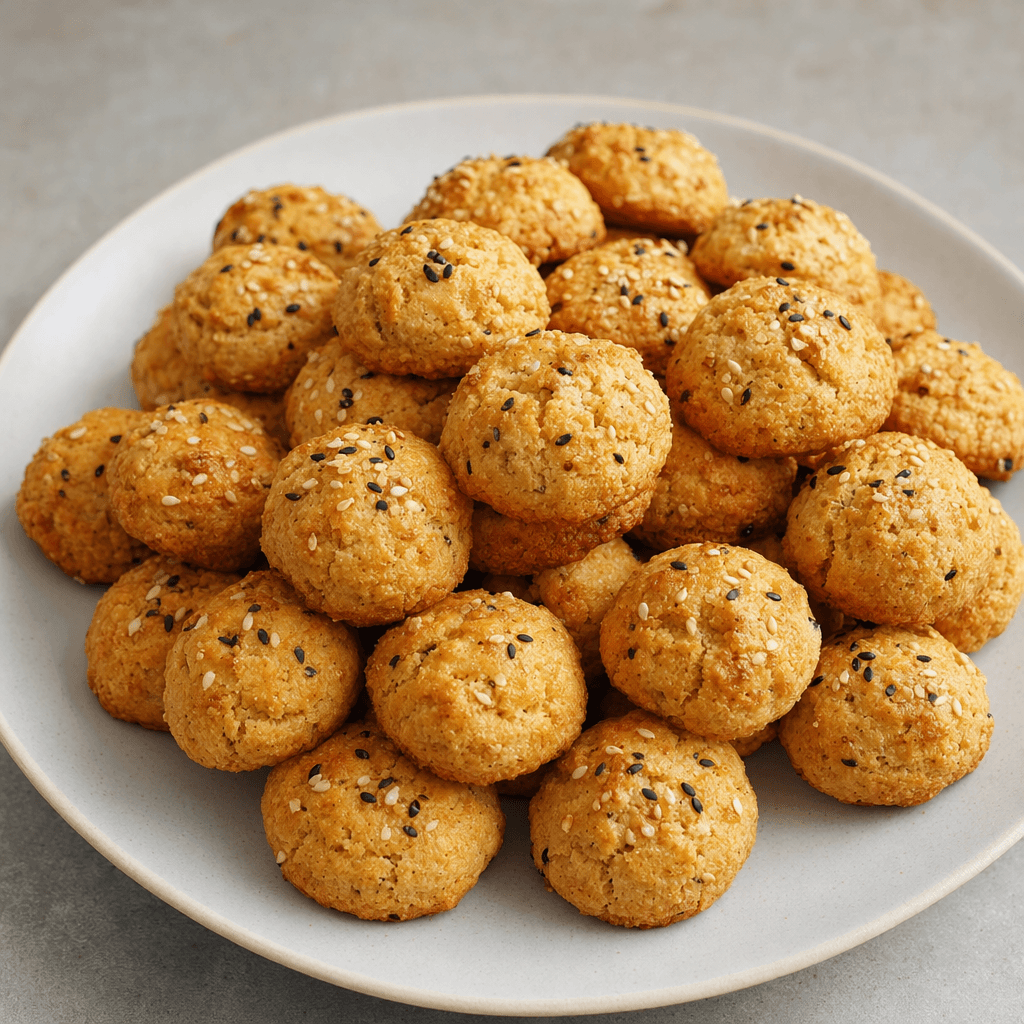
Savory cookie (homemade) Calories
Homemade savory cookie, typically made with flour, butter or margarine, yogurt, egg, salt, and leavening. Popular as a snack.
CALORIES
GI
POTASSIUM
FIBER
Quick answer
2 piece (medium) of Savory cookie (homemade) (30 g) has 144 calories. That works out to 480 calories per 100 g. It contains 15.6 g of carbs, 2.2 g of protein, 7.8 g of fat and 0.6 g of fiber. Its 234 mg of Sodium covers 10% of the Daily Value. Its glycemic index is 60 (medium), so it raises blood sugar at a moderate pace.
What is Savory cookie (homemade)?
A homemade savory cookie is a small, baked Turkish-style snack, usually made from flour with butter or margarine, yogurt, egg and a leavening agent. Sesame or nigella seeds are common toppings, though home recipes vary. The name refers to a savoury, crumbly biscuit rather than a sweet cookie.
Golden and lightly crisp, it is often served with tea in Turkey, offered to guests, or kept on hand for a quick snack. For English-speaking readers elsewhere, it works much like a savoury tea biscuit. It is fairly energy-dense, with most of its calories coming from flour and fat, and is not especially high in fibre. Pair a couple with fresh vegetables or yogurt for a more balanced snack.
Savory cookie (homemade) Nutrition Facts
Selected: 100 g
480
KCAL / 100G
Carbs
52g
· 19% DV
Protein
7.2g
· 14% DV
Fat
26g
· 33% DV
Fiber
2.1g
· 8% DV
DV is the share of the daily value covered, on a 2,000 kcal reference diet.
Calories come from: Carbs 44% · Protein 6% · Fat 50%
Savory cookie (homemade) Vitamins & Minerals
Vitamins
B1
0.19mg · 16% DV
B2
0.18mg · 14% DV
Vitamin A
120µg · 13% DV
Biotin
3.5µg · 12% DV
Minerals
Sodium
780mg · 34% DV
Selenium
7µg · 13% DV
Phosphorus
92mg · 13% DV
Iron
2mg · 11% DV
How Nutritious Is Savory cookie (homemade)?
Nutrient density
Low
How many vitamins, minerals and how much fiber this food carries per calorie. A high score means a lot of nutrition for few calories.
Satiety score
Low
An EatBetter score computed from fiber, protein and calorie density. A high score means staying full longer on the same calories.
Both scores are calculated per 100 g and do not change with the selected portion. The satiety score is EatBetter's own calculation, not a clinical measure.
Savory cookie (homemade) Glycemic Index
GLYCEMIC INDEX
GLYCEMIC LOAD
Accounts for portion size — a more realistic measure than GI alone.
How to Burn Off Savory cookie (homemade)
To burn the 480 calories in 100 g:
🚶
Walking (5 km/h)
🏃
Running (8 km/h)
🚴
Cycling
🏊
Swimming
Times are calculated with the MET equation for a 70 kg adult. Actual burn varies with your weight, age and pace.
Is Savory cookie (homemade) Processed?
NOVA 2
Minimally Processed
1. Unprocessed
2. Minimally Processed
3. Processed
4. Ultra-Processed
NOVA classifies foods into 4 groups by industrial processing. NOVA 1 (unprocessed) is the healthiest.
Does Savory cookie (homemade) Contain Allergens?
Contains these allergens:
Which Diets Is Savory cookie (homemade) Good For?
Vegan
— Not suitable
Vegetarian
— Not suitable
Gluten-Free
— Not suitable
Dairy-Free
— Not suitable
Mediterranean
✓ Suitable
Paleo
— Not suitable
Whole30
— Not suitable
DASH
— Not suitable
Keto
— Not suitable
Low FODMAP
— Not suitable
Savory cookie (homemade) Fat Profile
SATURATED
10.5g
MONOUNSATURATED
8.7g
POLYUNSATURATED
3.1g
Omega 6:3 ratio 33.8:1
Above the ideal 4:1 (33.8:1).
Compare Savory cookie (homemade)
Foods Similar to Savory cookie (homemade)
Frequently Asked Questions About Savory cookie (homemade)
How do you make homemade savory cookies?
Homemade savory cookies are usually made by mixing flour with butter or margarine, yogurt, egg, salt, and a leavening agent. Shape the dough, brush the tops with egg, add sesame or nigella seeds, and bake until golden.
Why do homemade savory cookies turn out hard?
Homemade savory cookies often turn hard when too much flour is added, the dough is overworked, or the cookies bake for too long. Add flour gradually and stop mixing as soon as the dough comes together.
How do you keep homemade savory cookies crisp?
Let homemade savory cookies cool completely before storing them in an airtight container in a cool, dry place. Sealing them while warm traps steam and softens their crumbly texture; a brief reheat in the oven can restore some crispness.
Can you freeze homemade savory cookies?
Yes, homemade savory cookies freeze well once fully cooled. Pack them in an airtight freezer container, separating layers with baking paper, then thaw at room temperature. Warm them briefly in the oven if you want to refresh their crisp texture.
Can you make homemade savory cookie dough ahead of time?
Yes, you can prepare homemade savory cookie dough ahead and cover it in the refrigerator. Chilling can make the dough easier to shape, but if it becomes too firm, let it sit at room temperature briefly before rolling or cutting.
What toppings go on homemade savory cookies?
Sesame seeds and nigella seeds are classic toppings for homemade savory cookies, and poppy seeds are another option. Brush the shaped cookies with beaten egg first so the seeds stick and the baked tops turn glossy.
Why does homemade savory cookie dough crumble when shaping?
Homemade savory cookie dough usually crumbles because it has too much flour or too little moisture to hold together. Add a small amount of yogurt or another liquid gradually, mixing just until the dough can be shaped without becoming sticky.
Can you add cheese to homemade savory cookies?
Yes, finely grated cheese can be added to homemade savory cookies for a saltier, richer flavor. Use a firm cheese and add it evenly; because cheese contributes moisture and salt, adjust the dough carefully rather than adding extra flour automatically.
Are homemade savory cookies served with tea or as appetizers?
Homemade savory cookies work as both a tea-time snack and a small savory bite on a party table. Serve them with tea, or pair them with olives, cheese, and fresh vegetables as part of a snack spread.
What makes Turkish-style homemade savory cookies different from sweet cookies?
Turkish-style homemade savory cookies are seasoned with salt and often topped with sesame or nigella seeds instead of sugar or icing. They are commonly shaped into small rounds, rings, or sticks and served as a snack with tea.
Have another question about Savory cookie (homemade)?
Ask the AI nutrition coach — calories, portions, alternatives and more, answered in seconds in the app.

Scan calories with your camera
Instant AI nutrition analysis

Nutrition data compiled from USDA FoodData Central and scientific sources.