

Ready & Packaged Foods
All →Vegetables & Legumes
All →Desserts & Confectionery
All →Meat & Protein
All →Grains & Bakery
All →Beverages
All →Milk & Dairy
All →

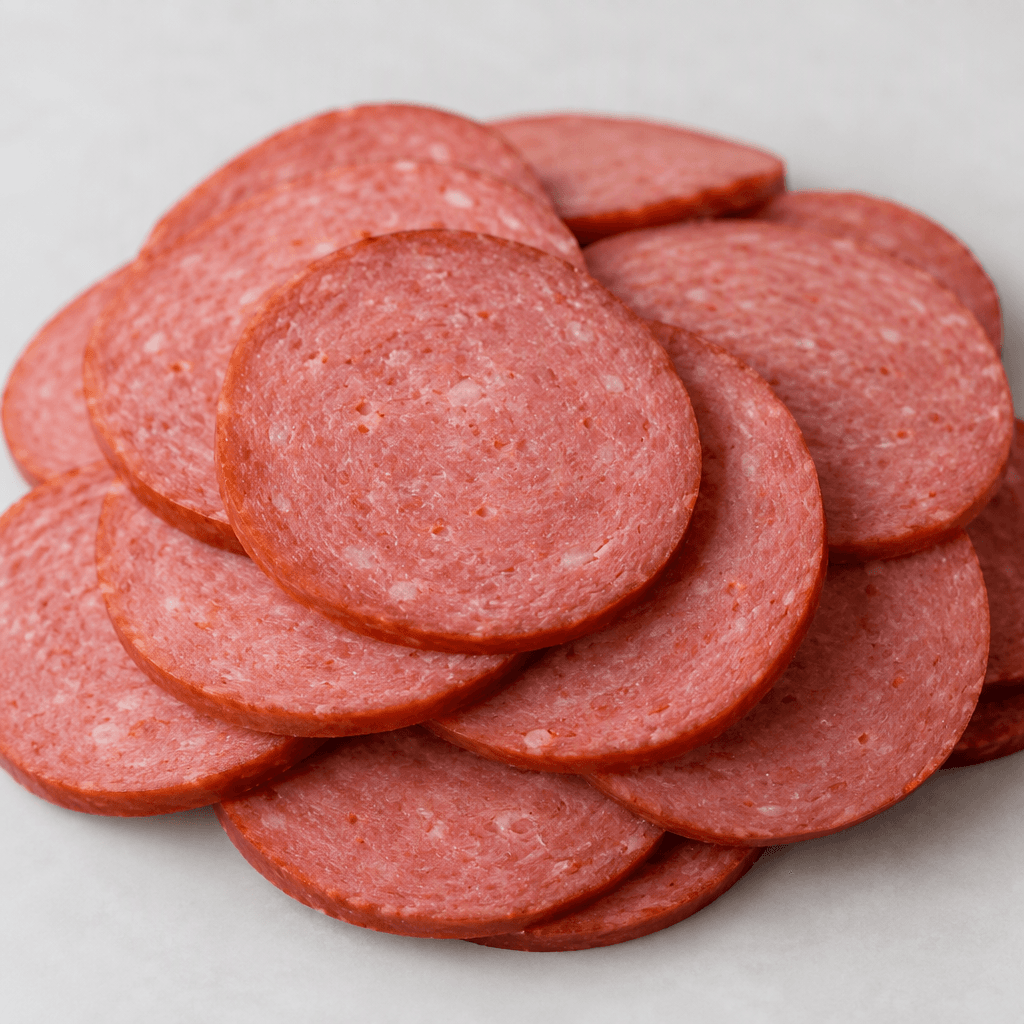
Sausage (slice) Calories
Source of protein and fat, processed meat product
CALORIES
GI
POTASSIUM
FIBER
Quick answer
1 slice (medium) of Sausage (slice) (25 g) has 73 calories. That works out to 290 calories per 100 g. It contains 0.8 g of carbs, 3.1 g of protein, 6.3 g of fat and 0 g of fiber. Its 0.3 µg of B12 covers 11% of the Daily Value. Its glycemic index is 0 (low), so it raises blood sugar slowly.
What is Sausage (slice)?
A sausage slice is a thin round cut from a seasoned sausage made with minced meat and fat, shaped and cooked before being sold. It is a familiar convenience ingredient rather than a dish tied to one particular cuisine. The slices are mildly savoury, soft and firm, with a smooth interior; frying gives the edges a little colour. They’re often added to breakfast plates, sandwiches, toasties, pizzas or quick pasta dishes. Sausage provides protein, but it is also relatively high in fat, so it works best as one part of a meal. Pair a few slices with vegetables or add them to a sandwich with salad for a lighter serving.
Sausage (slice) Nutrition Facts
Selected: 100 g
290
KCAL / 100G
Carbs
3.2g
· 1% DV
Protein
12.5g
· 25% DV
Fat
25g
· 32% DV
Fiber
0g
· 0% DV
DV is the share of the daily value covered, on a 2,000 kcal reference diet.
Calories come from: Carbs 4% · Protein 17% · Fat 79%
Sausage (slice) Vitamins & Minerals
Vitamins
B12
1.1µg · 46% DV
B1
0.45mg · 38% DV
B3
3.2mg · 20% DV
B5
0.8mg · 16% DV
Minerals
Sodium
900mg · 39% DV
Selenium
11µg · 20% DV
Zinc
2mg · 18% DV
Phosphorus
120mg · 17% DV
How Nutritious Is Sausage (slice)?
Nutrient density
Medium
How many vitamins, minerals and how much fiber this food carries per calorie. A high score means a lot of nutrition for few calories.
Satiety score
Low
An EatBetter score computed from fiber, protein and calorie density. A high score means staying full longer on the same calories.
Both scores are calculated per 100 g and do not change with the selected portion. The satiety score is EatBetter's own calculation, not a clinical measure.
Sausage (slice) Glycemic Index
GLYCEMIC INDEX
GLYCEMIC LOAD
Accounts for portion size — a more realistic measure than GI alone.
How to Burn Off Sausage (slice)
To burn the 290 calories in 100 g:
🚶
Walking (5 km/h)
🏃
Running (8 km/h)
🚴
Cycling
🏊
Swimming
Times are calculated with the MET equation for a 70 kg adult. Actual burn varies with your weight, age and pace.
Is Sausage (slice) Processed?
NOVA 3
Processed
1. Unprocessed
2. Minimally Processed
3. Processed
4. Ultra-Processed
NOVA classifies foods into 4 groups by industrial processing. NOVA 1 (unprocessed) is the healthiest.
Does Sausage (slice) Contain Allergens?
No known major allergens
Which Diets Is Sausage (slice) Good For?
Vegan
— Not suitable
Vegetarian
— Not suitable
Gluten-Free
✓ Suitable
Dairy-Free
— Not suitable
Mediterranean
✓ Suitable
Paleo
✓ Suitable
Whole30
— Not suitable
DASH
— Not suitable
Keto
✓ Suitable
Low FODMAP
— Not suitable
Sausage (slice) Fat Profile
SATURATED
8.8g
MONOUNSATURATED
10.2g
POLYUNSATURATED
2.2g
Omega 6:3 ratio 15.7:1
Above the ideal 4:1 (15.7:1).
Compare Sausage (slice)
Foods Similar to Sausage (slice)
Frequently Asked Questions About Sausage (slice)
Are sausage slices healthy to eat regularly?
Sausage slices are not an ideal everyday protein choice because they are processed meat. Frequent processed-meat consumption is associated with a higher risk of colorectal cancer, so keep them occasional and choose less-processed proteins more often.
Can you eat sausage slices cold?
Yes, most packaged sausage slices are cooked during manufacture and can be eaten cold if the package says they are ready to eat. If the product requires cooking, heat it thoroughly before eating and refrigerate it after opening.
How do you fry sausage slices without drying them out?
Fry sausage slices briefly over medium heat, using little or no added oil. They are usually already cooked, so prolonged frying is unnecessary; turn them as they warm and take them off the pan before the edges burn.
Can you freeze sausage slices?
Yes, sausage slices can be frozen. Separate them into portions, seal them in a freezer-safe container or bag, and thaw them in the refrigerator before use. Avoid freezing them again once thawed.
How should you store sausage slices after opening?
Keep opened sausage slices refrigerated in a sealed container or tightly wrapped. Follow the package’s guidance for how long they keep after opening, and discard them if they develop an off smell, a sticky surface, or an unusual color.
What are sausage slices usually made from?
Sausage slices are usually made from finely ground or emulsified meat, seasonings, and other ingredients used to bind or preserve the mixture. The type of meat varies by product, so there is no single recipe for every sausage slice.
Are sausage slices the same as salami?
No, sausage slices and salami are not necessarily the same product. Sausage slices are commonly made from cooked, finely ground meat, while salami is typically seasoned and fermented or cured; ingredients and preparation vary by style.
Why do sausage slices curl when you fry them?
Sausage slices can curl because the outer layer contracts as it heats faster than the middle. Use moderate heat, avoid overcrowding the pan, and turn the slices while warming them to help them stay flatter.
Can you put sausage slices on pizza?
Yes, sausage slices work as a pizza topping. Add them in a single layer so they heat evenly, and pair them with vegetables or other toppings; pre-cooked slices only need to warm through while the pizza bakes.
Are sausage slices safe to eat during pregnancy?
Sausage slices are safest during pregnancy when heated until steaming hot, especially if they are ready-to-eat packaged meat. This reduces the risk from harmful bacteria such as Listeria; ask your healthcare professional if you have specific concerns.
Have another question about Sausage (slice)?
Ask the AI nutrition coach — calories, portions, alternatives and more, answered in seconds in the app.

Scan calories with your camera
Instant AI nutrition analysis

Nutrition data compiled from USDA FoodData Central and scientific sources.