

Ready & Packaged Foods
All →Vegetables & Legumes
All →Desserts & Confectionery
All →Meat & Protein
All →Grains & Bakery
All →Beverages
All →Milk & Dairy
All →

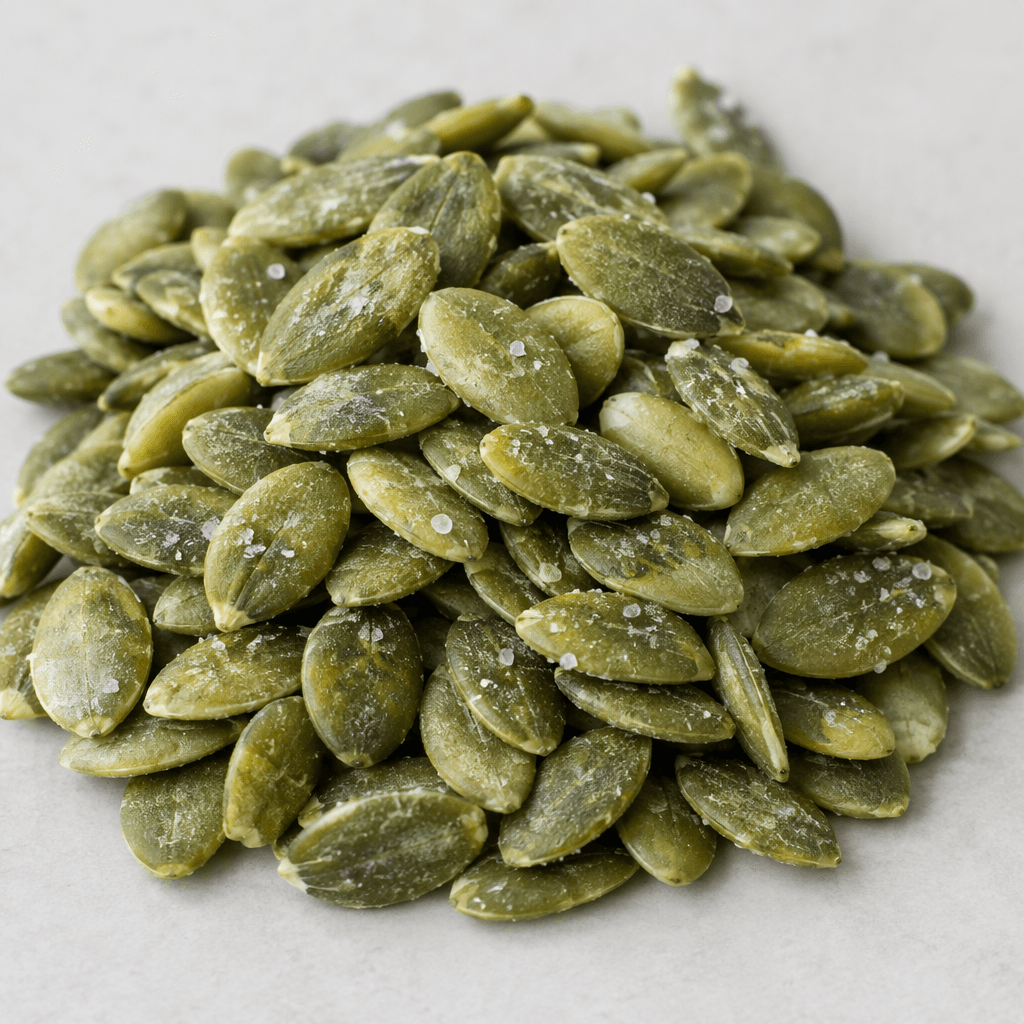
Salted pumpkin seeds Calories
Rich in minerals and healthy fats, salty snack
In season: Autumn · Winter
CALORIES
GI
POTASSIUM
FIBER
Quick answer
1 ounce (medium) of Salted pumpkin seeds (28 g) has 157 calories. That works out to 560 calories per 100 g. It contains 3 g of carbs, 8.3 g of protein, 12.9 g of fat and 1.7 g of fiber. Its 1.3 mg of Manganese covers 55% of the Daily Value. Its glycemic index is 10 (low), so it raises blood sugar slowly.
What is Salted pumpkin seeds?
Salted pumpkin seeds are the edible seeds of pumpkins, roasted and seasoned with salt. They’re enjoyed in many places, either in their shells or as shelled green kernels. Roasting brings out a nutty, slightly earthy flavour and gives them a crisp bite, while the salt makes them a savoury snack.
They’re easy to serve by the handful, add to a snack bowl, or scatter over salads and soups for crunch. In many English-speaking households, they’re also a convenient alternative to crisps. They provide protein and fibre alongside plenty of fat, making them filling but energy-dense: 100 g contains 560 calories. Choose an unsalted version or keep the portion modest if you’re watching your salt intake.
Salted pumpkin seeds Nutrition Facts
Selected: 100 g
560
KCAL / 100G
Carbs
10.7g
· 4% DV
Protein
29.8g
· 60% DV
Fat
46.1g
· 59% DV
Fiber
6g
· 21% DV
DV is the share of the daily value covered, on a 2,000 kcal reference diet.
Calories come from: Carbs 7% · Protein 21% · Fat 72%
Salted pumpkin seeds Vitamins & Minerals
Vitamins
B1
0.27mg · 23% DV
B5
0.75mg · 15% DV
Folate
58µg · 14% DV
B2
0.15mg · 12% DV
Minerals
Manganese
5mg · 217% DV
Phosphorus
1230mg · 176% DV
Magnesium
592mg · 141% DV
Copper
1mg · 111% DV
How Nutritious Is Salted pumpkin seeds?
Nutrient density
High
How many vitamins, minerals and how much fiber this food carries per calorie. A high score means a lot of nutrition for few calories.
Satiety score
High
An EatBetter score computed from fiber, protein and calorie density. A high score means staying full longer on the same calories.
Both scores are calculated per 100 g and do not change with the selected portion. The satiety score is EatBetter's own calculation, not a clinical measure.
Salted pumpkin seeds Glycemic Index
GLYCEMIC INDEX
GLYCEMIC LOAD
Accounts for portion size — a more realistic measure than GI alone.
How to Burn Off Salted pumpkin seeds
To burn the 560 calories in 100 g:
🚶
Walking (5 km/h)
🏃
Running (8 km/h)
🚴
Cycling
🏊
Swimming
Times are calculated with the MET equation for a 70 kg adult. Actual burn varies with your weight, age and pace.
Is Salted pumpkin seeds Processed?
NOVA 2
Minimally Processed
1. Unprocessed
2. Minimally Processed
3. Processed
4. Ultra-Processed
NOVA classifies foods into 4 groups by industrial processing. NOVA 1 (unprocessed) is the healthiest.
Does Salted pumpkin seeds Contain Allergens?
No known major allergens
Which Diets Is Salted pumpkin seeds Good For?
Vegan
✓ Suitable
Vegetarian
✓ Suitable
Gluten-Free
✓ Suitable
Dairy-Free
— Not suitable
Mediterranean
✓ Suitable
Paleo
✓ Suitable
Whole30
— Not suitable
DASH
— Not suitable
Keto
— Not suitable
Low FODMAP
— Not suitable
Salted pumpkin seeds Fat Profile
SATURATED
8.7g
MONOUNSATURATED
16.2g
POLYUNSATURATED
19.5g
Omega 6:3 ratio 207:1
Above the ideal 4:1 (207:1).
Compare Salted pumpkin seeds
Foods Similar to Salted pumpkin seeds
Frequently Asked Questions About Salted pumpkin seeds
Are salted pumpkin seeds good for you?
Yes, salted pumpkin seeds provide protein, fibre and unsaturated fats, but the added salt makes them less suitable for frequent large servings than unsalted seeds. They can fit into a balanced snack routine; keep an eye on how much salty food you eat overall.
Can you eat the shells of salted pumpkin seeds?
Yes, the thin shells of salted pumpkin seeds are edible, but they are tougher and more fibrous than the kernels. Chew them thoroughly, and discard the shells if they feel unpleasant or cause digestive discomfort.
How do you make salted pumpkin seeds at home?
To make salted pumpkin seeds, rinse fresh seeds, remove the stringy pulp, dry them well, then toss with a little salt and roast in a single layer, stirring occasionally. Let them cool before eating so they become crisp.
Are salted pumpkin seeds high in sodium?
They can be: salt added during processing increases the sodium content compared with unsalted pumpkin seeds. The amount varies by product, so if you are limiting sodium, choose an unsalted version or eat salted seeds less often.
Should you rinse salted pumpkin seeds before eating them?
No, salted pumpkin seeds are ready to eat without rinsing. A quick rinse can remove some surface salt, but it will not remove all the sodium and will make the seeds damp; eat them soon after rinsing.
How should you store salted pumpkin seeds?
Store salted pumpkin seeds in an airtight container in a cool, dry place to preserve their crunch and keep their oils from going stale. Discard them if they develop a rancid or unpleasant smell.
Are salted pumpkin seeds raw or roasted?
Salted pumpkin seeds may be raw or roasted; the word “salted” describes the seasoning, not the cooking method. Check the product description for roasting, or taste one to see whether it has the crisp texture and toasted flavour of roasted seeds.
Can you eat salted pumpkin seeds before bed?
Yes, you can eat salted pumpkin seeds before bed, but their salt may make you thirsty, and a large snack can feel uncomfortable when you lie down. A small portion is a more practical choice late in the evening.
What is the difference between salted pumpkin seeds and pepitas?
Pepitas are the green, hulled kernels of pumpkin seeds; salted pumpkin seeds may be sold with their shells on or as kernels, and may be seasoned either way. Check whether the package says hulled if you want pepitas.
Can salted pumpkin seeds go rancid?
Yes, salted pumpkin seeds can go rancid because their oils deteriorate with exposure to air, heat and light. Keep them sealed and away from warm, sunny places, and do not eat them if they smell paint-like, bitter or stale.
Have another question about Salted pumpkin seeds?
Ask the AI nutrition coach — calories, portions, alternatives and more, answered in seconds in the app.

Scan calories with your camera
Instant AI nutrition analysis

Nutrition data compiled from USDA FoodData Central and scientific sources.