

Ready & Packaged Foods
All →Vegetables & Legumes
All →Desserts & Confectionery
All →Meat & Protein
All →Grains & Bakery
All →Beverages
All →Milk & Dairy
All →

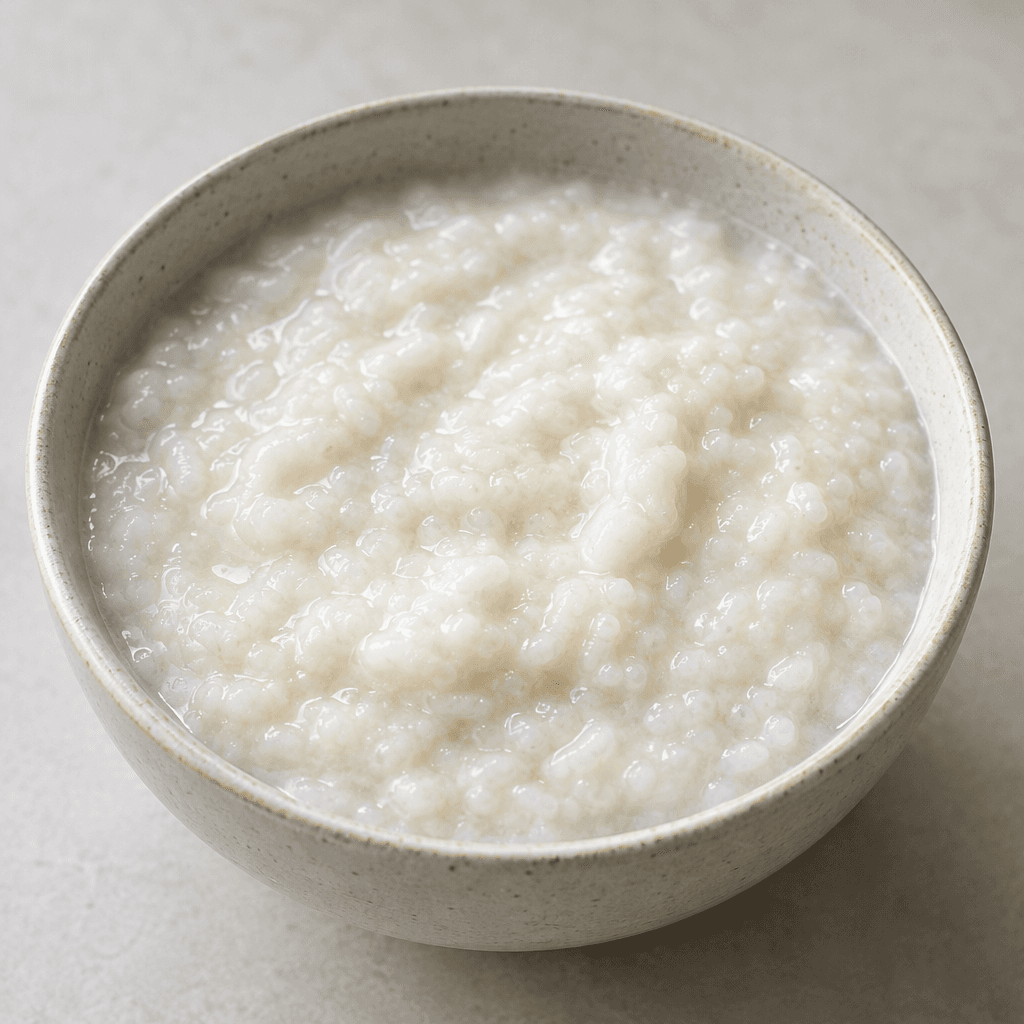
Rice Porridge Calories
Light, easy to digest, low fat, energy source
In season: Spring · Summer · Autumn · Winter
CALORIES
GI
POTASSIUM
FIBER
Quick answer
1 cup (medium) of Rice Porridge (200 g) has 140 calories. That works out to 70 calories per 100 g. It contains 31 g of carbs, 2.6 g of protein, 0.4 g of fat and 0.6 g of fiber. Its 0.3 mg of Manganese covers 13% of the Daily Value. Its glycemic index is 78 (high), so it raises blood sugar quickly.
What is Rice Porridge?
Rice porridge is made by simmering rice in water, broth or milk until the grains soften and the mixture turns thick and spoonable. It is prepared in many parts of the world, with no single style: some versions are kept plain, while others are seasoned or sweetened.
Its mild flavour and creamy texture work with either sweet toppings, such as fruit and cinnamon, or savoury additions like vegetables and herbs. It can be served for breakfast or as a simple meal at any time of day. Rice porridge is low in fat and gets most of its energy from carbohydrates, with comparatively little protein or fibre. For a more filling bowl, add a protein-rich accompaniment or some vegetables.
Rice Porridge Nutrition Facts
Selected: 100 g
70
KCAL / 100G
Carbs
15.5g
· 6% DV
Protein
1.3g
· 3% DV
Fat
0.2g
· 0% DV
Fiber
0.3g
· 1% DV
DV is the share of the daily value covered, on a 2,000 kcal reference diet.
Calories come from: Carbs 90% · Protein 8% · Fat 2%
Rice Porridge Vitamins & Minerals
Vitamins
B1
0.02mg · 2% DV
B3
0.3mg · 2% DV
B6
0.03mg · 2% DV
B2
0.01mg · 1% DV
Minerals
Selenium
1.5µg · 3% DV
Phosphorus
15mg · 2% DV
Calcium
5mg · 1% DV
Magnesium
4mg · 1% DV
How Nutritious Is Rice Porridge?
Nutrient density
Low
How many vitamins, minerals and how much fiber this food carries per calorie. A high score means a lot of nutrition for few calories.
Satiety score
Medium
An EatBetter score computed from fiber, protein and calorie density. A high score means staying full longer on the same calories.
Both scores are calculated per 100 g and do not change with the selected portion. The satiety score is EatBetter's own calculation, not a clinical measure.
Rice Porridge Glycemic Index
GLYCEMIC INDEX
GLYCEMIC LOAD
Accounts for portion size — a more realistic measure than GI alone.
How to Burn Off Rice Porridge
To burn the 70 calories in 100 g:
🚶
Walking (5 km/h)
🏃
Running (8 km/h)
🚴
Cycling
🏊
Swimming
Times are calculated with the MET equation for a 70 kg adult. Actual burn varies with your weight, age and pace.
Is Rice Porridge Processed?
NOVA 2
Minimally Processed
1. Unprocessed
2. Minimally Processed
3. Processed
4. Ultra-Processed
NOVA classifies foods into 4 groups by industrial processing. NOVA 1 (unprocessed) is the healthiest.
Does Rice Porridge Contain Allergens?
No known major allergens
Which Diets Is Rice Porridge Good For?
Vegan
✓ Suitable
Vegetarian
✓ Suitable
Gluten-Free
✓ Suitable
Dairy-Free
— Not suitable
Mediterranean
✓ Suitable
Paleo
— Not suitable
Whole30
— Not suitable
DASH
— Not suitable
Keto
— Not suitable
Low FODMAP
— Not suitable
Rice Porridge Fat Profile
SATURATED
0.05g
MONOUNSATURATED
0.04g
POLYUNSATURATED
0.05g
Omega 6:3 ratio 4:1
Below the ideal 4:1 — a good omega balance.
Compare Rice Porridge
Foods Similar to Rice Porridge
Frequently Asked Questions About Rice Porridge
What is rice porridge, and how is it made?
Rice porridge is rice simmered in liquid until the grains become very soft and the mixture turns thick and spoonable. Cook it gently, stirring now and then; add more water or milk as needed to reach your preferred consistency.
Is rice porridge the same as congee?
Rice porridge and congee are closely related, but the names are not always interchangeable. Congee usually refers to an Asian-style savory rice porridge cooked until the grains break down, while rice porridge can also be sweet and made with milk.
What is the best rice for rice porridge?
Short- or medium-grain rice works well for rice porridge because its starch helps make the result creamy. Long-grain rice also cooks into porridge, but the grains tend to stay more separate; choose based on the texture you prefer.
How much liquid should I use for rice porridge?
Use enough liquid to keep the rice submerged as it cooks, adding more gradually if the pot starts to look dry. A larger amount creates a looser porridge, while less liquid gives you a thicker, more spoonable bowl.
Can rice porridge be sweet or savory?
Yes, rice porridge can be sweet or savory. Cook it with milk and finish with fruit or cinnamon for a sweet bowl, or use water or stock and add ingredients such as scallions, egg, or vegetables for a savory version.
Why is my rice porridge still watery?
Rice porridge is often watery because it has not simmered long enough for the grains to soften and release their starch. Keep cooking uncovered over low heat, stirring occasionally; it will also thicken as it cools.
Can I make rice porridge in a rice cooker?
Yes, many rice cookers can make rice porridge using their porridge or congee setting. Use the cooker’s guidance for that setting, since liquid capacity varies; avoid filling past the marked limit because the mixture can bubble up.
What can I put on rice porridge?
Rice porridge takes both sweet and savory toppings. Try sliced fruit, cinnamon, or nuts for a sweet bowl; for a savory one, add scallions, a soft-cooked egg, or cooked vegetables just before serving.
How should I store leftover rice porridge?
Store leftover rice porridge in a covered container in the refrigerator and use it within three to four days. Cool it promptly after cooking, then reheat thoroughly with a splash of water or milk to loosen the thickened texture.
Can rice porridge be frozen?
Yes, rice porridge can be frozen in individual portions. The texture may become softer or separate after thawing, so reheat it gently with a little water or milk and stir until smooth.
Have another question about Rice Porridge?
Ask the AI nutrition coach — calories, portions, alternatives and more, answered in seconds in the app.

Scan calories with your camera
Instant AI nutrition analysis

Nutrition data compiled from USDA FoodData Central and scientific sources.