

Ready & Packaged Foods
All →Vegetables & Legumes
All →Desserts & Confectionery
All →Meat & Protein
All →Grains & Bakery
All →Beverages
All →Milk & Dairy
All →

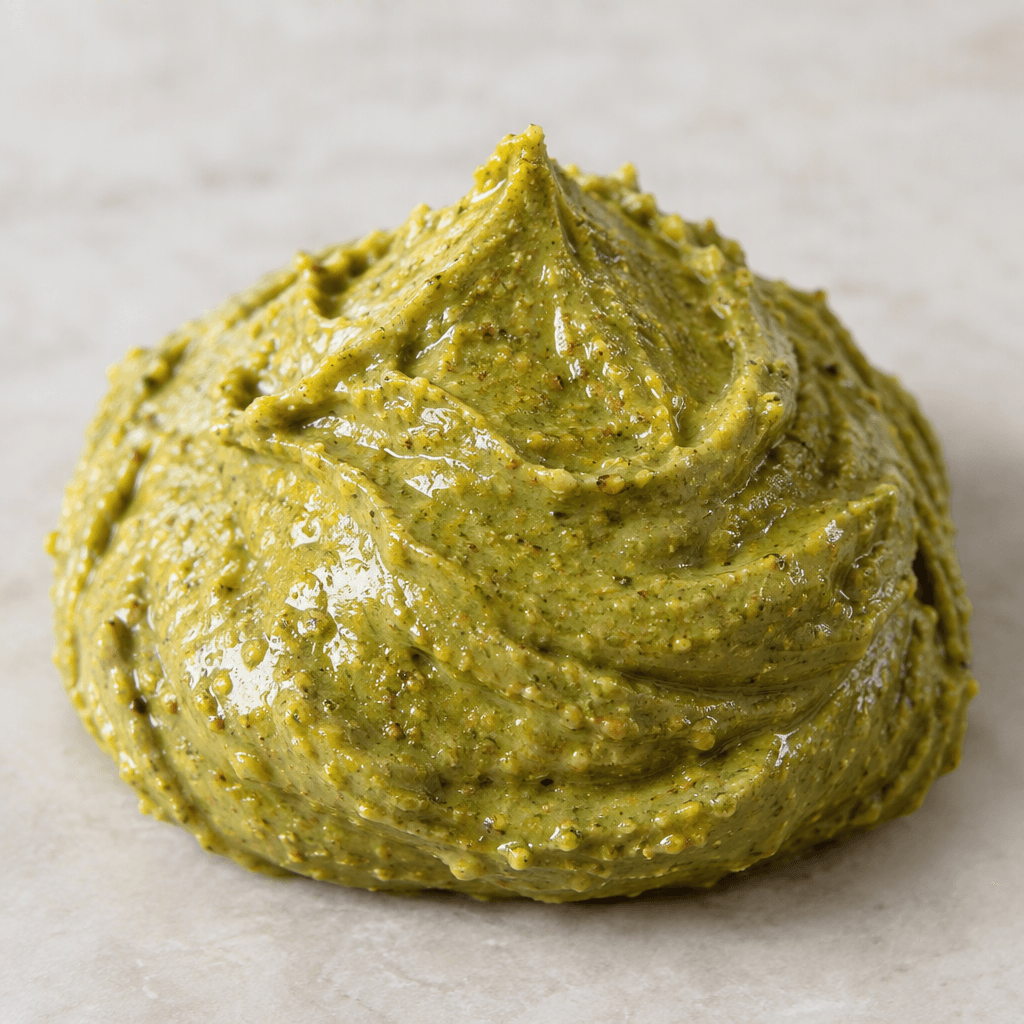
Pistachio paste Calories
Rich in healthy fats, protein, and vitamins; nutrient-dense pistachio spread.
In season: Spring · Summer · Autumn
CALORIES
GI
POTASSIUM
FIBER
Quick answer
1 tablespoon (medium) of Pistachio paste (18 g) has 108 calories. That works out to 600 calories per 100 g. It contains 3.2 g of carbs, 3.6 g of protein, 9 g of fat and 1.8 g of fiber. Its 0.2 mg of Copper covers 26% of the Daily Value. Its glycemic index is 15 (low), so it raises blood sugar slowly.
What is Pistachio paste?
Pistachio paste is made by grinding pistachios into a thick, smooth spread. Depending on the product, it may contain added sugar or oil; an unsweetened version lets the nut’s naturally sweet, distinctive flavour come through. It is used in both home cooking and desserts, especially in pistachio-rich Middle Eastern and Mediterranean baking.
Its texture is creamy and dense, with a fragrant, gently sweet taste. Spread it on toast, swirl it into yoghurt or porridge, or use it to flavour cakes, biscuits and fillings. It is nutrient-dense, providing protein alongside plenty of fat, so a little can add satisfying richness to a snack or dessert. Pair it with fresh fruit or plain yoghurt for a simple serving.
Pistachio paste Nutrition Facts
Selected: 100 g
600
KCAL / 100G
Carbs
18g
· 7% DV
Protein
20g
· 40% DV
Fat
50g
· 64% DV
Fiber
10g
· 36% DV
DV is the share of the daily value covered, on a 2,000 kcal reference diet.
Calories come from: Carbs 12% · Protein 13% · Fat 75%
Pistachio paste Vitamins & Minerals
Vitamins
B6
1.7mg · 100% DV
B1
0.87mg · 73% DV
B2
0.21mg · 16% DV
Vitamin E
2.3mg · 15% DV
Minerals
Copper
1mg · 111% DV
Phosphorus
485mg · 69% DV
Manganese
1mg · 43% DV
Potassium ⭐
1020mg · 30% DV
How Nutritious Is Pistachio paste?
Nutrient density
Very high
How many vitamins, minerals and how much fiber this food carries per calorie. A high score means a lot of nutrition for few calories.
Satiety score
High
An EatBetter score computed from fiber, protein and calorie density. A high score means staying full longer on the same calories.
Both scores are calculated per 100 g and do not change with the selected portion. The satiety score is EatBetter's own calculation, not a clinical measure.
Pistachio paste Glycemic Index
GLYCEMIC INDEX
GLYCEMIC LOAD
Accounts for portion size — a more realistic measure than GI alone.
How to Burn Off Pistachio paste
To burn the 600 calories in 100 g:
🚶
Walking (5 km/h)
🏃
Running (8 km/h)
🚴
Cycling
🏊
Swimming
Times are calculated with the MET equation for a 70 kg adult. Actual burn varies with your weight, age and pace.
Is Pistachio paste Processed?
NOVA 2
Minimally Processed
1. Unprocessed
2. Minimally Processed
3. Processed
4. Ultra-Processed
NOVA classifies foods into 4 groups by industrial processing. NOVA 1 (unprocessed) is the healthiest.
Does Pistachio paste Contain Allergens?
Contains these allergens:
Which Diets Is Pistachio paste Good For?
Vegan
✓ Suitable
Vegetarian
✓ Suitable
Gluten-Free
✓ Suitable
Dairy-Free
— Not suitable
Mediterranean
✓ Suitable
Paleo
✓ Suitable
Whole30
— Not suitable
DASH
— Not suitable
Keto
✓ Suitable
Low FODMAP
— Not suitable
Pistachio paste Fat Profile
SATURATED
6.5g
MONOUNSATURATED
24g
POLYUNSATURATED
16g
Omega 6:3 ratio 54:1
Above the ideal 4:1 (54:1).
Compare Pistachio paste
Foods Similar to Pistachio paste
Frequently Asked Questions About Pistachio paste
What is pistachio paste made from?
Pistachio paste is made by grinding shelled pistachios until their natural oils create a smooth or slightly coarse paste. Some versions contain only pistachios, while others include sugar or added oil, so the ingredient list can differ by product.
How do you make pistachio paste at home?
Make pistachio paste by processing shelled pistachios until they release their oils and turn creamy, stopping to scrape down the sides as needed. A food processor works best; added oil usually isn’t necessary, though patience and short processing breaks help.
How is pistachio paste different from pistachio butter?
Pistachio paste and pistachio butter can both be ground pistachios, and the names are not used consistently. In baking, “paste” often means a smooth, concentrated ingredient, while “butter” commonly describes a spread; check whether a particular product is sweetened.
What can you use pistachio paste for?
Pistachio paste works in cakes, cookies, ice cream, pastry creams, sauces, and spreads. Stir a little into yogurt or oatmeal, or blend it into a dressing. Its concentrated flavor and green color make it especially useful in desserts.
Does pistachio paste need to be refrigerated after opening?
Refrigerating pistachio paste after opening helps keep it fresh, particularly if you use it slowly or live in a warm climate. It may firm up when cold, so let the amount you need sit briefly at room temperature before stirring or spreading.
How long does pistachio paste last after opening?
Pistachio paste lasts longest when kept tightly sealed, cool, and dry, and handled with a clean utensil. The exact shelf life varies with its ingredients and storage, so follow the product’s date guidance; discard it if you notice mold or an off smell.
Why does oil separate in pistachio paste?
Oil separation in pistachio paste is normal because ground pistachios release their natural oils, which can rise to the surface over time. Stir the paste thoroughly before using it. Separation alone does not mean the paste has spoiled.
Can you substitute pistachio paste for pistachio butter?
Often, yes: unsweetened pistachio paste and pistachio butter can be interchangeable when both contain ground pistachios. Check the ingredients first, because sweetened or oil-added paste can change the sweetness, texture, and balance of a recipe.
Why is pistachio paste so expensive?
Pistachio paste can cost more than many nut spreads because pistachios are relatively costly, and making a smooth paste requires shelled nuts and substantial grinding. A product made with a high proportion of pistachios generally costs more than a diluted or sweetened version.
Can you eat pistachio paste straight from the jar?
Yes, pistachio paste can be eaten straight from the jar if it is made for direct consumption. Plain paste has a concentrated, savory-nutty taste rather than the sweetness of a dessert filling, so many people spread it on toast or pair it with fruit.
Have another question about Pistachio paste?
Ask the AI nutrition coach — calories, portions, alternatives and more, answered in seconds in the app.

Scan calories with your camera
Instant AI nutrition analysis

Nutrition data compiled from USDA FoodData Central and scientific sources.