

Ready & Packaged Foods
All →Vegetables & Legumes
All →Desserts & Confectionery
All →Meat & Protein
All →Grains & Bakery
All →Beverages
All →Milk & Dairy
All →

Peanut Calories
Rich in plant protein and healthy fats, high in magnesium and vitamin E
In season: Autumn · Winter
CALORIES
GI
POTASSIUM
FIBER
Quick answer
1 ounce (medium) of Peanut (28 g) has 159 calories. That works out to 567 calories per 100 g. It contains 4.5 g of carbs, 7.2 g of protein, 13.8 g of fat and 2.4 g of fiber. Its 0.3 mg of Copper covers 35% of the Daily Value. Its glycemic index is 14 (low), so it raises blood sugar slowly.
What is Peanut?
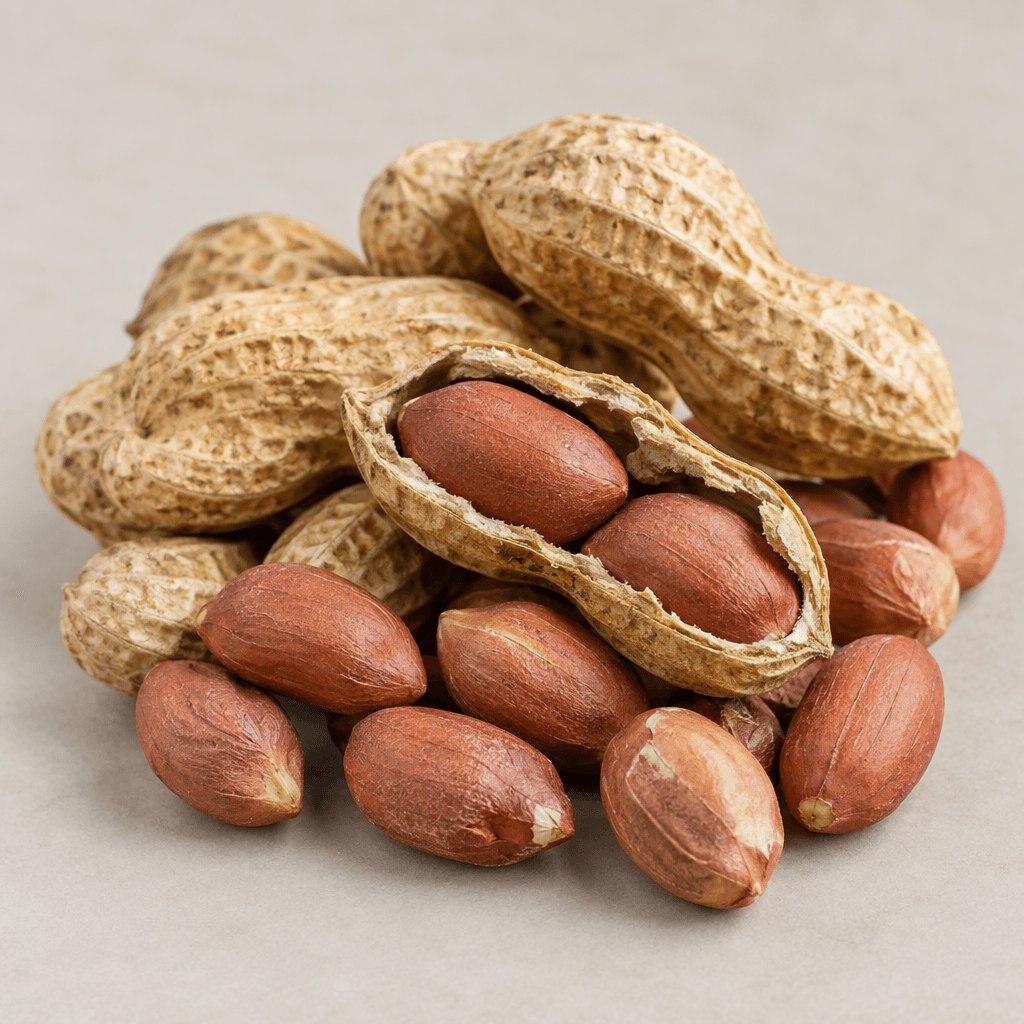
Peanuts are the edible seeds of a legume whose pods mature underground. Native to South America, they are now grown widely and eaten around the world. Sold in or out of their shells, they may be raw, roasted, salted, or ground into peanut butter.
Their flavour is gently sweet and earthy, with a firm crunch when roasted and a richer aroma than when raw. They are a familiar snack, and peanut butter is often spread on toast or used in sauces, baking, and sandwiches. Peanuts provide plant protein, fibre, and plenty of fat, so a small handful can be satisfying; choose unsalted ones if you want to keep the salt down.
Peanut Nutrition Facts
Selected: 100 g
567
KCAL / 100G
Carbs
16.1g
· 6% DV
Protein
25.8g
· 52% DV
Fat
49.2g
· 63% DV
Fiber
8.5g
· 30% DV
DV is the share of the daily value covered, on a 2,000 kcal reference diet.
Calories come from: Carbs 11% · Protein 17% · Fat 72%
Peanut Vitamins & Minerals
Vitamins
Biotin
34µg · 113% DV
B3
12.07mg · 75% DV
Folate
240µg · 60% DV
Vitamin E
8.33mg · 56% DV
Minerals
Copper
1mg · 111% DV
Manganese
2mg · 87% DV
Phosphorus
376mg · 54% DV
Magnesium
168mg · 40% DV
How Nutritious Is Peanut?
Nutrient density
High
How many vitamins, minerals and how much fiber this food carries per calorie. A high score means a lot of nutrition for few calories.
Satiety score
High
An EatBetter score computed from fiber, protein and calorie density. A high score means staying full longer on the same calories.
Both scores are calculated per 100 g and do not change with the selected portion. The satiety score is EatBetter's own calculation, not a clinical measure.
Peanut Glycemic Index
GLYCEMIC INDEX
GLYCEMIC LOAD
Accounts for portion size — a more realistic measure than GI alone.
How to Burn Off Peanut
To burn the 567 calories in 100 g:
🚶
Walking (5 km/h)
🏃
Running (8 km/h)
🚴
Cycling
🏊
Swimming
Times are calculated with the MET equation for a 70 kg adult. Actual burn varies with your weight, age and pace.
Is Peanut Processed?
NOVA 1
Unprocessed
1. Unprocessed
2. Minimally Processed
3. Processed
4. Ultra-Processed
NOVA classifies foods into 4 groups by industrial processing. NOVA 1 (unprocessed) is the healthiest.
Does Peanut Contain Allergens?
Contains these allergens:
Which Diets Is Peanut Good For?
Vegan
✓ Suitable
Vegetarian
✓ Suitable
Gluten-Free
✓ Suitable
Dairy-Free
— Not suitable
Mediterranean
✓ Suitable
Paleo
✓ Suitable
Whole30
— Not suitable
DASH
— Not suitable
Keto
✓ Suitable
Low FODMAP
— Not suitable
Peanut Fat Profile
SATURATED
6.83g
MONOUNSATURATED
24.43g
POLYUNSATURATED
15.56g
Compare Peanut
Foods Similar to Peanut
Frequently Asked Questions About Peanut
Are peanuts nuts or legumes?
Peanuts are legumes, not botanical tree nuts. They grow in pods underground, unlike almonds or walnuts, which grow on trees. In cooking, peanuts are often grouped with nuts because they are commonly eaten as a snack or used in similar recipes.
Are peanuts healthy to eat?
Yes, peanuts provide plant protein, mostly unsaturated fats, magnesium, and vitamin E. Choose plain or dry-roasted peanuts more often than heavily salted or oil-fried versions, and portion them out since they are easy to eat by the handful.
Can peanuts cause an allergic reaction?
Yes, peanuts can cause reactions ranging from hives or swelling to breathing problems and anaphylaxis. Anyone with a suspected peanut allergy should avoid eating them until assessed; throat swelling or difficulty breathing requires emergency care.
Is it better to eat peanuts raw or roasted?
Both raw and roasted peanuts can be eaten. Roasting brings out a stronger flavor and crunch, while salted or oil-roasted versions add extra sodium or fat. Pick the form you enjoy, and choose unsalted peanuts if you want to limit sodium.
How do you roast peanuts at home?
Spread shelled peanuts in a single layer on a baking sheet and roast them, stirring occasionally, until fragrant and lightly browned. Let them cool before judging the crunch, since peanuts continue to firm up as they cool.
How should you store peanuts, and how can you tell if they have gone bad?
Keep peanuts in an airtight container in a cool, dry place; heat and humidity can make their oils turn rancid. Discard peanuts with a stale, bitter, or paint-like smell, or any visible mold. Peanuts in their shells generally keep better.
Can you eat the red skin on peanuts?
Yes, the thin reddish-brown skin on a peanut is edible, so there is no need to remove it. The rough outer shell is not eaten. The skin can taste slightly bitter, especially on roasted peanuts.
Can you make peanut butter from peanuts alone?
Yes, you can make peanut butter by blending roasted peanuts until they release their natural oils and become smooth. The mixture first looks crumbly, then turns creamy; salt, sugar, or other additions are optional.
Are peanuts safe for dogs?
Plain, unsalted peanuts are not toxic to dogs, but they should only be an occasional treat because they are rich and can be a choking hazard. Avoid salted peanuts and peanut butter containing xylitol, which is dangerous to dogs.
Do peanuts help keep you full?
Yes, peanuts can make a snack more filling because they combine protein, fiber, and fat. Pairing a modest portion with fruit or another simple snack can be more satisfying than eating a highly refined snack on its own.
Have another question about Peanut?
Ask the AI nutrition coach — calories, portions, alternatives and more, answered in seconds in the app.

Scan calories with your camera
Instant AI nutrition analysis

Nutrition data compiled from USDA FoodData Central and scientific sources.