

Ready & Packaged Foods
All →Vegetables & Legumes
All →Desserts & Confectionery
All →Meat & Protein
All →Grains & Bakery
All →Beverages
All →Milk & Dairy
All →

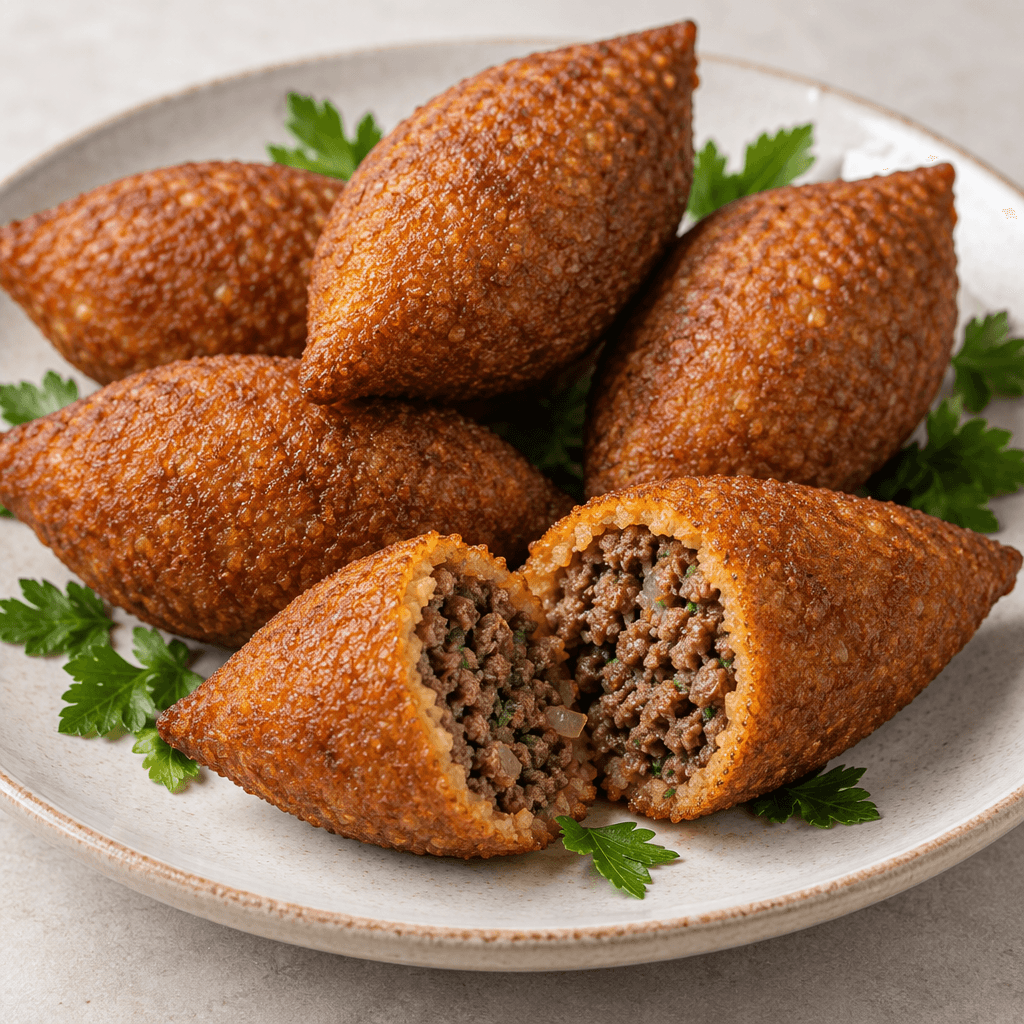
Oruk Calories
Traditional bulgur shell with minced meat filling, similar to stuffed kibbeh
CALORIES
GI
POTASSIUM
FIBER
Quick answer
1 piece (medium) of Oruk (120 g) has 294 calories. That works out to 245 calories per 100 g. It contains 27.4 g of carbs, 13.4 g of protein, 14.5 g of fat and 3.7 g of fiber. Its 1.1 µg of B12 covers 45% of the Daily Value. Its glycemic index is 48 (low), so it raises blood sugar slowly.
What is Oruk?
Oruk is a traditional dish from Hatay in southern Turkey, made by wrapping a seasoned minced-meat filling in a shell of fine bulgur. It resembles stuffed kibbeh and is often shaped into an elongated piece; recipes may bake or fry it. The bulgur casing is pleasantly firm, while the filling is tender and savoury. In Turkey, oruk is served as a substantial meal at home or for gatherings, commonly alongside salad, yoghurt or ayran. Bulgur contributes carbohydrates and fibre, and the meat provides protein; frying makes the dish richer. For a lighter plate, choose a baked piece and serve it with plenty of fresh greens.
Oruk Nutrition Facts
Selected: 100 g
245
KCAL / 100G
Carbs
22.8g
· 8% DV
Protein
11.2g
· 22% DV
Fat
12.1g
· 16% DV
Fiber
3.1g
· 11% DV
DV is the share of the daily value covered, on a 2,000 kcal reference diet.
Calories come from: Carbs 37% · Protein 18% · Fat 45%
Oruk Vitamins & Minerals
Vitamins
B12
0.9µg · 38% DV
B3
2.9mg · 18% DV
B6
0.21mg · 12% DV
B1
0.12mg · 10% DV
Minerals
Manganese
1mg · 43% DV
Selenium
14µg · 25% DV
Phosphorus
146mg · 21% DV
Zinc
2mg · 18% DV
How Nutritious Is Oruk?
Nutrient density
Medium
How many vitamins, minerals and how much fiber this food carries per calorie. A high score means a lot of nutrition for few calories.
Satiety score
Medium
An EatBetter score computed from fiber, protein and calorie density. A high score means staying full longer on the same calories.
Both scores are calculated per 100 g and do not change with the selected portion. The satiety score is EatBetter's own calculation, not a clinical measure.
Oruk Glycemic Index
GLYCEMIC INDEX
GLYCEMIC LOAD
Accounts for portion size — a more realistic measure than GI alone.
How to Burn Off Oruk
To burn the 245 calories in 100 g:
🚶
Walking (5 km/h)
🏃
Running (8 km/h)
🚴
Cycling
🏊
Swimming
Times are calculated with the MET equation for a 70 kg adult. Actual burn varies with your weight, age and pace.
Is Oruk Processed?
NOVA 2
Minimally Processed
1. Unprocessed
2. Minimally Processed
3. Processed
4. Ultra-Processed
NOVA classifies foods into 4 groups by industrial processing. NOVA 1 (unprocessed) is the healthiest.
Does Oruk Contain Allergens?
No known major allergens
Which Diets Is Oruk Good For?
Vegan
— Not suitable
Vegetarian
— Not suitable
Gluten-Free
— Not suitable
Dairy-Free
— Not suitable
Mediterranean
✓ Suitable
Paleo
— Not suitable
Whole30
— Not suitable
DASH
— Not suitable
Keto
— Not suitable
Low FODMAP
— Not suitable
Oruk Fat Profile
SATURATED
3.6g
MONOUNSATURATED
4.9g
POLYUNSATURATED
1.7g
Omega 6:3 ratio 18.1:1
Above the ideal 4:1 (18.1:1).
Compare Oruk
Foods Similar to Oruk
Frequently Asked Questions About Oruk
Is Oruk the same as kibbeh?
Oruk is a regional Turkish form of stuffed kibbeh, rather than a completely separate dish. It has a bulgur-based shell around minced-meat filling, and Hatay-style versions are often shaped into elongated pieces.
What is Oruk made of?
Oruk is made with a shell of fine bulgur, commonly kneaded with water and sometimes other binding ingredients, wrapped around seasoned minced-meat filling. Onion is typical in the filling, while recipes and spices vary by household.
Can Oruk be baked instead of fried?
Yes, Oruk can be baked; tray-style Oruk is a familiar variation. Individual pieces may also be fried, depending on the recipe. Baking gives the dish a different texture, so use the cooking method specified for your version.
Why does Oruk break open during frying?
Oruk can split when the bulgur shell is too dry, unevenly kneaded, or left with a thin spot or an open seam. Keep the shell pliable, avoid overfilling it, seal it carefully, and fry without overcrowding the pan.
Which bulgur should you use for Oruk?
Fine bulgur is the usual choice for Oruk’s shell because it can be kneaded into a smooth, shapeable mixture. Coarser bulgur tends to leave the shell rough and harder to seal; let the fine bulgur soften before kneading.
Can you prepare Oruk ahead of time?
Yes, you can shape Oruk ahead and keep it covered in the refrigerator until cooking. For longer storage, freeze the uncooked pieces separately before packing them together, so they do not stick or lose their shape.
What meat is usually used in Oruk?
Oruk is usually filled with minced meat, commonly beef or lamb depending on the local recipe. The filling is cooked or prepared with onion and seasoning; choose a filling that is not excessively wet, so it stays inside the shell.
Is Oruk a Hatay dish?
Yes, Oruk is strongly associated with Hatay, especially Antakya’s food traditions. The name refers to a local stuffed-bulgur preparation, and family recipes differ in their filling, shaping, and choice of frying or baking.
How should you reheat leftover Oruk?
Reheat leftover Oruk in an oven or a covered pan over gentle heat until hot through. These methods help the outside retain more texture than microwaving; add a small splash of water only if the bulgur shell seems dry.
Why is Oruk often shaped like a long oval?
The long oval is a traditional shape for many Hatay-style Oruk recipes and makes the bulgur shell easy to fill and seal around the meat. Other shapes exist, particularly in home cooking and tray-baked versions.
Have another question about Oruk?
Ask the AI nutrition coach — calories, portions, alternatives and more, answered in seconds in the app.

Scan calories with your camera
Instant AI nutrition analysis

Nutrition data compiled from USDA FoodData Central and scientific sources.