

Ready & Packaged Foods
All →Vegetables & Legumes
All →Desserts & Confectionery
All →Meat & Protein
All →Grains & Bakery
All →Beverages
All →Milk & Dairy
All →

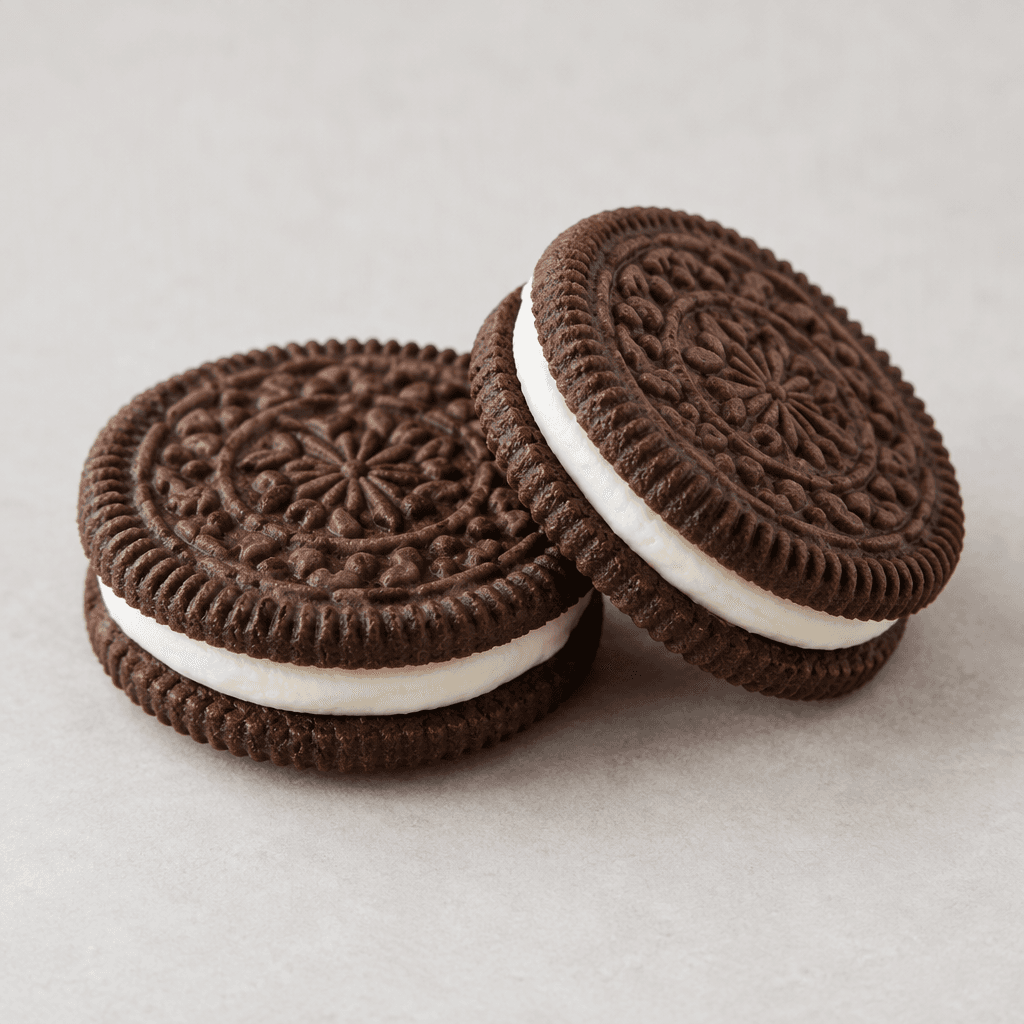
Oreo biscuit Calories
Popular chocolate sandwich biscuit with sweet creamy filling
CALORIES
GI
POTASSIUM
FIBER
Quick answer
3 piece (medium) of Oreo biscuit (34 g) has 163 calories. That works out to 480 calories per 100 g. It contains 24.7 g of carbs, 1.6 g of protein, 6.6 g of fat and 0.9 g of fiber. Its 1.2 mg of Iron covers 7% of the Daily Value. Its glycemic index is 60 (high), so it raises blood sugar quickly.
What is Oreo biscuit?
Oreo biscuit is a packaged American snack made from two dark cocoa biscuits with a sweet, pale cream filling between them. The embossed tops and crisp bite are part of its familiar appeal, and the chocolate flavour is balanced by the distinctly sweet centre.
It is commonly eaten with milk, tea or coffee, enjoyed as a quick snack, or used in desserts such as cheesecake and milkshakes. Its nutritional profile is mainly carbohydrate, with some fat; it is more of a sweet treat than a filling, protein-rich snack. For a lighter snack, have a few with plain milk or fruit rather than making them the whole meal.
Oreo biscuit Nutrition Facts
Selected: 100 g
480
KCAL / 100G
Carbs
72.6g
· 26% DV
Protein
4.7g
· 9% DV
Fat
19.5g
· 25% DV
Fiber
2.5g
· 9% DV
DV is the share of the daily value covered, on a 2,000 kcal reference diet.
Calories come from: Carbs 60% · Protein 4% · Fat 36%
Oreo biscuit Vitamins & Minerals
Vitamins
B2
0.18mg · 14% DV
B1
0.13mg · 11% DV
B3
1.2mg · 8% DV
B5
0.23mg · 5% DV
Minerals
Iron
4mg · 22% DV
Sodium
370mg · 16% DV
Zinc
1mg · 9% DV
Selenium
5.2µg · 9% DV
How Nutritious Is Oreo biscuit?
Nutrient density
Low
How many vitamins, minerals and how much fiber this food carries per calorie. A high score means a lot of nutrition for few calories.
Satiety score
Low
An EatBetter score computed from fiber, protein and calorie density. A high score means staying full longer on the same calories.
Both scores are calculated per 100 g and do not change with the selected portion. The satiety score is EatBetter's own calculation, not a clinical measure.
Oreo biscuit Glycemic Index
GLYCEMIC INDEX
GLYCEMIC LOAD
Accounts for portion size — a more realistic measure than GI alone.
How to Burn Off Oreo biscuit
To burn the 480 calories in 100 g:
🚶
Walking (5 km/h)
🏃
Running (8 km/h)
🚴
Cycling
🏊
Swimming
Times are calculated with the MET equation for a 70 kg adult. Actual burn varies with your weight, age and pace.
Is Oreo biscuit Processed?
NOVA 4
Ultra-Processed
1. Unprocessed
2. Minimally Processed
3. Processed
4. Ultra-Processed
NOVA classifies foods into 4 groups by industrial processing. NOVA 1 (unprocessed) is the healthiest.
Does Oreo biscuit Contain Allergens?
Contains these allergens:
Which Diets Is Oreo biscuit Good For?
Vegan
— Not suitable
Vegetarian
✓ Suitable
Gluten-Free
— Not suitable
Dairy-Free
— Not suitable
Mediterranean
— Not suitable
Paleo
— Not suitable
Whole30
— Not suitable
DASH
— Not suitable
Keto
— Not suitable
Low FODMAP
— Not suitable
Oreo biscuit Fat Profile
SATURATED
6.5g
MONOUNSATURATED
6.9g
POLYUNSATURATED
2.1g
Omega 6:3 ratio 120:1
Above the ideal 4:1 (120:1).
Compare Oreo biscuit
Foods Similar to Oreo biscuit
Frequently Asked Questions About Oreo biscuit
What is the filling in an Oreo biscuit made of?
The filling in a standard Oreo biscuit is a sweet creme-style filling, not fresh dairy cream; it is typically made with sugar and vegetable oils. Recipes can vary by country and flavour, so specialty versions may have different ingredients.
Do Oreo biscuits contain real chocolate?
Oreo biscuits contain cocoa in their dark outer biscuits, but they are not coated in chocolate and their filling is not a chocolate ganache. The cocoa gives the biscuits their characteristic chocolate-like flavour.
Are Oreo biscuits healthy to eat every day?
Oreo biscuits are a sweet, ultra-processed snack rather than a nutrient-dense everyday food. Having them occasionally as part of a varied eating pattern is different from relying on them regularly for a snack.
Why do people dip Oreo biscuits in milk?
Dipping an Oreo biscuit in milk softens its crisp layers and combines the cocoa flavour with the sweet filling. A quick dip keeps it intact; leaving it in too long can make it soggy and liable to break.
Where did Oreo biscuits originate?
Oreo biscuits were first introduced in the United States in 1912, in New York City. Their familiar format is two cocoa biscuits sandwiching a sweet creme-style filling.
How should you store Oreo biscuits after opening?
Keep opened Oreo biscuits in an airtight container in a cool, dry place. Exposure to air and humidity makes the biscuits lose their crispness, while nearby strong-smelling foods can affect their flavour.
Can you freeze Oreo biscuits?
Yes, Oreo biscuits can be frozen, either for later snacking or for use in chilled desserts. Seal them well to prevent moisture getting in, and let the closed container come to room temperature before opening.
Can dogs eat Oreo biscuits?
No, Oreo biscuits are not a safe treat for dogs. Their cocoa-containing biscuits and sugary filling are unsuitable for pets; contact a veterinarian if your dog has eaten several or seems unwell.
Can Oreo biscuits be used in cheesecake?
Yes, Oreo biscuits work well crushed into a cheesecake crust or folded into the filling. For a firm crust, combine the crumbs with melted butter and press them into the tin before adding the cheesecake mixture.
Do Oreo biscuits contain caffeine?
Yes, the cocoa in Oreo biscuits naturally contributes a small amount of caffeine, though the amount varies by serving and product. They are not a caffeine-free choice, but they are not usually eaten as a major source of caffeine.
Have another question about Oreo biscuit?
Ask the AI nutrition coach — calories, portions, alternatives and more, answered in seconds in the app.

Scan calories with your camera
Instant AI nutrition analysis

Nutrition data compiled from USDA FoodData Central and scientific sources.