

Ready & Packaged Foods
All →Vegetables & Legumes
All →Desserts & Confectionery
All →Meat & Protein
All →Grains & Bakery
All →Beverages
All →Milk & Dairy
All →

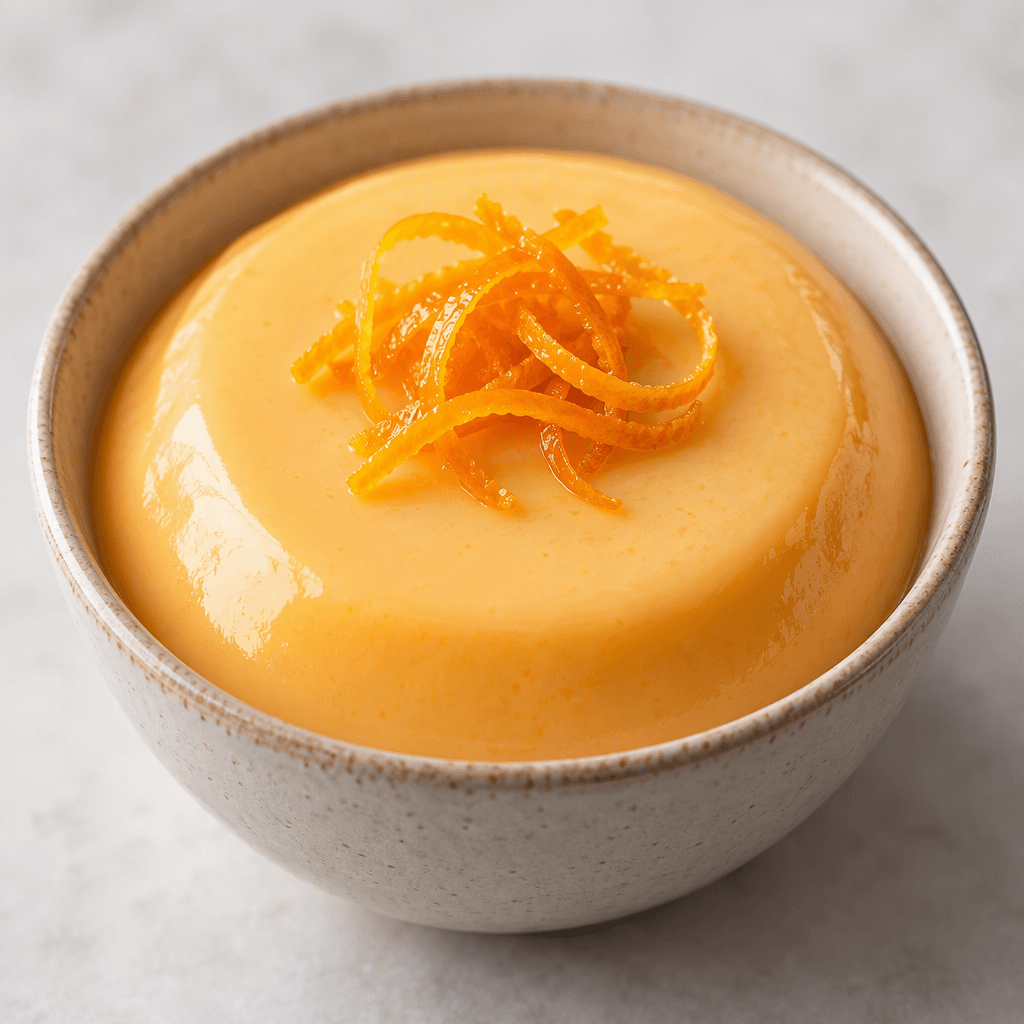
Orange pudding Calories
Orange pudding
In season: Winter
CALORIES
GI
POTASSIUM
FIBER
Quick answer
1 cup (medium) of Orange pudding (150 g) has 165 calories. That works out to 110 calories per 100 g. It contains 32.3 g of carbs, 3.2 g of protein, 3 g of fat and 0.6 g of fiber. Its 19.5 mg of Vitamin C covers 22% of the Daily Value. Its glycemic index is 55 (medium), so it raises blood sugar at a moderate pace.
What is Orange pudding?
Orange pudding is a Turkish home-style take on muhallebi, a softly set milk pudding thickened with starch or flour. Orange juice and finely grated zest give it a fresh citrus aroma and its characteristic pale colour. It is usually served chilled in individual bowls, sometimes finished with a little extra zest, as a simple dessert after a meal or alongside tea or coffee.
It is mainly a source of carbohydrates, with about 110 calories per 100 g. For a less sweet version, use less sugar and let the orange provide more of the flavour; fresh fruit makes an easy accompaniment.
Orange pudding Nutrition Facts
Selected: 100 g
110
KCAL / 100G
Carbs
21.5g
· 8% DV
Protein
2.1g
· 4% DV
Fat
2g
· 3% DV
Fiber
0.4g
· 1% DV
DV is the share of the daily value covered, on a 2,000 kcal reference diet.
Calories come from: Carbs 77% · Protein 7% · Fat 16%
Orange pudding Vitamins & Minerals
Vitamins
Vitamin C
13mg · 14% DV
Vitamin A
35µg · 4% DV
B5
0.18mg · 4% DV
B1
0.03mg · 3% DV
Minerals
Calcium
65mg · 7% DV
Phosphorus
45mg · 6% DV
Potassium ⭐
85mg · 3% DV
Magnesium
7mg · 2% DV
How Nutritious Is Orange pudding?
Nutrient density
Low
How many vitamins, minerals and how much fiber this food carries per calorie. A high score means a lot of nutrition for few calories.
Satiety score
Low
An EatBetter score computed from fiber, protein and calorie density. A high score means staying full longer on the same calories.
Both scores are calculated per 100 g and do not change with the selected portion. The satiety score is EatBetter's own calculation, not a clinical measure.
Orange pudding Glycemic Index
GLYCEMIC INDEX
GLYCEMIC LOAD
Accounts for portion size — a more realistic measure than GI alone.
How to Burn Off Orange pudding
To burn the 110 calories in 100 g:
🚶
Walking (5 km/h)
🏃
Running (8 km/h)
🚴
Cycling
🏊
Swimming
Times are calculated with the MET equation for a 70 kg adult. Actual burn varies with your weight, age and pace.
Is Orange pudding Processed?
NOVA 3
Processed
1. Unprocessed
2. Minimally Processed
3. Processed
4. Ultra-Processed
NOVA classifies foods into 4 groups by industrial processing. NOVA 1 (unprocessed) is the healthiest.
Does Orange pudding Contain Allergens?
Contains these allergens:
Which Diets Is Orange pudding Good For?
Vegan
— Not suitable
Vegetarian
✓ Suitable
Gluten-Free
— Not suitable
Dairy-Free
— Not suitable
Mediterranean
— Not suitable
Paleo
— Not suitable
Whole30
— Not suitable
DASH
— Not suitable
Keto
— Not suitable
Low FODMAP
— Not suitable
Orange pudding Fat Profile
SATURATED
1.1g
MONOUNSATURATED
0.4g
POLYUNSATURATED
0.1g
Omega 6:3 ratio 7:1
Above the ideal 4:1 (7:1).
Compare Orange pudding
Foods Similar to Orange pudding
Frequently Asked Questions About Orange pudding
How do you make orange pudding?
Orange pudding is made by cooking milk, sugar, and a thickener until smooth, then adding orange flavour. Use finely grated zest for fragrance and stir in a little juice after thickening so the milk is less likely to split.
Should you use orange juice or zest in orange pudding?
Use both for the fullest orange flavour: zest adds aroma, while juice brings a sharper citrus taste. Add only the coloured outer zest, and mix juice in after the milk base thickens to avoid a thin or split pudding.
How do you stop orange pudding from curdling?
Add orange juice to the thickened orange pudding after taking it off the heat, rather than boiling it with the milk. Stir the juice in gradually; the citrus acid can make hot milk curdle if cooked together for too long.
Why is my orange pudding runny?
Orange pudding is often runny because the starch did not cook long enough or too much juice was added. Keep stirring the milk mixture until it visibly thickens, and add citrus juice in small amounts after cooking.
Can you make orange pudding with mandarins instead of oranges?
Yes, mandarins can flavour orange pudding, though their juice is usually milder and sweeter than regular orange juice. Taste the mixture before serving and add a little extra zest if you want a more pronounced citrus flavour.
Can orange pudding be made without dairy milk?
Yes, orange pudding can be made with an unsweetened plant milk, although the result may be less creamy than a dairy version. Choose a neutral-tasting option and check the pudding as it cooks, since different milks thicken differently.
Can you make orange pudding ahead of time?
Yes, orange pudding can be made ahead and chilled until serving. Cover the surface or seal the serving bowls once cool to prevent a skin from forming and to keep the pudding from absorbing refrigerator odours.
Can orange pudding be frozen?
Orange pudding is best not frozen because its milk-based texture can separate or turn grainy after thawing. Chill it in the refrigerator instead and serve it within a few days for the smoothest consistency.
Is orange pudding served warm or cold?
Orange pudding is usually served cold, after chilling so it sets and becomes easy to spoon. Let it cool before refrigerating, then finish it with fresh orange zest or a few orange segments just before serving.
What is the difference between orange pudding and orange custard?
Orange pudding is commonly thickened with starch, while orange custard typically relies on egg yolks for its set and creamy texture. The names can vary between recipes, so the ingredient list shows which style a particular orange dessert uses.
Have another question about Orange pudding?
Ask the AI nutrition coach — calories, portions, alternatives and more, answered in seconds in the app.

Scan calories with your camera
Instant AI nutrition analysis

Nutrition data compiled from USDA FoodData Central and scientific sources.