

Ready & Packaged Foods
All →Vegetables & Legumes
All →Desserts & Confectionery
All →Meat & Protein
All →Grains & Bakery
All →Beverages
All →Milk & Dairy
All →

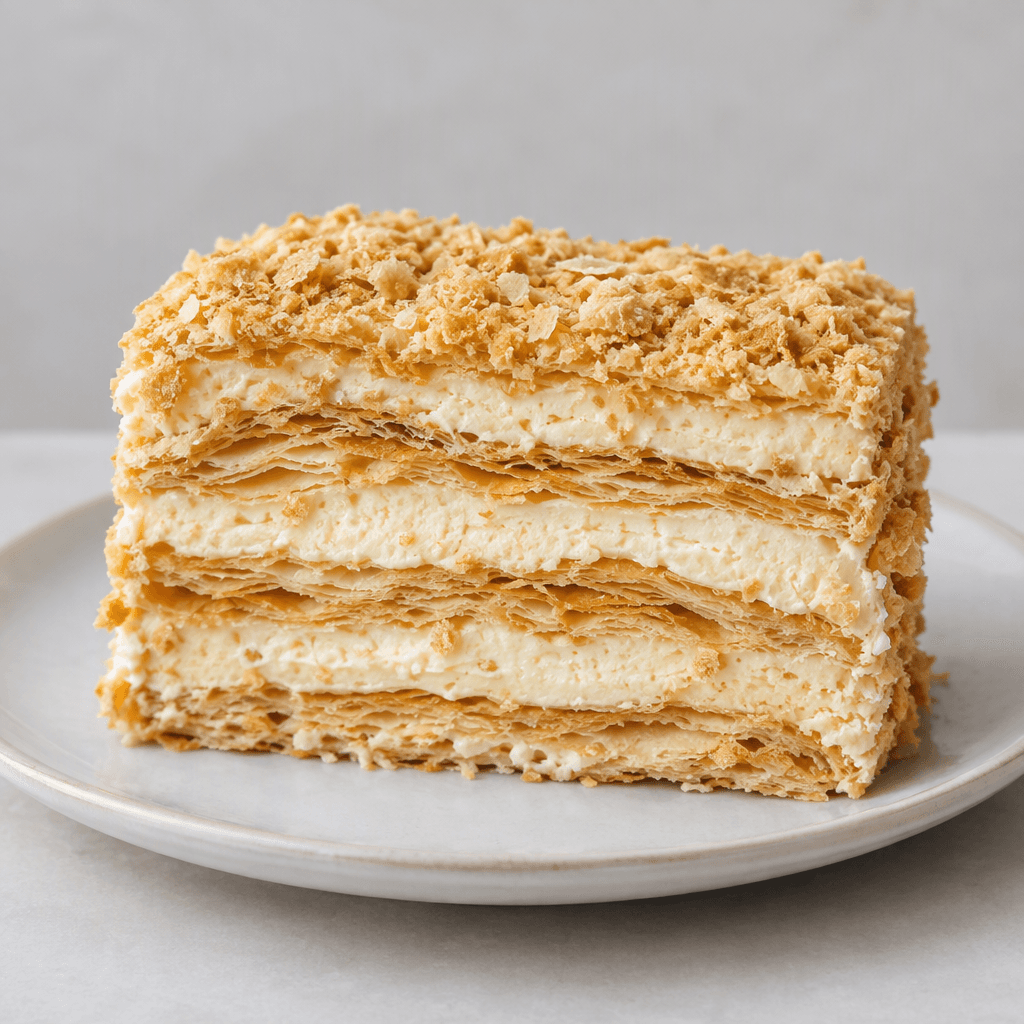
Napoleon cake Calories
Classic French dessert with layered puff pastry and cream filling
In season: Spring · Summer · Autumn · Winter
CALORIES
GI
POTASSIUM
FIBER
Quick answer
1 slice (medium) of Napoleon cake (80 g) has 280 calories. That works out to 350 calories per 100 g. It contains 28 g of carbs, 4 g of protein, 17.6 g of fat and 1 g of fiber. Its 96 µg of Vitamin A covers 11% of the Daily Value. Its glycemic index is 60 (medium), so it raises blood sugar at a moderate pace.
What is Napoleon cake?
Napoleon cake is made from crisp layers of puff pastry sandwiched with pastry cream, then finished with cream or pastry crumbs. It is a classic French-style layered dessert, closely related to mille-feuille, and is usually served in neat slices, though its delicate layers often crumble as you cut into them.
The contrast is part of its appeal: buttery, flaky pastry against a smooth, gently sweet filling. It suits a coffee break, afternoon tea or a celebration, and is commonly enjoyed as a dessert rather than an everyday snack. With pastry and cream at its heart, it is relatively rich in fat and energy and low in fibre. Serve a modest slice with fresh berries or fruit for a lighter-feeling finish.
Napoleon cake Nutrition Facts
Selected: 100 g
350
KCAL / 100G
Carbs
35g
· 13% DV
Protein
5g
· 10% DV
Fat
22g
· 28% DV
Fiber
1.2g
· 4% DV
DV is the share of the daily value covered, on a 2,000 kcal reference diet.
Calories come from: Carbs 39% · Protein 6% · Fat 55%
Napoleon cake Vitamins & Minerals
Vitamins
B2
0.18mg · 14% DV
Vitamin A
120µg · 13% DV
B5
0.5mg · 10% DV
Biotin
2.5µg · 8% DV
Minerals
Selenium
6µg · 11% DV
Zinc
1mg · 9% DV
Sodium
210mg · 9% DV
Phosphorus
65mg · 9% DV
How Nutritious Is Napoleon cake?
Nutrient density
Low
How many vitamins, minerals and how much fiber this food carries per calorie. A high score means a lot of nutrition for few calories.
Satiety score
Low
An EatBetter score computed from fiber, protein and calorie density. A high score means staying full longer on the same calories.
Both scores are calculated per 100 g and do not change with the selected portion. The satiety score is EatBetter's own calculation, not a clinical measure.
Napoleon cake Glycemic Index
GLYCEMIC INDEX
GLYCEMIC LOAD
Accounts for portion size — a more realistic measure than GI alone.
How to Burn Off Napoleon cake
To burn the 350 calories in 100 g:
🚶
Walking (5 km/h)
🏃
Running (8 km/h)
🚴
Cycling
🏊
Swimming
Times are calculated with the MET equation for a 70 kg adult. Actual burn varies with your weight, age and pace.
Is Napoleon cake Processed?
NOVA 3
Processed
1. Unprocessed
2. Minimally Processed
3. Processed
4. Ultra-Processed
NOVA classifies foods into 4 groups by industrial processing. NOVA 1 (unprocessed) is the healthiest.
Does Napoleon cake Contain Allergens?
Contains these allergens:
Which Diets Is Napoleon cake Good For?
Vegan
— Not suitable
Vegetarian
— Not suitable
Gluten-Free
— Not suitable
Dairy-Free
— Not suitable
Mediterranean
✓ Suitable
Paleo
— Not suitable
Whole30
— Not suitable
DASH
— Not suitable
Keto
— Not suitable
Low FODMAP
— Not suitable
Napoleon cake Fat Profile
SATURATED
10g
MONOUNSATURATED
7g
POLYUNSATURATED
2.5g
Omega 6:3 ratio 40:1
Above the ideal 4:1 (40:1).
Compare Napoleon cake
Foods Similar to Napoleon cake
Frequently Asked Questions About Napoleon cake
What is Napoleon cake made of?
Napoleon cake is made from layers of baked puff pastry and cream filling. The filling is often pastry cream or a custard-style cream, while the top may be covered with pastry crumbs, icing sugar, or an extra layer of cream.
Is Napoleon cake the same as mille-feuille?
They are closely related layered puff-pastry desserts, but recipes and names vary by country. Napoleon cake often refers to a Russian-style version with many thin pastry layers and a generous cream filling, while mille-feuille commonly has fewer, more defined layers.
Where did Napoleon cake come from?
Napoleon cake is especially associated with Russia, where it became a popular celebration dessert. Its layered puff pastry is linked to the French mille-feuille tradition, though the Russian-style cake developed its own recipes and customs.
Why does Napoleon cake get soggy?
Napoleon cake softens as moisture from the cream moves into the puff pastry. Assemble it closer to serving time if you want crisp layers; a cake that rests longer will be softer and easier to cut, which is also common in many recipes.
How many layers does Napoleon cake have?
Napoleon cake has no fixed number of layers; recipes may use just a few pastry sheets or many thin ones. The pastry layers are separated by cream, and trimmed scraps are often crumbled over the top rather than counted as another layer.
How long does Napoleon cake last in the fridge?
Napoleon cake generally keeps for about 2–3 days in the refrigerator when covered. Keep it chilled because of the cream filling; the pastry will gradually soften as it absorbs moisture, so it is usually at its crispest soon after assembly.
Can you freeze Napoleon cake?
Yes, Napoleon cake can be frozen, but the pastry may lose its crisp texture and the cream may change slightly after thawing. Freeze it in airtight portions and thaw it slowly in the refrigerator for a more even texture.
How do you cut Napoleon cake without crushing it?
Use a sharp serrated knife and a gentle sawing motion to cut Napoleon cake without pressing down hard on its layers. Chilling the cake first helps it hold together, and wiping the blade between slices keeps cream from smearing.
Can you make Napoleon cake ahead of time?
Yes, you can assemble Napoleon cake ahead and chill it so the cream sets between the pastry layers. The longer it rests, the softer the pastry becomes; for a crisper result, bake the pastry sheets in advance and assemble the cake closer to serving.
What should you serve with Napoleon cake?
Serve Napoleon cake with black coffee or unsweetened tea, which balances its rich cream filling. Fresh berries also work well, especially tart ones that add a bright contrast to the sweet pastry.
Have another question about Napoleon cake?
Ask the AI nutrition coach — calories, portions, alternatives and more, answered in seconds in the app.

Scan calories with your camera
Instant AI nutrition analysis

Nutrition data compiled from USDA FoodData Central and scientific sources.