

Ready & Packaged Foods
All →Vegetables & Legumes
All →Desserts & Confectionery
All →Meat & Protein
All →Grains & Bakery
All →Beverages
All →Milk & Dairy
All →

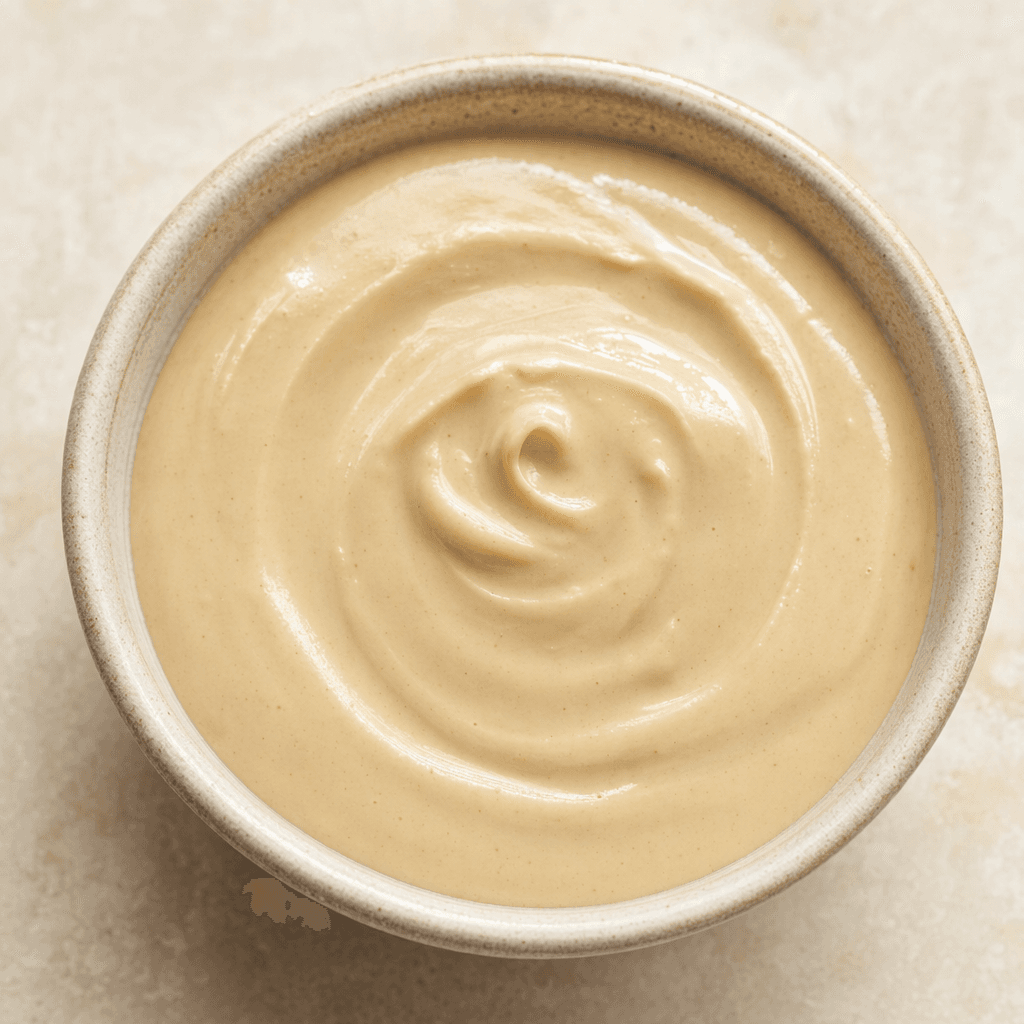
Light tahini Calories
Sesame paste, reduced fat, light
In season: Spring · Summer · Autumn · Winter
CALORIES · 100 G
GI
POTASSIUM · 100 G
FIBER · 100 G
Quick answer
1 tablespoon (medium) of Light tahini (15 g) has 74 calories. That works out to 490 calories per 100 g. It contains 2.8 g of carbs, 2.5 g of protein, 5.6 g of fat and 1.2 g of fiber. Its 0.3 mg of Copper covers 28% of the Daily Value. Its glycemic index is 35 (low), so it raises blood sugar slowly.
Light tahini Nutrition Facts
Selected: 1 tablespoon (medium) · 15 g
74
KCAL / 15G
Carbs
2.8g
· 1% DV
Protein
2.5g
· 5% DV
Fat
5.6g
· 7% DV
Fiber
1.2g
· 4% DV
DV is the share of the daily value covered, on a 2,000 kcal reference diet.
Calories come from: Carbs 16% · Protein 14% · Fat 70%
Light tahini nutrition facts table · 1 tablespoon (medium) (15 g)
| Nutrient | Amount | % DV |
|---|---|---|
| Calories | 74 kcal | |
| Total fat | 5.6 g | 7% |
| Saturated fat | 0.83 g | 4% |
| Trans fat | 0 g | |
| Sodium | 2.7 mg | 0% |
| Total carbohydrate | 2.8 g | 1% |
| Fiber | 1.2 g | 4% |
| Protein | 2.5 g | 5% |
Calories: Calories measure energy. Average daily need is 2,000 kcal. Excess calories are stored as fat, too few cause weight loss.
Carbs: Your body's primary energy source. The brain runs exclusively on carbs. Daily need: 275g.
Protein: Essential for muscle repair and cell growth. Daily need: 50g. Keeps you full and boosts metabolism.
Fat: Needed for hormone production and vitamin absorption. Daily need: 78g. Limit saturated fats, choose unsaturated.
Fiber: Critical for digestive health and satiety. Daily need: 28g. Stabilizes blood sugar, lowers cholesterol.

Log this food in EatBetter
100,000+ people use it
- Get your daily calorie target
- Snap your meal, log it in seconds
- See every vitamin and mineral

📸 Scan the code to get the app free.

How Many Calories in 1 Tablespoon of Light tahini?
| Serving | Amount | Calories |
|---|---|---|
| 1 tablespoon (medium) | 15 g | 74 kcal |
| 1 teaspoon (small) | 5 g | 25 kcal |
| 1 piece (medium) | 20 g | 98 kcal |
| 1 ounce (medium) | 28 g | 137 kcal |
| 2 tablespoon (large) | 30 g | 147 kcal |
| 1 serving (medium) | 30 g | 147 kcal |
| 1 pack (medium) | 50 g | 245 kcal |
| 100 g | 100 g | 490 kcal |
| 1 cup (large) | 240 g | 1176 kcal |
Calculated from 490 calories per 100 g.
Frequently Asked Questions About Light tahini
What is light tahini made from?
Light tahini is sesame paste sold in a reduced-fat version. It is still a sesame-based spread, but its formulation differs from regular tahini; the exact ingredients and method can vary between products.
How is light tahini different from regular tahini?
Light tahini has less fat than regular tahini. Its flavor, thickness, and behavior in recipes can also differ by product, so add liquid gradually when using it in dips or dressings.
Can you use light tahini to make hummus?
Yes, light tahini works in hummus. Blend it with chickpeas, lemon, garlic, and a little water, adding the water gradually until the hummus reaches the texture you want.
Why does light tahini separate, and should you stir it?
Oil can rise to the top of light tahini through natural separation. Stir it thoroughly from the bottom before serving; separation alone does not mean the tahini has spoiled.
Does light tahini need to be refrigerated after opening?
Usually, light tahini can be kept tightly sealed in a cool, dry cupboard away from heat and sunlight. Refrigeration is optional for many products, but it can make tahini firmer; follow the storage directions on the jar.
Can light tahini replace regular tahini in recipes?
Yes, you can replace regular tahini with light tahini in many recipes. Because the fat content and consistency may differ, adjust water or other liquids gradually, especially when making sauces and baked goods.
Why does my light tahini taste bitter?
A mild bitterness can come from the sesame seeds or how they were roasted. If the flavor has turned sharply bitter or comes with a rancid smell, discard the tahini rather than trying to mask the taste.
How can you tell if light tahini has gone bad?
Discard light tahini if it smells rancid or sour, develops mold, or has an unusual change in appearance or flavor. A layer of separated oil is normal; stir it and assess the smell and paste itself.
Can you bake with light tahini?
Yes, light tahini can be used in cookies, cakes, and other baked goods. Its reduced-fat formulation may change a recipe’s moisture or texture, so make the first batch using the recipe’s liquid amounts as a starting point.
Is light tahini good for weight loss?
Light tahini is not a weight-loss food by itself. Its reduced-fat formulation distinguishes it from regular tahini, but it still contributes energy, so consider the amount you spread or add to meals.
Light tahini Vitamins & Minerals
Vitamins
B1
0.11mg · 9% DV
Vitamin K
5.25µg · 4% DV
B3
0.69mg · 4% DV
Biotin
1.27µg · 4% DV
Minerals
Copper
0.26mg · 29% DV
Phosphorus
86mg · 12% DV
Manganese
0.17mg · 7% DV
Calcium
65mg · 7% DV
Potassium ⭐
71mg · 2% DV
Sodium
2.7mg · 0% DV
Light tahini Glycemic Index
GLYCEMIC INDEX
GLYCEMIC LOAD
Accounts for portion size — a more realistic measure than GI alone.
How to Burn Off Light tahini
To burn the 74 calories in 1 tablespoon (medium) (15 g):
🚶
Walking (5 km/h)
🏃
Running (8 km/h)
🚴
Cycling
🏊
Swimming
Times are calculated with the MET equation for a 70 kg adult. Actual burn varies with your weight, age and pace.
What is Light tahini?
Light tahini is sesame paste made from ground sesame seeds, formulated to contain less fat than regular tahini. It keeps tahini’s characteristic toasted, slightly bitter flavour, though it may taste less rich and feel a little lighter.
Tahini is widely used across the Middle East and eastern Mediterranean: stir it into hummus, whisk it with lemon for a sauce, or drizzle it over vegetables and grain bowls. It also works on toast or in baking. It contributes plant protein and fibre, with 16.5 g of protein per 100 g. For a lighter dressing, thin it with water and lemon juice; add garlic for a savoury version.
How Nutritious Is Light tahini?
Nutrient density
Very high
How many vitamins, minerals and how much fiber this food carries per calorie. A high score means a lot of nutrition for few calories.
Satiety score
Medium
An EatBetter score computed from fiber, protein and calorie density. A high score means staying full longer on the same calories.
Both scores are calculated per 100 g and do not change with the selected portion. The satiety score is EatBetter's own calculation, not a clinical measure.
Is Light tahini Processed?
NOVA 2
Minimally Processed
1. Unprocessed
2. Minimally Processed
3. Processed
4. Ultra-Processed
NOVA classifies foods into 4 groups by industrial processing. NOVA 1 (unprocessed) is the healthiest.
Does Light tahini Contain Allergens?
Contains these allergens:
Which Diets Is Light tahini Good For?
Vegan
✓ Suitable
Vegetarian
✓ Suitable
Gluten-Free
✓ Suitable
Dairy-Free
— Not suitable
Mediterranean
✓ Suitable
Paleo
— Not suitable
Whole30
— Not suitable
DASH
— Not suitable
Keto
✓ Suitable
Low FODMAP
— Not suitable
Light tahini Fat Profile
SATURATED
0.83g
MONOUNSATURATED
2.28g
POLYUNSATURATED
2.66g
Omega 6:3 ratio 131.5:1
Above the ideal 4:1 (131.5:1).
Compare Light tahini
Foods Similar to Light tahini
Have another question about Light tahini?
Ask the AI nutrition coach — calories, portions, alternatives and more, answered in seconds in the app.

Scan calories with your camera
Instant AI nutrition analysis

Nutrition data compiled from USDA FoodData Central and scientific sources.