

Ready & Packaged Foods
All →Vegetables & Legumes
All →Desserts & Confectionery
All →Meat & Protein
All →Grains & Bakery
All →Beverages
All →Milk & Dairy
All →

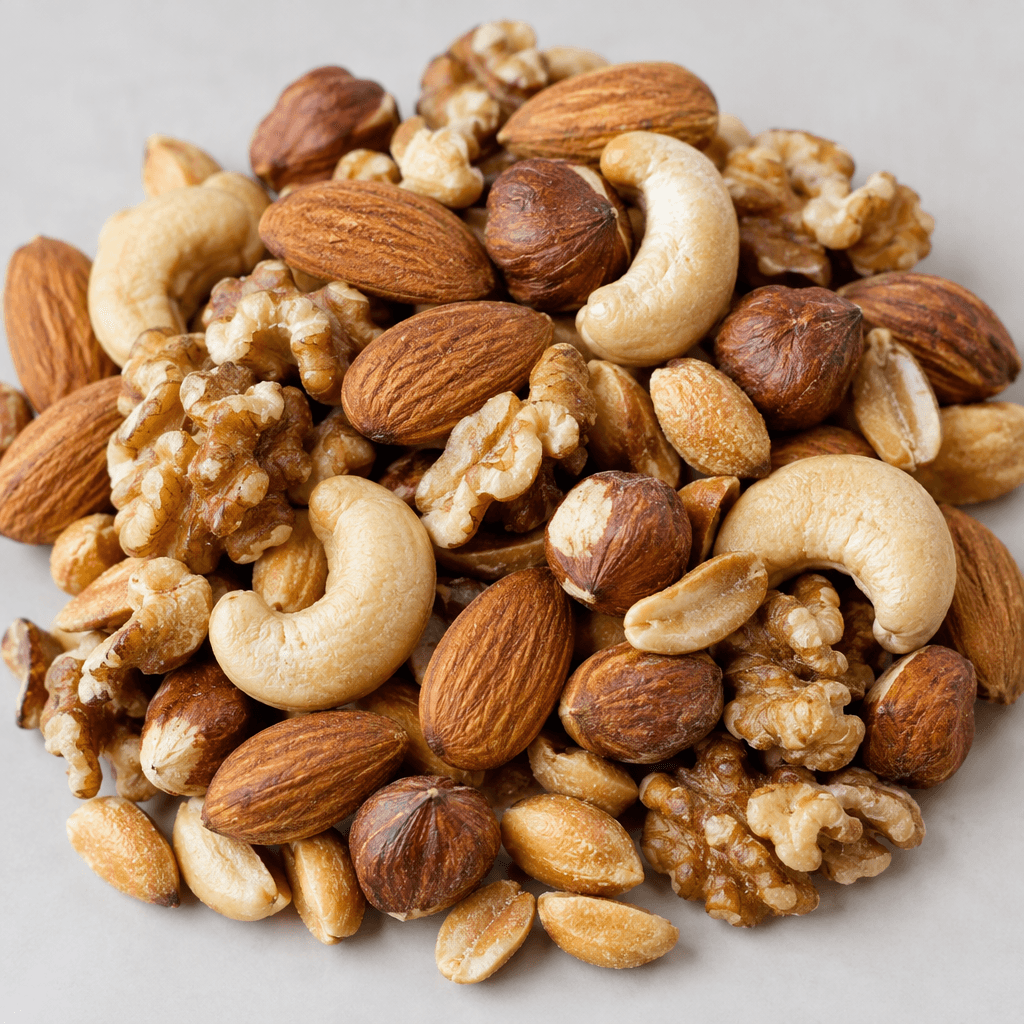
Mixed Nuts Calories
Source of protein and healthy fats, rich in magnesium and vitamin E
In season: Spring · Summer · Autumn · Winter
CALORIES
GI
POTASSIUM
FIBER
Quick answer
1 serving (medium) of Mixed Nuts (30 g) has 180 calories. That works out to 600 calories per 100 g. It contains 6.3 g of carbs, 5.4 g of protein, 15.6 g of fat and 2.4 g of fiber. Its 0.4 mg of Copper covers 40% of the Daily Value. Its glycemic index is 15 (low), so it raises blood sugar slowly.
What is Mixed Nuts?
Mixed Nuts brings together edible nuts such as almonds, cashews, walnuts and hazelnuts; some mixes also include peanuts. There is no single place of origin or fixed recipe—the varieties and whether they are roasted can differ from one blend to another.
They are commonly eaten by the handful as a snack, added to porridge or yoghurt, or put out for sharing with drinks. Their texture is crisp and varied, with a rich, nutty flavour that can be gently sweet or earthy depending on the pieces. Mixed Nuts provides protein alongside plenty of fat and some fibre, so a small portion can feel satisfying. A handful of about 30 g is a useful guide; choose an unsalted mix if you want to keep the overall taste simple.
Mixed Nuts Nutrition Facts
Selected: 100 g
600
KCAL / 100G
Carbs
21g
· 8% DV
Protein
18g
· 36% DV
Fat
52g
· 67% DV
Fiber
8g
· 29% DV
DV is the share of the daily value covered, on a 2,000 kcal reference diet.
Calories come from: Carbs 13% · Protein 12% · Fat 75%
Mixed Nuts Vitamins & Minerals
Vitamins
Vitamin E
8mg · 53% DV
Biotin
15µg · 50% DV
B1
0.4mg · 33% DV
B2
0.3mg · 23% DV
Minerals
Copper
1mg · 111% DV
Manganese
2mg · 87% DV
Phosphorus
420mg · 60% DV
Magnesium
220mg · 52% DV
How Nutritious Is Mixed Nuts?
Nutrient density
Very high
How many vitamins, minerals and how much fiber this food carries per calorie. A high score means a lot of nutrition for few calories.
Satiety score
Medium
An EatBetter score computed from fiber, protein and calorie density. A high score means staying full longer on the same calories.
Both scores are calculated per 100 g and do not change with the selected portion. The satiety score is EatBetter's own calculation, not a clinical measure.
Mixed Nuts Glycemic Index
GLYCEMIC INDEX
GLYCEMIC LOAD
Accounts for portion size — a more realistic measure than GI alone.
How to Burn Off Mixed Nuts
To burn the 600 calories in 100 g:
🚶
Walking (5 km/h)
🏃
Running (8 km/h)
🚴
Cycling
🏊
Swimming
Times are calculated with the MET equation for a 70 kg adult. Actual burn varies with your weight, age and pace.
Is Mixed Nuts Processed?
NOVA 2
Minimally Processed
1. Unprocessed
2. Minimally Processed
3. Processed
4. Ultra-Processed
NOVA classifies foods into 4 groups by industrial processing. NOVA 1 (unprocessed) is the healthiest.
Does Mixed Nuts Contain Allergens?
Contains these allergens:
Which Diets Is Mixed Nuts Good For?
Vegan
✓ Suitable
Vegetarian
✓ Suitable
Gluten-Free
✓ Suitable
Dairy-Free
— Not suitable
Mediterranean
✓ Suitable
Paleo
✓ Suitable
Whole30
— Not suitable
DASH
— Not suitable
Keto
✓ Suitable
Low FODMAP
— Not suitable
Mixed Nuts Fat Profile
SATURATED
6g
MONOUNSATURATED
30g
POLYUNSATURATED
15g
Omega 6:3 ratio 25:1
Above the ideal 4:1 (25:1).
Compare Mixed Nuts
Foods Similar to Mixed Nuts
Frequently Asked Questions About Mixed Nuts
Are mixed nuts good for you?
Yes, mixed nuts can be a nutritious snack, combining foods such as almonds, walnuts and peanuts. Choose plain varieties when possible, since added salt, sugar or coatings can change what you are eating.
Do mixed nuts help with weight loss?
They can fit into a weight-loss eating plan, but they do not cause weight loss on their own. Mixed nuts are energy-dense, so portioning out a small serving is more useful than eating from the bag.
How many mixed nuts should you eat a day?
A serving of about 30 grams is a practical daily portion for many people. Measure it into a small bowl; handfuls can vary considerably, and eating straight from a large bag makes it easy to overdo.
Are raw or roasted mixed nuts healthier?
Both can be nutritious. The bigger difference is often whether roasting adds oil or salt, so choose plain raw or dry-roasted mixed nuts if you want to avoid those additions.
Are salted mixed nuts bad for you?
Not necessarily, but salted mixed nuts can add a substantial amount of sodium, especially if you snack on large portions. Choose unsalted nuts more often if you are limiting sodium.
How should you store mixed nuts after opening?
Seal mixed nuts in an airtight container and keep them somewhere cool, dark and dry. Refrigeration can help preserve freshness, particularly in a warm kitchen, because the natural oils can turn rancid.
What nuts are usually in mixed nuts?
There is no fixed recipe: mixed nuts often combine almonds, cashews, walnuts, hazelnuts and peanuts, but the blend varies. Read the ingredient list if you need to know exactly which nuts are included.
Can people with diabetes eat mixed nuts?
Yes, plain mixed nuts can fit into a diabetes meal plan, but sweetened or honey-roasted blends are different. Portion size and individual meal plans matter, so discuss regular servings with your diabetes care team if needed.
Should you soak mixed nuts before eating them?
No, soaking mixed nuts is not necessary. It softens their texture, but there is no established need to soak them for better nutrition; eat soaked nuts promptly rather than storing them damp.
Can you freeze mixed nuts?
Yes, mixed nuts freeze well when kept in an airtight, moisture-proof container. Take out only what you need and let it come to room temperature before opening, which helps prevent condensation on the nuts.
Have another question about Mixed Nuts?
Ask the AI nutrition coach — calories, portions, alternatives and more, answered in seconds in the app.

Scan calories with your camera
Instant AI nutrition analysis

Nutrition data compiled from USDA FoodData Central and scientific sources.