

Ready & Packaged Foods
All →Vegetables & Legumes
All →Desserts & Confectionery
All →Meat & Protein
All →Grains & Bakery
All →Beverages
All →Milk & Dairy
All →

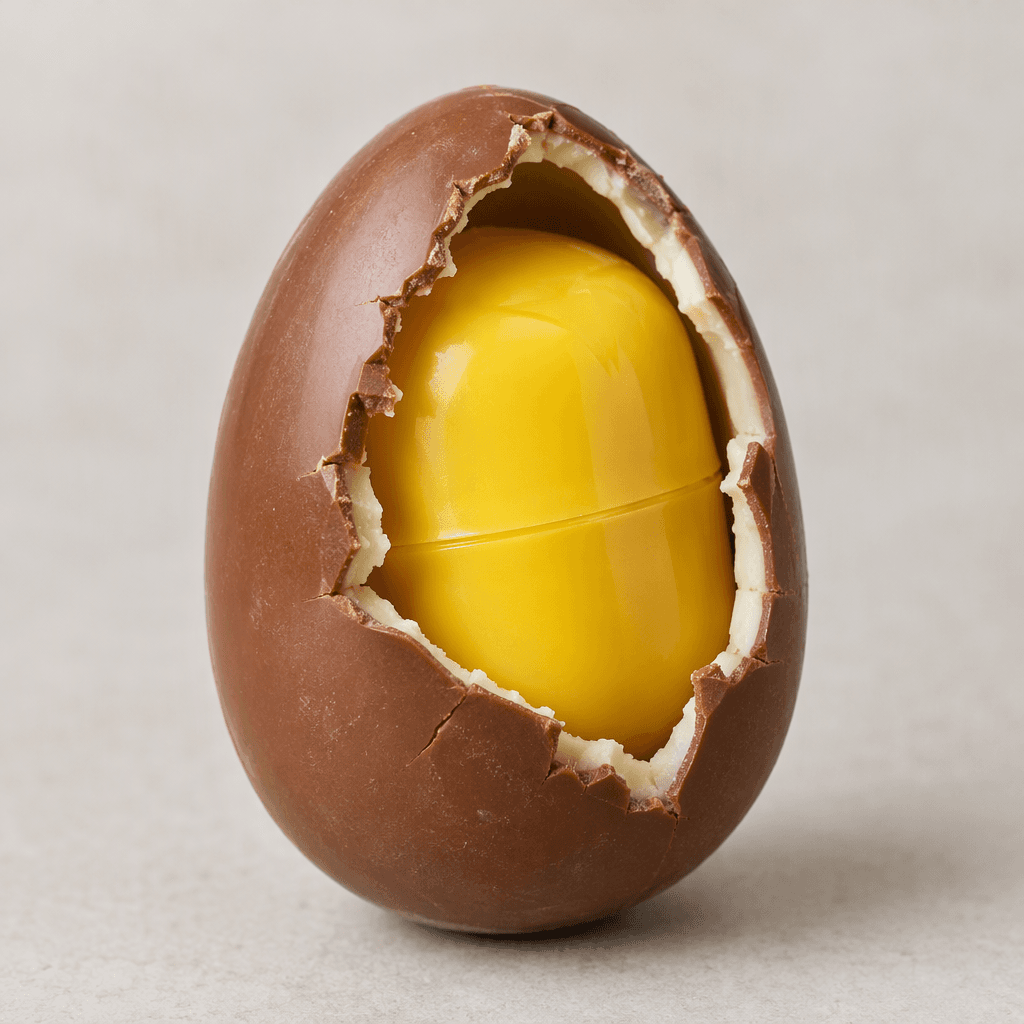
Kinder Surprise Egg Calories
Popular chocolate treat for children, contains a toy.
In season: Spring · Summer · Autumn · Winter
CALORIES
GI
POTASSIUM
FIBER
Quick answer
1 piece (medium) of Kinder Surprise Egg (20 g) has 108 calories. That works out to 540 calories per 100 g. It contains 10.9 g of carbs, 1.7 g of protein, 6.5 g of fat and 0.4 g of fiber. Its 0.1 mg of Copper covers 7% of the Daily Value. Its glycemic index is 55 (medium), so it raises blood sugar at a moderate pace.
What is Kinder Surprise Egg?
Kinder Surprise Egg is a Ferrero confection that originated in Italy: a hollow milk-chocolate shell with a thin white-chocolate layer around a plastic capsule containing a small toy. Breaking the shell and discovering the capsule are part of the appeal, especially for children.
The chocolate is smooth, sweet and creamy, so the egg is usually enjoyed as an occasional treat rather than a substantial snack. It is familiar in many countries as a small gift or surprise for children, and can be shared or eaten on its own. Its nutrition is chiefly from fat and carbohydrates, with less protein and fibre. For a more balanced snack, serve it alongside fruit and keep to one small egg.
Kinder Surprise Egg Nutrition Facts
Selected: 100 g
540
KCAL / 100G
Carbs
54.5g
· 20% DV
Protein
8.7g
· 17% DV
Fat
32.5g
· 42% DV
Fiber
2.2g
· 8% DV
DV is the share of the daily value covered, on a 2,000 kcal reference diet.
Calories come from: Carbs 40% · Protein 6% · Fat 54%
Kinder Surprise Egg Vitamins & Minerals
Vitamins
B12
0.5µg · 21% DV
B2
0.25mg · 19% DV
B5
0.6mg · 12% DV
B1
0.08mg · 7% DV
Minerals
Phosphorus
180mg · 26% DV
Calcium
180mg · 18% DV
Iron
2mg · 11% DV
Magnesium
45mg · 11% DV
How Nutritious Is Kinder Surprise Egg?
Nutrient density
Low
How many vitamins, minerals and how much fiber this food carries per calorie. A high score means a lot of nutrition for few calories.
Satiety score
Low
An EatBetter score computed from fiber, protein and calorie density. A high score means staying full longer on the same calories.
Both scores are calculated per 100 g and do not change with the selected portion. The satiety score is EatBetter's own calculation, not a clinical measure.
Kinder Surprise Egg Glycemic Index
GLYCEMIC INDEX
GLYCEMIC LOAD
Accounts for portion size — a more realistic measure than GI alone.
How to Burn Off Kinder Surprise Egg
To burn the 540 calories in 100 g:
🚶
Walking (5 km/h)
🏃
Running (8 km/h)
🚴
Cycling
🏊
Swimming
Times are calculated with the MET equation for a 70 kg adult. Actual burn varies with your weight, age and pace.
Is Kinder Surprise Egg Processed?
NOVA 4
Ultra-Processed
1. Unprocessed
2. Minimally Processed
3. Processed
4. Ultra-Processed
NOVA classifies foods into 4 groups by industrial processing. NOVA 1 (unprocessed) is the healthiest.
Does Kinder Surprise Egg Contain Allergens?
Contains these allergens:
Which Diets Is Kinder Surprise Egg Good For?
Vegan
— Not suitable
Vegetarian
✓ Suitable
Gluten-Free
— Not suitable
Dairy-Free
— Not suitable
Mediterranean
— Not suitable
Paleo
— Not suitable
Whole30
— Not suitable
DASH
— Not suitable
Keto
— Not suitable
Low FODMAP
— Not suitable
Kinder Surprise Egg Fat Profile
SATURATED
19.5g
MONOUNSATURATED
9.2g
POLYUNSATURATED
1.1g
Omega 6:3 ratio 30:1
Above the ideal 4:1 (30:1).
Compare Kinder Surprise Egg
Foods Similar to Kinder Surprise Egg
Frequently Asked Questions About Kinder Surprise Egg
Is the toy inside a Kinder Surprise Egg edible?
No, the toy inside a Kinder Surprise Egg is not edible. It is enclosed in a yellow plastic capsule inside the chocolate shell; remove the capsule before eating and keep its small parts away from young children.
What is inside a Kinder Surprise Egg?
A Kinder Surprise Egg has a milk-chocolate shell with a thin white-chocolate layer and a plastic capsule containing a small toy. The toy is separate from the chocolate and comes out when you open the capsule.
What is the difference between a Kinder Surprise Egg and Kinder Joy?
A Kinder Surprise Egg has a toy capsule inside its chocolate shell. Kinder Joy comes in a plastic package split into two compartments: one holds cocoa-and-milk cream with crunchy pieces, and the other holds the toy.
Why is the Kinder Surprise Egg banned in the United States?
The Kinder Surprise Egg’s toy capsule is enclosed within the chocolate, which conflicts with US rules restricting non-food objects embedded in candy. Kinder Joy is sold there instead, with the toy kept in a separate compartment.
What age is a Kinder Surprise Egg suitable for?
A Kinder Surprise Egg is not suitable for children under three because the toy and its parts can pose a choking risk. Older children should open and assemble the toy with adult supervision, keeping small pieces out of their mouths.
How do you open a Kinder Surprise Egg?
Carefully crack the chocolate shell of a Kinder Surprise Egg and remove the yellow capsule. Open the capsule and assemble the toy using its instructions; keep the capsule and small toy parts away from young children.
How should you store a Kinder Surprise Egg?
Store a Kinder Surprise Egg in a cool, dry place away from direct sunlight and heat. Once opened, keep the chocolate covered and eat it soon so it does not absorb moisture or other food odors.
Are the toys in Kinder Surprise Eggs always the same?
No, the toy inside a Kinder Surprise Egg can vary by collection and production period. You generally cannot tell which figure is inside before opening the egg, so buying one does not guarantee a particular toy.
Where did the Kinder Surprise Egg originate?
The Kinder Surprise Egg was developed in Italy by Ferrero under its Kinder brand and first appeared in the 1970s. It became known for combining a chocolate treat with a toy hidden inside.
Can a Kinder Surprise Egg melt in hot weather?
Yes, a Kinder Surprise Egg can soften or melt in warm conditions because chocolate is heat-sensitive. Keep it out of a hot car and direct sun; chocolate that melts and sets again may have a changed texture or appearance.
Have another question about Kinder Surprise Egg?
Ask the AI nutrition coach — calories, portions, alternatives and more, answered in seconds in the app.

Scan calories with your camera
Instant AI nutrition analysis

Nutrition data compiled from USDA FoodData Central and scientific sources.